

Tucson-based Raytheon Missile Systems has entered a crowded competition to develop a new aircraft-defense system that can disrupt incoming missiles with a laser beam.
Raytheon recently submitted its bid to become the prime contractor for the U.S Army's Common Infrared Countermeasures (CIRCM) program, which is potentially worth more than $1.5 billion.
At least four other defense companies, including BAE Systems and Northrop Grumman, have submitted proposals for the CIRCM program.
Later this year, the Army is expected to pick at least two contractors to further compete in a 21-month technology development phase. The winner in that phase will develop a production version of its system for deployment by 2016.
Some Army helicopters already are equipped with a missile-defense system made by BAE since 2007.
People are also reading…
The Army is seeking a lighter, more capable and less expensive laser-based system to defend helicopters from heat-seeking missiles - particularly so-called "man-portable" ground-fired weapons.
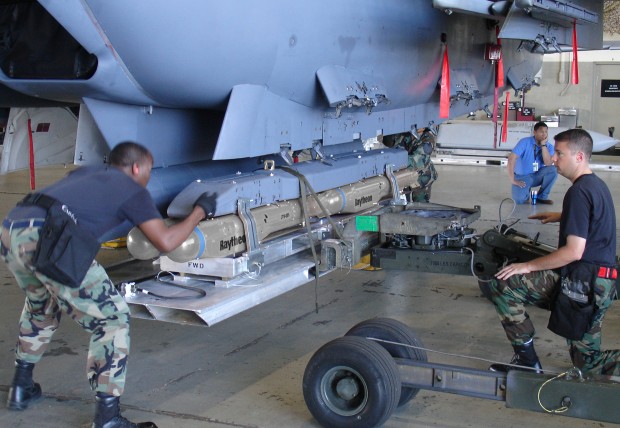
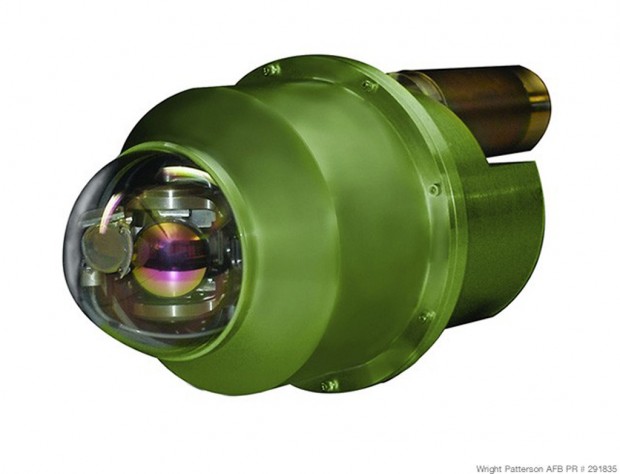
Raytheon's system uses an infrared seeker adapted from its Sidewinder air-to-air missile and turned into a "tracker-pointer" for the CIRCM system, said Mike Booen, Raytheon vice president of advanced security and directed energy systems.
Once the seeker finds a missile threat, "You basically blast a very low-power laser at the missile, and you confuse the missile so it can't see the infrared (heat) signature of the helicopter," Booen said.
The use of the Sidewinder seeker allows Raytheon to offer a technologically mature system that is easily produced and will cost far less than the current system, he said, adding that the system has performed flawlessly in company testing.
"It's a great reuse of technology," Booen said. "It leverages for the Army probably a billion-dollar investment the Defense Department has made in air-to-air missiles."
The Raytheon system uses a Northrop Grumman quantum-cascade laser and commercial off-the-shelf processors.
BAE already makes the missile-blinding Advanced Threat Infrared Countermeasures (ATIRCM) system, which uses infrared energy or laser light. That system works with BAE's Common Missile Warning System, which detects missiles and deploys countermeasures such as flares, metal chaff or the ATIRCM system.
While BAE's ATIRCM system is roughly the size of a basketball, "ours is the size of a baseball," Booen said.
Besides Raytheon, BAE and Northrop, ITT Corp. and Lockheed Martin have bid for the CIRCM program.
A defense analyst said BAE and Northrop may have an inside track on the competition since they already make fielded infrared countermeasure systems.
The Army wants the new system to work with BAE's Common Missile Warning System, which weighs in BAE's favor, said Loren Thompson, analyst and chief operating officer of the Lexington Institute in Arlington, Va.
"When the Army buys a solution to its airborne missile-defense needs, it's better to buy something that will be easily integrated on its helicopters," Thompson said.
Northrop Grumman makes the large aircraft (LAIRCM) system for the Air Force and Navy. Northrop has teamed up with Selex Galileo, part of the Italian industrial group Finmeccanica, for the CIRCM bid.
BIGGEST WORKFORCE
Raytheon Missile Systems is Southern Arizona's largest employer, reporting 10,500 full-time equivalent employees in this year's Star 200 survey.
Contact Assistant Business Editor David Wichner at dwichner@azstarnet.com or 573-4181.