

Prototron Circuits Southwest Inc. started out humble, at least in Tucson.
Parent company Prototron Circuits of Redmond, Wash., was doing work for big-name companies in the Seattle area including Boeing and Nintendo, even building boards for prototypes of Microsoft Xbox game consoles.
But when Prototron owner Dave Ryder bought Southwest Circuits of Tucson in late 1998, Southwest was closed, on the ropes.
"We didn't open again for four or five months," he said.
The Tucson branch had to start from scratch, recruiting customers and updating equipment in the building in an industrial park near the Union Pacific tracks between South Alvernon Way and South Palo Verde Road.
Now, Ryder says, the Tucson operation does about one-third of the company's total work.
People are also reading…
At the time of the sale, a Prototron spokesman said their strength would be speed, knocking out prototypes in as little as three days.
Now, company execs say, they can often take an engineer's circuit plan from drawing to finished bare circuit board in 24 hours.
Prototron produces just bare circuit boards, with the maze of conductive paths that will create a working circuit when the customer attaches components - resistors, capacitors, coils, integrated-circuit chips, input and output connectors.
"It can start out as basic as a sketch on a cocktail napkin," Ryder says of the plans they execute.
"We have turned a board in as little as one shift," says Kevin Pizzuto, regional salesman - a veteran of the business, including a hitch with Southwest Circuits.
There's a division of clients between Redmond and Tucson, Ryder says. Part of it is based on work classifications: Tucson is MilSpec 55110G certified, qualified to build printed circuit boards for U.S. military projects, the kind of work done for Raytheon Missile Systems and other local defense contractors and their subcontractors. It is also ITAR (International Traffic in Arms Regulations) certified, allowed to work on projects in which national security is a concern.
The Redmond operation has more of a commercial clientele, Ryder said.
But not all of the Tucson work is defense-related. There's also a division of work based on geography. Proximity to customers is often an asset, particularly in the prototype stage.
The circuit boards Prototron builds are only part of another company's product. And the technical people designing those boards often like to get face-to-face with the people carrying out their ideas. They want to know if their ideas work - often as soon as possible.
Being physically available to help a customer improve or debug a design is something that gives Prototron an edge, even with non-defense contractors who could use overseas competitors.
Time is money on prototype work. A product can't go into production until a working prototype has been finished, tested, and possibly refined.
Having these strong niche positions - proximity and quick turnaround times - lets the operation survive, but Ryder has no illusions about getting too big. Most large-scale production for U.S. customers went offshore long ago.
There is no beating the Far East manufacturers' prices on mass-production jobs, Ryder said.
There were only 299 printed-circuit-board manufacturers in the United States at the first of the year, down from 2,500 15 years ago, Pizzuto said.
Prototron Circuits may even get elbowed out on some relatively small jobs if the customer crowds too much on price, said Prototron customer R.D. Castillo of Tucson's Mastek InnerStep. Mastek manufactures electronic devices for other companies. "We do anything from one prototype to 10,000," Castillo says. "Prototron isn't supplying us with 10,000. We'll use other companies if we do higher volume, or if we can't meet the customer's price point."
He adds, "They offer bare circuit boards that we choose to buy from them a large percentage of the time because they are local and offer a fast turnaround. They've been great to work with in terms of quality and customer service."
Castillo says Mastek Innerstep once asked, and got, a one-off board made in 24 hours. "Yes," he says, "it worked."
That was due to the efforts of technicians in Prototron's board-fabrication and quality-control maze.
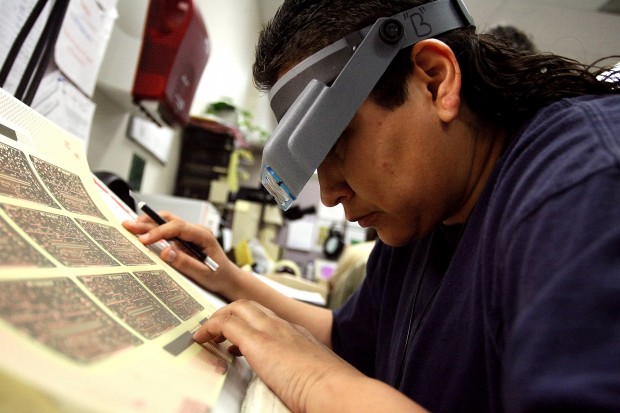
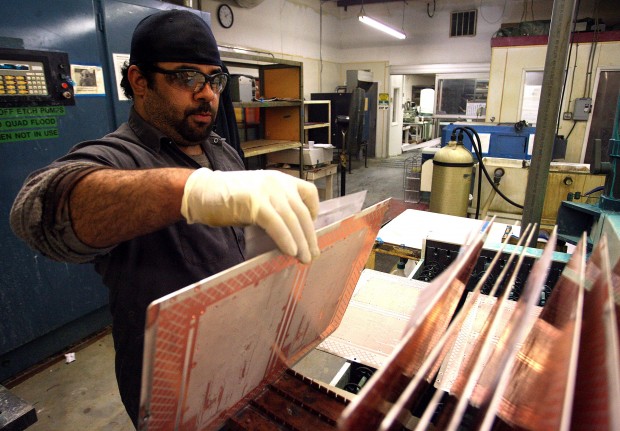
Building the up to 20 layers that make up a finished board, with their maplike "traces" of conductive paths and hundreds of tiny, precisely placed holes into which components' leads are placed, is a process of 20-some stages. And when it's done, there's only perfect or failure. Without the planned hundreds of connections there is no "circuit," just "board."
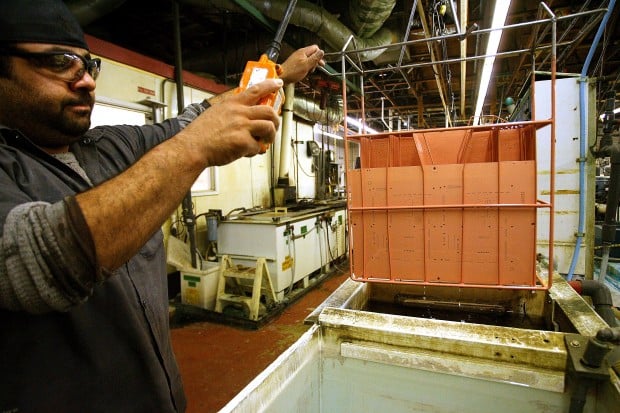
At the end of the line, after all the circuit-board etching, smelly chemical baths and assembly, waits Emma, the Moving Probe Tester.
The $100,000 robotic CNC (computed numerically controlled) tester shoots out and retracts needle probes like a crazed sewing machine, checking conductivity against a CNC map of the board. It issues a pass or fail grade.
Production manager Richard Reynolds says more than nine out of 10 pass. He says it's possible to fix some mistakes, but often faster to make an entire new board - and make a customer wait.
So, quality control is more than a poster slogan in a place that depends on speed for work.
Future work also depends on the economy's rebound.
After all, prototype work depends on customers building new devices. If it just keeps making existing products, there isn't much work in that for Prototron, Pizzuto says.
THE SERIES
Made in Tucson is an occasional series about local companies that make things, how they're made and the people who make them.
If you'd like to have your company highlighted as a subject of a Made in Tucson feature, or have a suggestion on a local manufacturer you'd like to see featured, drop us a note to business@azstarnet.com and use "Made in Tucson" in the subject line. Or, call us at 573-4181 or send a fax to 573-4144.
Production manager Richard Reynolds says more than nine out of 10 circuit boards
pass inspection. He says it's possible to fix some mistakes, but it's often faster
to make an entire new board.
The company at a glance
Prototron Circuits
• History: Prototron Circuits of Redmond, Wash., bought Southwest Circuits of Tucson in late 1998.
• Specialty: Makes "one-off" (prototype) or small- to medium-size batches of bare printed circuit boards.
• Peak Tucson employment: 56 in 2008.
• Current work force: 45.
What is a circuit board?
"Circuit boards are basically a wiring harness," says Prototron Circuits' Kevin Pizzuto.
A circuit board is seldom one board, and at Prototron Circuits can be as many as 20 layers deep. The board layers are like maps, with conductive pathways, "traces," for roads. Components - resistors, capacitors, coils, transistors, integrated-circuit chips, input and output connectors - mounted on the top have their connecting leads connect to one another.
A lead - a stiff wire or metal prong coming out of a component - goes into a hole - a "via" - and connects with some layers' conductive paths, and skips others. For everything to work properly - to form a complete circuit - every layer, conductive path or non-conductive area and hole must be aligned perfectly.
You've seen a circuit board if you've ever opened a computer case, changed a battery in a smoke detector or stepped on a remote control a little too hard. The circuit board is the "green thing."
At Prototron Circuits they aren't all green. Some customers, Pizzuto says, have a signature color that they want used on all their products.
But, for most consumer products, the kind of things we're likely to see, they're green. "I don't know why," Pizzuto says.
The whole purpose of it, a non-conductive (insulator) epoxy, was originally to prevent unintentional connections during the solder process and to protect the copper circuit boards underneath from oxidation.
Dan Sorenson
Contact reporter Dan Sorenson at 573-4185 or dsorenson@azstarnet.com