

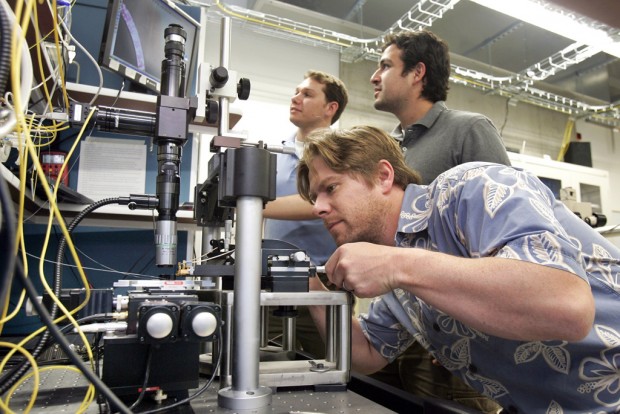

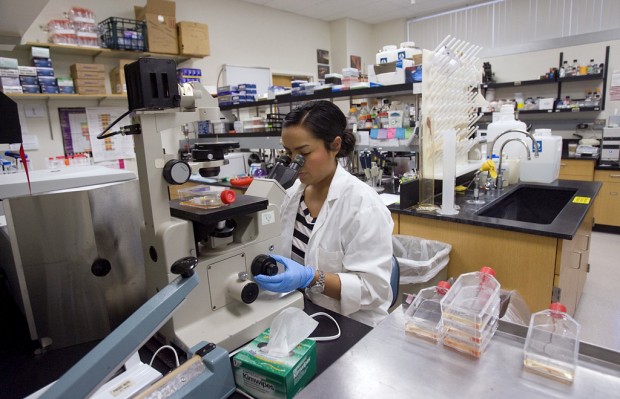
The 13 U.S. patents issued to University of Arizona researchers and faculty members in fiscal year 2010 provide a window onto a range of technological advancements.
These Tucsonans' work could help to do everything from inhibiting the growth and spread of cancer tumors to increasing crop yields to help feed people to creating a super-zippy Internet speed, among other promising developments.
Here's a snapshot of each patent:
1. Title: Biocides.
Issued: July 28, 2009.
The UA's Michael Riggs and Deborah Schaefer, in collaboration with ioGenetics in Wisconsin, are working on a treatment for an intestinal parasite called Cryptosporidium.
The parasite is commonly found in calves and can also harm humans who work with calves on farms, said Riggs, an associate professor of veterinary science and microbiology.
People are also reading…
He said if people with a healthy immune system catch the parasite, they may fight it off in a few weeks, but it's not a pleasant experience. "I managed to catch it myself while working on it," Riggs said. "I wouldn't wish it on anyone. It's very, very bad."
And a person with a compromised immune system may have severe setbacks after catching the parasite and there is no approved treatment for it.
The researchers are continuing trials that began two years ago to develop a treatment, and possibly a vaccine, for the parasite.
2. Title: Methods for decoding corrupt JPEG2000 codestreams.
Issued: Aug. 25, 2009.
Professors Michael Marcellin and Ali Bilgin along with Zhenyu Wu developed a method to decode corrupt computer code in images and videos.
3. Title: DWF4 polynucleotides, polypeptides and uses thereof.
Issued: Sept. 15, 2009.
Kenneth Feldmann, a UA professor of plant sciences, is working with Sunghwa Choe and Ricardo Azpiroz to overexpress certain genes in plants in order to increase the yield.
"The plants get bigger, they're darker green and they can yield more," said Feldmann.
He said they have used the gene with rice and have licensed it to Ceres, a company that develops sustainable crops.
4. Title: Advanced polarization imaging method, apparatus, and computer program product for retinal imaging, liquid crystal testing, active remote sensing, and other applications.
Issued: Nov. 3, 2009.
Russell Chipman, a UA professor in the college of optical sciences, is trying to make invisible structures in the eye visible by probing the eye with polarized light.
With the ability to see these structures in the eye, diseases like glaucoma would be easier to diagnose, Chipman said.
He is working on building a new instrument and hopes a company will license the technology and incorporate it into future optical instrumentation. "It's something that I'm optimistic will lead to a better diagnosis of retinal diseases," he said.
5. Title: Third-order optical autocorrelator for time-domain operation at the telecommunication wavelengths.
Issued: Nov. 3, 2009.
Bernard Kippelen and Seth Marder, former UA professors, developed technology that uses lasers to see a distorted image.
Marder said this technology could be used in medical applications when trying to get a clear image of something inside the body, when other materials are blocking that image.
He said they haven't tried to commercialize it, and may come back to the technology in the future.
6. HYD1 peptides as anti-cancer agents.
Issued: Dec. 15, 2009.
Anne Cress, deputy dean for research in the UA College of Medicine, in collaboration with the University of Florida, is using the HYD1 peptide to block the spread of tumors in patients with cancer.
She said they mainly work with cases of prostate cancer, but the peptide - a chain of amino acids - could also be used in breast cancer.
The peptide keeps the cancer from traveling to distant sites.
"We hope to give our clinical colleagues another therapeutic approach for preventing all the complications of this disease, which is pain and suffering," said Cress.
She said they have done all of the pre-clinical work and are still in the process of testing the peptide.
7. Title: Animal model for perimenopause and menopause and methods of inducing ovarian failure.
Issued: Dec. 29, 2009.
Patricia Hoyer, a UA professor of physiology, along with Loretta Mayer, a former professor at Northern Arizona University, is looking at the effects of menopause or ovarian failure in mice and rats.
This research could be used to control wildlife populations, as a non-surgical method of spaying, said Hoyer.
"People are interested in this all over the country," she said. "The U of A will be recognized as having devised this method and obtain some recognition and credit for it."
8. Title: Silicon refining process.
Issued: March 23, 2010.
David Lynch, a UA professor of mining engineering, is working on a way to decrease the cost of producing silicon used for solar cells through a new purification process.
Lynch said the process could also cut the upfront costs of installing solar panels on a house.
He said the researchers are currently in negotiations with a company to build a pilot plant and if all goes well, they will continue with a commercial plant.
9. Title: Interferometry testing of lenses and systems and devices for same.
Issued: March 30, 2010.
John Edward Greivenkamp, a UA professor in the college of optical sciences, worked with Johnson & Johnson Vision Care, Inc. to develop a method of testing contact lenses.
The university transferred the rights to Johnson & Johnson for a one-time fee, said Amy Phillips, a technology transfer officer for the optical sciences college.
She said Johnson & Johnson uses the technology primarily in-house during manufacturing.
10. Title: Hybridelectro-optic polymer/sol-gel modulator.
Issued: April 6, 2010.
Bob Norwood, a UA professor of optical sciences, Nasser Peyghambarian, Yasufumi Enami and Christopher DeRose are working toward creating a very fast type of Internet speed.
Norwood said this speed of 100 gigabits per second is needed for communication between large cities, or between computers at large companies like Google.
He said there has been some interest in licensing the technology from Tucson-area technology companies.
11. Title: Proteins and DNA related to salt tolerance in plants.
Issued: April 13, 2010.
Jian-Kang Zhu, a former UA professor of plant sciences, and Rebecca Stevenson, a former student, are developing a method to make a more salt-tolerant plant.
When farmers irrigate their fields, minerals may be added and the soil gets increasingly salty. Some plants won't survive in this type of soil, Stevenson said.
She said the researchers are still doing testing and are trying to make a salt-tolerant tomato, corn or wheat.
12. Title: Metabolites of wortmannin analogs and methods of using the same.
Issued: May 25, 2010.
Garth Powis, a former professor of pathology at the Arizona Cancer Center, worked on developing a treatment for tumors by working with metabolites of the fungus Penicillium.
The methods he developed inhibit cancer activity and can be used to treat certain malignant tumors, in a variety of cancers.
13. Title: Methods for modulating angiogenesis with apelin compositions.
Issued: June 15, 2010.
Paul Krieg, a UA professor of cellular and molecular medicine, is working on a method to regulate blood-vessel growth.
He said stimulating blood-vessel growth in patients with diabetes can be beneficial by increasing blood flow to the limbs.
On the opposite side, Krieg said blocking blood vessel growth in patients with tumors will stop the tumor from growing.
Krieg said the researchers have done animal trials, and are talking to companies in California about licensing the technology.
Rikki Mitchell is a University of Arizona journalism student and a NASA Space Grant intern. Contact her at rmitchell@azstarnet.com