

Hospitals across Western New York are getting uncomfortably full as the fall Covid surge continues.
Erie County Executive Mark Poloncarz pointed out Wednesday that Erie County Medical Center, Mercy Hospital of Buffalo and Sisters of Charity Hospital had 100% of their staffed beds occupied as of Monday.
But there's more to the strained hospital capacity than the current spike in Covid-19 cases.
To be sure, Covid is putting more pressure on an overburdened hospital system.
But there are other factors pressuring local hospitals, from employee shortages – which often means fewer beds are staffed – to difficulties discharging patients who need to be in long-term care facilities that don't have room.
"This is not just a Covid issue," said Dr. Sam Cloud, ECMC's associate medical director and an attending physician in the emergency department. "It's more complicated than that."
People are also reading…
Across the five-county Western New York region, 503 Covid-19 patients were hospitalized as of Monday, more than double the roughly 200 such patients just one month earlier. Across the region, 2,149 of the 2,374 staffed acute care beds were occupied, or 90.5%.
Now let's flash back to the last time Western New York had 503 Covid-19 hospitalizations: Jan. 16. On that day, according to state Health Department data, 1,826 of 2,545 acute care beds were full, or about 72%. That's 323 fewer patients at a time when the region had 171 additional beds available.
There's no question that Covid-19 is a significant issue in hospitals' daily struggles, especially considering the majority of those hospitalized with the virus have decided against getting a vaccination that has been readily available for much of this year.
But it is just one factor that is pushing capacity to the brink.
Staffing shortages mean fewer beds
Perhaps no topic has dominated the health care conversation this year more than staffing, which was the primary issue that led to a 35-day strike at Mercy Hospital in South Buffalo.
The pandemic, which helped convince many health care workers to retire, switch fields or quit, put a spotlight on the issue.
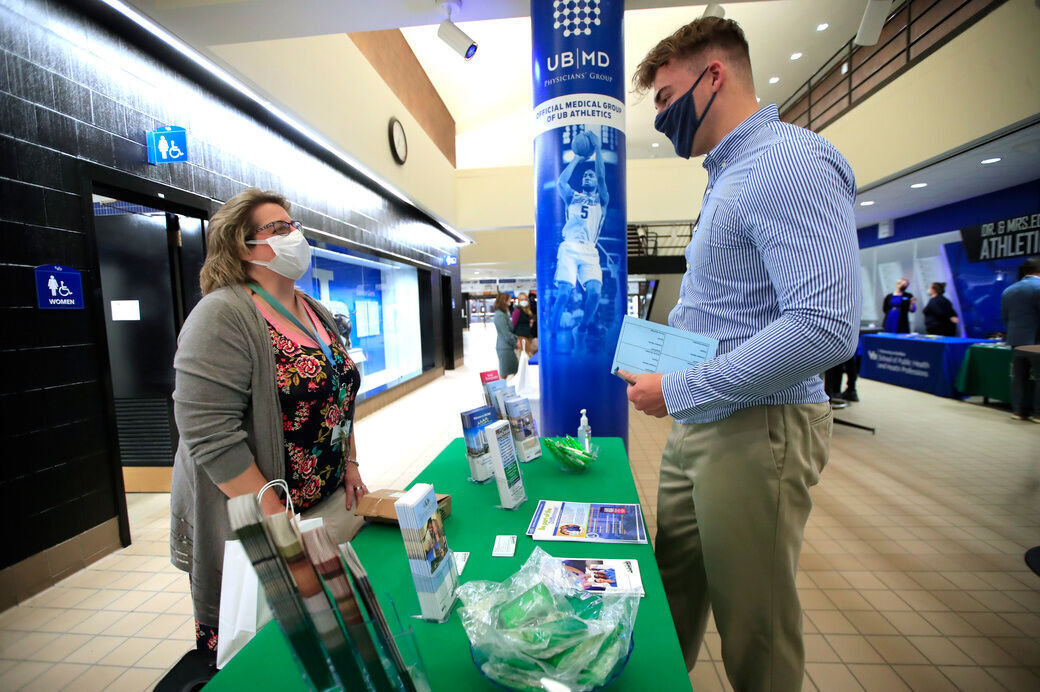
Health care employment across the country is down by 524,000 since February 2020, with nursing and residential care facilities making up about 80% of the loss, according to the U.S. Bureau of Labor Statistics.
"We are maxed out. We are tapped out," said Sarah Dempsey, a registered nurse who works in a Covid-19 unit at Millard Fillmore Suburban Hospital. "There's only so much we can do. People are leaving the profession."
Health care employment across the country is down by 460,000 since February 2020, according to the U.S. Bureau of Labor Statistics.
Many workers who stayed in the field also have opted to chase higher wages with travel agencies, noted Martin Boryszak, Catholic Health's senior vice president of acute care services.
In addition to losing workers, the local health systems also are filling their staffing shortfalls by contracting with those same travel agencies for workers who can cost three to four times more than permanent employees.
"That has absolutely drained our resource pool," Boryszak said.
All of this means hospitals can't staff as many of their beds.
For example, Millard Fillmore had a total of 289 staffed acute care beds and 23 staffed intensive care unit beds on Monday, which was down from 323 staffed beds and 38 ICU beds a year ago, according to State Health Department data.
At Mercy Hospital, still ramping up following the strike, all 230 staffed beds and all 21 ICU beds were occupied Monday. One year earlier, Mercy had 316 staffed beds and 45 staffed ICU beds.
That staffing situation could worsen in the next few days as a few hundred unvaccinated local hospital workers who previously secured religious objections to the vaccine mandate lose those exemptions.
Difficulty discharging non-Covid patients
One of the only Western New York hospitals that had more staffed beds Monday than one year ago was ECMC.
Its hospital is licensed for 573 beds but, on Monday, it went beyond capacity and had 576 beds – all of which were occupied.
"This is unprecedented at ECMC," Cloud said. "It's a real pressure cooker right now."
Aside from more Covid-19 patients, ECMC also is struggling to get non-Covid patients out of the hospital.
Cloud said the average patient coming to ECMC is sicker than they were before the pandemic, meaning it's more likely they'll be admitted to the hospital and require more resources once they're there.
Depending on the day, ECMC is holding anywhere from 47 to 51 Alternate Level of Care patients, who are people who no longer need to be in a hospital, he said. These patients need to be in nursing homes, rehab facilities or group homes, but ECMC is having difficulty discharging those people because those facilities also are understaffed and unable to operate as many beds.
"We are holding onto 50 patients on average who don't need to be in a hospital but we don't have anywhere to put them," Cloud said.

If things get much worse, Erie County Executive Mark Poloncarz warned Wednesday, the county may have to order all elective surgeries canceled or postponed at the area's hospitals.
Cloud said ECMC's previous high of Covid-19 patients came on Jan. 5, with 75 people. That same day, ECMC had just 16 ALC patients.
Now as cases again approach that total – ECMC had 72 Covid-19 patients hospitalized Wednesday, 57 of whom were unvaccinated – the hospital has about 50 beds already tied up with patients who can't find a spot in other facilities.
Seeking to alleviate some of the burden at nursing homes, Gov. Kathy Hochul on Wednesday announced the deployment of 60 National Guard medical teams to various long-term care facilities across the state "where the need for additional resources has been identified."
Controlling the controllable
With Covid cases rising, local hospitals once again are cutting back on optional procedures as a way to keep beds available for sick patients.
ECMC, for one, hasn't done inpatient elective surgeries since September.
Starting this Friday, under an executive order signed by Hochul last week, the Health Department will be allowed to limit nonessential, nonurgent procedures at hospitals with less than 10% of staffed beds available. As of Thursday, 56 hospitals across the state met that criteria, including eight in Western New York.
Hochul said Thursday the state is in touch with the hospitals, local health departments and elected officials to figure out how to get more health care workers inside the facilities.
"It is absolutely not a shortage of beds," Hochul said. "It's a shortage of people to staff the beds."
Bea Grause, president of the Healthcare Association of New York State, said hospitals "surge and flex every single day" to maintain essential community services.
"Many hospitals have already been modifying their elective surgery schedules to accommodate the increased number of patients they are seeing and the workforce shortages they are facing," she said.
'Back to Covidland'
But make no mistake, Covid-19 is back, and it's making an already bad situation within hospital walls even worse.
Dempsey, a 29-year-old who has worked at Millard Fillmore for three years, said she and her fellow nurses know they're "back to Covidland."
Dempsey works in a Covid unit on the hospital's third floor and said it feels like it's starting to get as bad as it was last winter.
"Now with the holidays, of course, it's going to be history repeating itself," she said.
State data shows Millard Fillmore had 67 Covid-19 patients hospitalized Monday, compared with 81 one year earlier.

A nurse takes to Facebook to give people insight into a Covid-19 unit, and hopes that they would start wearing masks and respecting science.
It puts even more pressure on the workers who remain. The stress mounts every time nurses have to dress up in full personal protective equipment and make uncomfortable decisions about which Covid-19 patient to see first, Dempsey said.
"We're only one person," she said. "We only have two hands. We can only spend so much time in each room and worry and wonder about the next one."
What's burning out health care workers even more, Dempsey said, is coming into contact with so many unvaccinated patients.
"It's harder and harder to go to work because many of these patients are unvaccinated, and many of them still don't have any intention of getting the vaccine when they can or taking the proper treatments while they're there," she said.
If they won't get vaccinated, Dempsey at least hopes those people will "be smart," staying away from big groups and taking other preventative measures.
If they don't, it's very likely the hospital capacity crunch will get even worse.


