
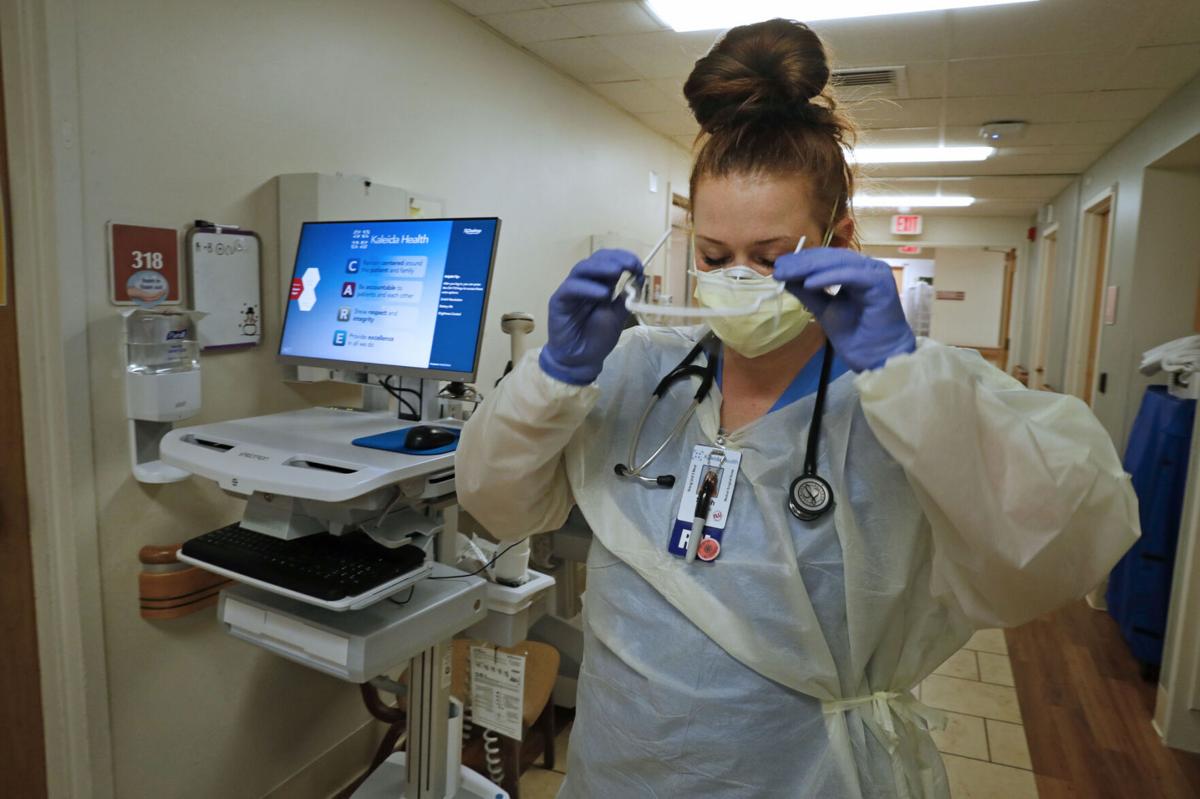
Sarah Dempsey’s thoughts were sitting heavy.
She’s 28, married with a 3-year-old and an infant, and a year and a half into her career as a registered nurse. She leaves her family most days a little after 6 a.m. for bone-tiring, 12-hour shifts in a Covid-19 wing at Millard Fillmore Suburban Hospital that is busier now than it was in the spring, when the pandemic began.
Treating Covid-19 is intense and clustered. When Dempsey and other medical staff walk into a room, they don full personal protective equipment and take care of every possible need: checking vitals, changing a dirty bedpan, or even just providing an assuring conversation. When they exit the room, where the coronavirus was in the air and on the surfaces, the PPE comes off and they switch into new gear before walking in to see the next patient.
There are so many patients, so many rooms. And Dempsey knows – and the data backs her up on this – that the caseload is coming from a Covid-19 spread that is driven by people getting together without masks. If a patient needs something – even a drink of water – they may have to wait longer than they should because of the overload.
People are also reading…
The hospital needs more staff or fewer patients – and since Dempsey can’t go out and hire nurses, she decided to do what she could: Give people insight into a Covid-19 unit, and hope that they would start wearing masks and respecting science.
One Monday afternoon in November, she opened Facebook and began typing a 269-word missive that began with “A nurse’s thoughts…”
In this installment of “Pandemic Lessons,” we dive into Dempsey’s thoughts as a window into the realities of nurses and other medical professionals who are charged with helping and healing the people hit hardest by Covid-19.
What does she want you to know?
Quite a lot.
In this post – one of many she wrote – Dempsey emphasized that for nurses, Covid-19 “is our normal.”
It’s an abnormal normal – “I still cannot believe this is our current reality,” she wrote – and a messy, still-dangerous one, especially for people in hospitals.
“We’re tired and we’re used to it,” Dempsey wrote. “We do our best to care for and treat this virus to the best of our ability given the limited knowledge we have at this point. These people are really sick. We’re used to that. I don’t want to be ‘used to it’ anymore.”
Dempsey views nursing as an artform, one that encompasses science, compassion, resilience, teamwork, creativity and connection. It was a source of happiness and purpose for her when she returned to it in August, after a three-month maternity leave during which she dealt with postpartum issues. Even as hospitalization numbers rise across the region, it still gives her a greater purpose every day. But every day brings frustration, too.
“I pour my heart and soul into my craft,” Dempsey told The Buffalo News recently in a conversation about her Facebook posts. “During this pandemic, it is extremely disheartening that my patients will not get my best because it is physically impossible.”
That’s what happens when hospitals get overpacked. Western New York’s Covid-19 hospitalization rate, as a percentage of the population, is .04%, according to numbers released Dec. 12 by the state. (The overall New York average is .03%.) The region also has 285 patients in intensive care, which accounts for 53% of the available ICU capacity.
If those numbers alone don’t sound high, consider this too: Covid-19 is a still-new and complex condition. Medical professionals have learned much about how to treat it, but that’s over months – not the years and decades spent combating other illnesses.
So Dempsey keeps pushing herself to help each patient and family with every bit of her energy. “You are my lifeline,” a patient’s child told her recently. “The only connection I have to my dad is you.”
And she keeps pushing people on the outside to get smarter and dig deep for empathy. On Facebook, she wrote: “If you’re not concerned because it hasn’t directly affected YOU or your family (yet) ... then YOU are a big part of the problem. (Plain and simple: selfish).”
What’s the one most important thing people can do to cut down on the spread?
Stop household gatherings.
Other activities are dangerous – particularly ones that are unmasked, less-distanced, minimally ventilated and longer in duration, like eating in many restaurants. But at-home gatherings that mix people from multiple households are the worst, because they combine the most dangerous elements of dining out or going to a bar with a false sense of comfort. Being in the home of a relative or friend feels safe and comforting. But it doesn’t stop a virus.
In fact, it helps the virus spread.
Gov. Andrew M. Cuomo revealed last week that state contract tracing data indicates 74% – or three of every four instances – of traceable Covid-19 exposures from September to November happened because of household and social gatherings.
Dempsey and her colleagues could have guessed that. She tried to warn people.
“Remdesivir, dexamethasone, plasma. Repeat,” she wrote in mid-November. “If you’d like to do without the Covid Cocktail, consider skipping Friendsgiving this year.”
Several days later, on the holiday itself, Dempsey wrote, “Happy Thanksgiving from the Covid unit. I hope you’re all staying safe and being smart. It’s as simple as enjoying your turkey and stuffing with the people you LIVE with. We would greatly appreciate it.”
Soon she will be issuing those warnings again. “This Christmas, we know it’s coming,” Dempsey told The News. “It’s the most depressing thing. This is a foreshadowing you’d never expect in life.”
Stopping the spread as we head into winter is priority one. But looking longer term, how concerned should we be about the health of nurses, doctors and other medical workers?
Enormously concerned.
“There are going to be serious psychiatric and psychological consequences for health care workers,” said Dr. Karen Swartz, a psychiatrist who is director of clinical and educational programs at the Johns Hopkins School of Medicine Mood Disorders Center. Speaking during a November conference hosted by the Association of Health Care Journalists, Swartz shared a list of likely issues, including post traumatic stress disorder, anxiety, depression and possibly suicide.
The “psychological consequences,” Swartz said, are “going to be growing with time. It is probably going to be six to 12 months after we have a vaccine and a sense of control of the virus itself that I think we’re going to see peaks in the need for supportive care – when people have the time to actually look back at what they have survived to go forward.”
Speaking on the same conference panel, another Johns Hopkins official noted a national survey during the pandemic in which 67% of nurses who responded indicated they are planning to leave their jobs.
“Along with the physical, emotional and spiritual exhaustion that many of them are experiencing, they’re also experiencing moral suffering – and that’s different from burnout,” said Dr. Cynda Hylton Rushton, a registered nurse who is professor of clinical ethics at the Johns Hopkins Berman Institute of Bioethics. “Moral distress is that experience that arises when we know what we ought to do but we’re unable to act on it, because there are some kind of constraints. In the pandemic, there are lots of constraints, largely out of our control.”
At the end of the panel, when Rushton was asked to offer a headline of a story she thinks journalists should be writing, she said, ‘Who will care for you after Covid when there is no health care workforce?’ ”
Will Sarah Dempsey stay with the job?
Her own words answer the question.
“This isn’t just our career,” she wrote last month. “It’s our calling.”
She’ll be there. But unless those of us on the outside of the Covid units start changing our behavior, the patients will be there, too – in numbers that are dangerously high.
Note: Do you have a topic or question you’d like to see explored in an upcoming installment of “Pandemic Lessons”? Send it to Tim O’Shei at toshei@buffnews.com or via Twitter (@timoshei).