

![315762[1]](https://bloximages.chicago2.vip.townnews.com/tucson.com/content/tncms/assets/v3/editorial/5/36/5368db09-7f03-57ad-9595-e0ad14994041/69a0a85d37f47.image.jpg?resize=750%2C500)
CINCINNATI – An art deco train station opened here to nationwide acclaim during the Great Depression, built by two renowned railroad architects a mile and a half from downtown.
The station’s use peaked during World War II, but as trains gave way to planes and automobiles, the station fell into disuse and disrepair.
That changed about 20 years ago, when Cincinnati turned the architectural marvel into the city’s largest cultural attraction – the renamed Cincinnati Museum Center at Union Terminal. Attendance reached 1.3 million last year.
“People love this place,” said Katie Webb, the station’s assistant manager of admissions. “It’s one of the places you take people from out of town.”
Many people in Buffalo yearn for that same outcome at the city’s Central Terminal.
People are also reading…
Both art deco stations share much in common, such as the same architects, Alfred T. Fellheimer and Steward Wagner, and the decline up to and after Amtrak left both stations in the 1970s.
But that’s where the similarities end.
Central Terminal – with its 17-story tower, grand concourse and baggage building – is located in one of Buffalo’s most depressed neighborhoods. The cavernous complex has been empty for 36 years, waiting for a private developer to spend tens of millions of dollars on needed repairs.
Meanwhile, Cincinnati’s 10-story limestone, concrete and glass Union Terminal, located in an industrial area, basks in its resurrection.
Cincinnati turned its albatross into a civic treasure because residents voted to raise taxes – expected to exceed $200 million – to help pay for the full restoration and maintenance.
“The reuse of this building has been a great success,” said Margo Warminski, a director with the Cincinnati Preservation Association. “It’s very popular with the public, and as one of the city’s icons, it definitely adds to the idea of Cincinnati on the move.”
Attractions boost economy
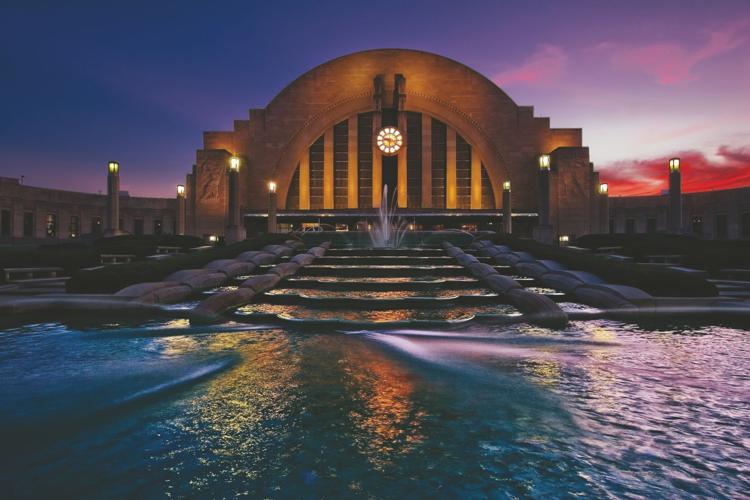
Union Terminal can be found on some 300 acres in Queensgate, an industrial area about 1.5 miles northwest of downtown. It’s the main reason that people take Ezzard Charles Drive – named for the former heavyweight champion known as “the Cincinnati Cobra” – into Queensgate. The route takes them down a long, landscaped entrance to the station, fronted by a mint-green, scallop shell-shaped fountain and pool.
Large bas reliefs – signifying transportation and commerce – flank the station’s entrance. A one-story clock reigns above.
An explosion of shapes and colors await visitors inside the 106-foot-tall, 180-foot-wide half dome – the largest in the Western Hemisphere.
Large spheres of yellow, orange and brown, separated by bands of silver, fan across the ceiling. Rays from the sun refract through a massive, half-domed window. Two large and colorful glass tile and plaster mosaic murals – totaling 108 feet – tell the story of Cincinnati’s transition from farming and rural life to skyscrapers and city living.
Art deco letters spell “Scripps Howard Newsreel Theater” and “Outgoing Taxis and Motor Coaches.” Other details further bring the station’s glory years to life.
On a recent summer day, groups of children, some wearing camp T-shirts, stepped off school buses. They gathered on the terrazzo floor, before being herded into the children’s museum on the lower floor, or the Robert D. Lindner Family OMNIMAX Theatre, where giant reels of film could be seen through the glass-enclosed projection booth.
The attractions benefit Cincinnati’s economy. Officials estimated the local impact at $114 million during a 12-month period ending July 2014. The University of Cincinnati Economic Center study also cited $425 million in benefits to tourism-related businesses, along with 1,278 local jobs created.
Some 216 trains a day pulled into Union Terminal – built in March 1933 for $41.5 million – at its peak.
During World War II, single-day attendance reached 34,000. But demand for trains dropped dramatically after the war, and the number of scheduled trips kept falling until Amtrak left in 1972.
By that time, the nearby residential area had also changed amid the urban renewal projects that swept the country in the 1950s and 1960s.
An area once vibrant with European immigrants, Jews and later African-Americans was dismantled, as was nearby Lincoln Park. City planners had hoped to attract commerce and industry to the area, but many of the expected companies never came.
Meanwhile, the new Interstate 75 cut through a portion of the West End, leaving what Warminski called an enduring “physical and psychological barrier.”
In the 1970s, Union Terminal served as the model for the Justice League of America headquarters in the animated series “Super Friends.”
In reality, it could have used the help of Superman, Green Lantern or Aquaman.
Union Terminal’s next owner, freight operator Southern Railway, sought to tear down the building before the City Council protected it with a historic designation. A 450-foot-long concourse above the platforms was demolished, but not before preservationists forced the relocation of 14 murals depicting Cincinnati industry.
The city took ownership after a shopping and entertainment complex opened in 1978 and closed several years later. Then, a vote in 1986 saved Union Terminal.
Voters support restoration
Voters approved a $33 million tax bond to partially restore and transform the building into the Cincinnati Museum Center.
In 1990, the Cincinnati History Museum, the Museum of Natural History and Science, the Cincinnati History Library and Archives, and OMNIMAX Theatre all opened. Amtrak also returned, providing service for the Cardinal line, which operates three times a week between Chicago and New York. Ridership totaled 13,681 in 2014. The Cincinnati Children’s Museum followed suit in 1997.
In May 2004, voters approved paying for maintenance, operations and minor repairs for five years.
Then, last November, voters supported raising taxes again by increasing the county’s sales tax by one-quarter of 1 percent for the next five years. The extra tax – expected to raise $170 million – will be spent for the station’s full restoration.
That will fix the station’s water damage and deterioration that led to its place on the National Trust for Historic Preservation’s “11 Most Endangered Places” list in 2014.
An additional $38 million needed to complete the restoration is expected to be raised through state grants, private funds and state and federal historic tax credits.
Jason Clement, the National Trust’s director of community outreach, is based in Buffalo, but he spent a month in Cincinnati last October with five other staffers to mobilize support for the vote.
“The threat to Union Terminal was very real,” Clement said. “Core tenants would have been forced to leave the site if the facility was not renovated. But one of the things Union Terminal had going for it was that it’s been in active use for quite some time, unlike our train station, where there is no public use right now.”
Clement said voters in the traditional Republican city proved willing to pay for the restoration with a tax increase because Union Terminal has a clear use and shows success. He hopes Central Terminal can also find a happy ending.
“Driving up to both stations, they are imposingly beautiful structures, and it’s easy to see that having been designed by the same architects, they are kind of like brother and sister,” Clement said.
“The adage ‘They don’t build them like they used to’ absolutely applies to both buildings,” he said. “We are just never going to get buildings like this again.”
Paul Lang, vice chairman of Central Terminal Restoration Corp., said the not-for-profit’s board of directors looked at the Cincinnati station as a model several years ago. But board members concluded that raising taxes, as Ohio voters did, would be a nonstarter in Western New York – even though the $70 million estimated to restore Central Terminal is less than half of Cincinnati Union Terminal’s cost.
Instead, the group, which took ownership of the abandoned station in 1997, issued a request for proposals in April to find a developer, calling that approach the best path forward.
‘Great example’ of reuse
“When you see school budgets being voted down, and there’s a general consensus that people are paying enough in taxes, it seemed we would be setting ourselves up for failure if we asked the general public to be taxed additionally,” Lang said.
How people in Cincinnati reinvented their station impresses Lang.
“I think it’s a great example of how you could reuse these large stations,” Lang said.
“If the individual components fail, you’re also not stuck in another single-purpose space again. They’ve managed to maintain the station’s historic character while reinventing it in a sustainable manner.”
email: msommer@buffnews.com
