

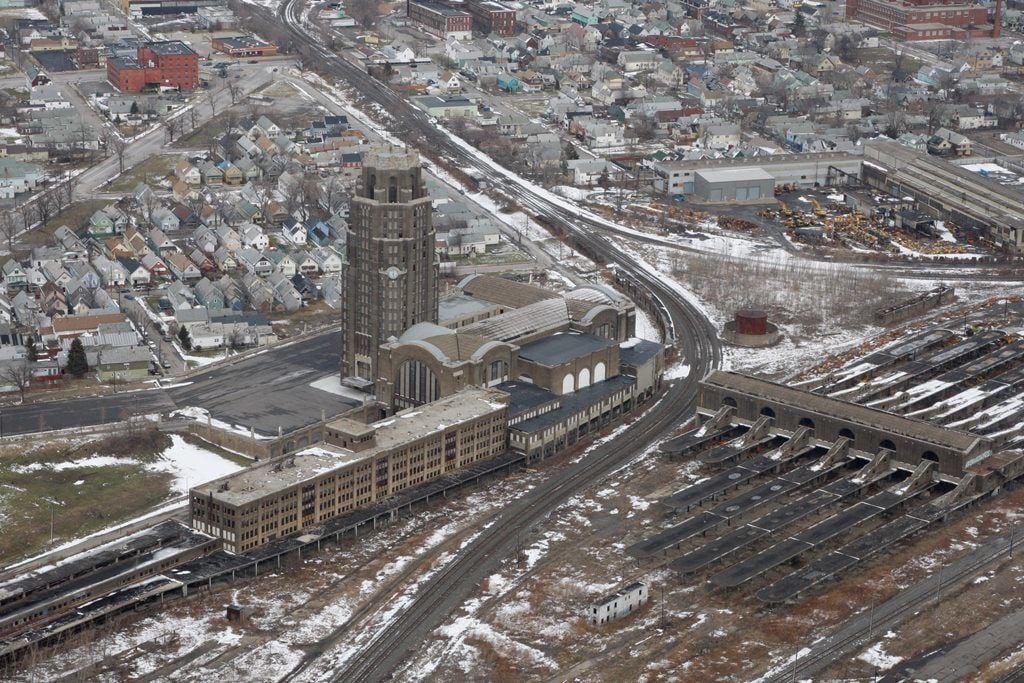
Douglas Jemal already has his hands on the Seneca One tower and Statler Hotel as he negotiates for most of the Richardson Olmsted Campus, but he also has his eyes on what many consider Buffalo's last remaining architectural jewel in need of a rescue.
He wants to save the Central Terminal.
People are also reading…
"I think it's one of the top 10 coolest buildings in the world," Jemal said of the historic art deco building, a train station for 50 years until rail service ended in 1979. "It's phenomenal. I would love to do that one. That one is the coup de grace. It's got to be done."
Jemal, 77, said he has no timeline, but plans to sit down soon to explore the possibility with representatives of the Central Terminal Restoration Corp., the nonprofit that took ownership of it in 1997.
Jemal toured the site a few years ago with Paul Lang, the group's chairman. Jemal was focused at the time on renovating Seneca One and finding tenants, but the 1929 art deco complex left an indelible impression.
"You can create a whole city right there," Jemal said of the 16-story tower, grand concourse and mezzanine and baggage building.
There are also more development possibilities on the site. The City of Buffalo owns 16 acres, as well as a mail building adjacent to the baggage building.
Jemal, based in Washington, D.C., has had considerable success in the nation's capital turning around rundown buildings in distressed neighborhoods. That's why he isn't intimidated by two issues that have long discouraged other developers looking at the Central Terminal – the condition of the Broadway-Fillmore neighborhood and the building's distance from downtown.
"I like revitalization. That's what turns me on. And that area certainly needs revitalization and services," Jemal said. "That's where the challenge begins. That's building."
The Central Terminal's location, about 3 miles from downtown, isn't a drawback, he said.
"It's a short trip to anywhere from there," he said.
Lang hasn't spoken to Jemal since they walked around the site together, but was excited to learn that the developer has the Central Terminal in his sights.
"I kind of thought he forgot about us and focused on downtown," Lang said. "To have someone of his pedigree see the potential validates that what we are doing is worth it, and that it's not unrealistic to believe it can be done, and that it can be done sooner than later."
Lang said Jemal was noticeably intrigued by the 1929 art deco station, which is on the National Register of Historic Places.
"He really liked some of the spaces and saw a lot of potential," Lang said. "Obviously, he had big ideas."
Jemal's knowledge also impressed him.
"It was an informed conversation," Lang said. "It wasn't impractical, like a lot of developers who have nonsensical ideas when they come to us."
Central Terminal Restoration Corp. is going through a community process to develop a master plan for the Central Terminal, which is also expected to help the board evaluate interested developers. It is expected to be completed in late spring.
The organization has worked for nearly a quarter-century to preserve the building and expects anyone who shows interest in the property to honor its mission.
Jemal's other projects in Buffalo show he's not afraid of big challenges, Lang said.
"With the Richardson, he will have taken on three of the biggest white elephant-type projects," Lang said.
Lang, as an architect with Carmina Wood Morris, is helping Jemal obtain historic tax credits for the former downtown police headquarters being converted to residential lofts.
Jemal is spending $150 million to re-create the 38-story Seneca One tower. . When completed, it will be anchored by M&T Bank Corp.’s technology hub, house other technology companies and include 115 apartments and retail space.
Plans for the Statler City complex call for 536 apartments on floors 3 through 18, with the existing banquet and events operations – including ballrooms – remaining on the first two floors, along with retail space.
Jemal also holds the mortgage and expects to complete ownership later this year of the Buffalo Hyatt Regency, a 396-room full-service hotel.
The developer hopes to gain approval at the end of the month to lease three buildings occupied by the former Hotel Henry – which he has said would be renamed The Richardson – and the seven buildings west of the hotel that are expected to need tens of millions in renovations.
But the scale and scope to restore the Central Terminal could be Buffalo's biggest challenge of all.
The vacant 523,000-square-foot complex is the size of nine football fields.
As part of Central Terminal Restoration Corp.'s master plan effort, the SmithGroup, a Detroit architectural and engineering firm, was hired to determine what it would cost to get the buildings ready for development.
That amount is expected to reach into the tens of millions of dollars – at a minimum.
However, Jemal is used to pricey projects.
"Projects like this are what makes your blood flow," Jemal said. "Lets wake it up. Lets go for the whole enchilada."
Mark Sommer covers preservation, development, the waterfront, culture and more. He's also a former arts editor at The News.


