

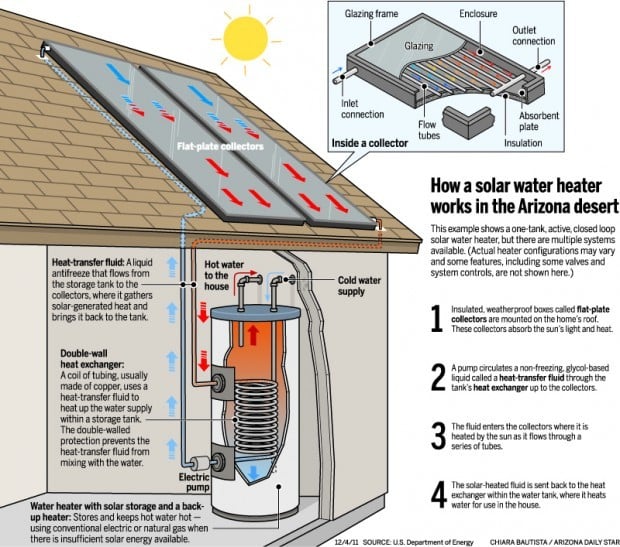
Rooftop solar electric installations get most of the buzz. But another solar technology for turning sunlight into electricity - solar water heating - can also save homeowners money, and can pay off its initial investment much faster.
"For many customers, the first step should be solar hot water," said Joseph DiMatteo, longtime owner of Sunpower of Arizona.
"It's also the most affordable entry point into solar, and if you're a year-round resident, that cost can be about the same as replacing a generic water heater," DiMatteo said.
Solar water heaters, which are generally used in tandem with electric or natural-gas heaters, can knock 50 to 80 percent off your water-heating costs, the Department of Energy and industry sources say.
Depending on usage, a solar hot-water heater can pay for itself in less than 10 years in Arizona. And subsidies including state and local tax credits and utility incentive payments can slash your upfront costs.
People are also reading…
But how much you can save varies, depending on how much hot water you use, the cost of heating your water with electricity or gas, the cost and efficiency of the solar heater and other factors.
Solar hot water guide
Is a solar water heater right for you?
• Hot-water usage: Since the more hot water you use the more money you save with a solar heating system, large households will save a lot more by going solar. For example, a family of four will save a lot more than a two-person household, making the investment pay off much faster.
In fact, solar hot water may not be a good buy for a single householder.
DiMatteo recalls the call he got from a 92-year-old man interested in solar water heating. After learning the man used very little water - he lived alone and generally showered every day at his athletic club - DiMatteo convinced him that a solar water heater might not be a good investment.
• Primary heating source: Most solar water heaters are installed in conjunction with a standard electric or natural-gas heating system, which bring water preheated by solar up to temperature (an important feature on overcast or rainy days, when solar collectors are less productive).
Because electric water heaters are generally less efficient than natural gas and thus cost more to operate, households with electric water stand to save more money than those with gas heaters.
• Penciling out savings: It's difficult to estimate actual savings from a solar hot-water system without knowing the type and efficiency of the system (see below). But reputable contractors should be able to help you make some initial calculations based on the types and models of systems they offer.
Choosing an installer
• Choose a licensed contractor. Installers should have a specific license to install solar hot-water systems. Ask for a license number with the state Registrar of Contractors and check for a current license and complaint history at www.azroc.gov or call 628-6345 (toll-free statewide 1-877-692-9762).
• Ask how long the company has been in business and whether it has operated under other names. Check for complaints with sources such as Better Business Bureau and Angie's List.
• Ask about the professional credentials of the people who will be designing and installing your system.
• Ask friends for referrals. You may also ask a prospective installer for references, and check them, but bear in mind they're likely to steer you to satisfied customers.
• Ask about products offered. Companies that sell and install a range of system types and brands may have a more consultative approach to sales.
• A relatively new local organization, the Southern Arizona Solar Standards Board (www.solarstandards.org) accredits members based on factors including staff certification and requires members to meet minimum standards and ethics.
The board has seven accredited members and four in process of accreditation. But membership isn't mandatory, and some reputable, longtime local installers aren't members.
Choosing a system
Several types of solar hot-water systems use mature technologies. A system installer should help you choose the right system for your budget and situation.
• Active solar water-heating systems feature a pump that circulates water or heating fluid.
• Passive, or self-pumping, systems rely on gravity or thermal effects to circulate water or fluids. Thermosyphon passive systems use natural convection to circulate water. Integral collector, or batch systems combine a collector and storage tank in one unit.
• Open-loop (or direct circulation) systems circulate potable water through solar collectors and into a tank for use.
• Closed-loop (or indirect circulation) systems circulate water or an anti-freeze fluid through collectors and into a heat-exchanger to heat water (see diagram).
• Glazed vs. unglazed: In glazed systems, solar collectors are housed in a glass box to retain more heat and protect components.
Unglazed systems, which may be made of plastic tubing integrated into a thin panel, are less efficient due to heat loss, said Kevin Koch, co-owner of Technicians for Sustainability and a co-founder of the Southern Arizona Solar Standards Board.
The board recommends glazed systems for home hot water, though unglazed systems may make sense for pool-water heating.
Efficiency and savings
• Solar hot-water systems are certified by the Solar Rating and Certification Corp. (SRCC).
• Based on testing, the SRCC assigns each certified solar water-heating system a Solar Energy Factor (SEF) as its performance rating. The SEF equals the energy delivered by the system divided by the electrical or gas energy put into the system. The higher the SEF, the more efficient the system is (most range from 2 to 3).
• You can find SRCC ratings for specific makes and models at www.solar-rating.org online; enter your location and get estimated annual savings in kilowatt hours.
Another solar water-heater performance measure is the solar fraction, or the portion of the total conventional hot-water heating load delivered. The higher the solar fraction, the greater the solar contribution to water heating. According to the Department of Energy, the typical solar fractions are 0.5 to 0.75 (50 to 75 percent).
Read more about system efficiency at tinyurl.com/83x87g6 online, or go to www.energysavers.gov
Incentives
Home solar water-heating systems generally start at about $5,000, but their cost can vary widely based on size, design and brand.
But like other renewable-energy systems, solar hot-water installations qualify for several incentives (funded by taxpayers and utility ratepayers):
• A 30 percent federal tax credit (not available for pool-heating systems);
• A 25 percent state tax credit of up to $1,000;
• Exemption from state sales tax;
• Utility incentives. State-regulated electric utilities handle ratepayer-backed incentives for solar water heaters, whether the primary heating source is electric or gas.
Tucson Electric Power Co. offers an incentive of $750 plus 25 cents per kilowatt-hour energy savings (or equivalent gas savings), based on system rating and other factors, to a maximum of $1,750. (TEP incentives are exhausted for 2011, but the company has proposed similar incentive levels for next year.)
This year, 520 solar water-heating systems were installed with incentives in TEP territory, up from 475 in 2010, the company said.
You can view a list of solar-energy systems installed in Arizona by utility territory, including system costs and incentive payments, at arizonagoessolar.org
Contact Assistant Business Editor David Wichner at dwichner@azstarnet.com or 573-4181.