

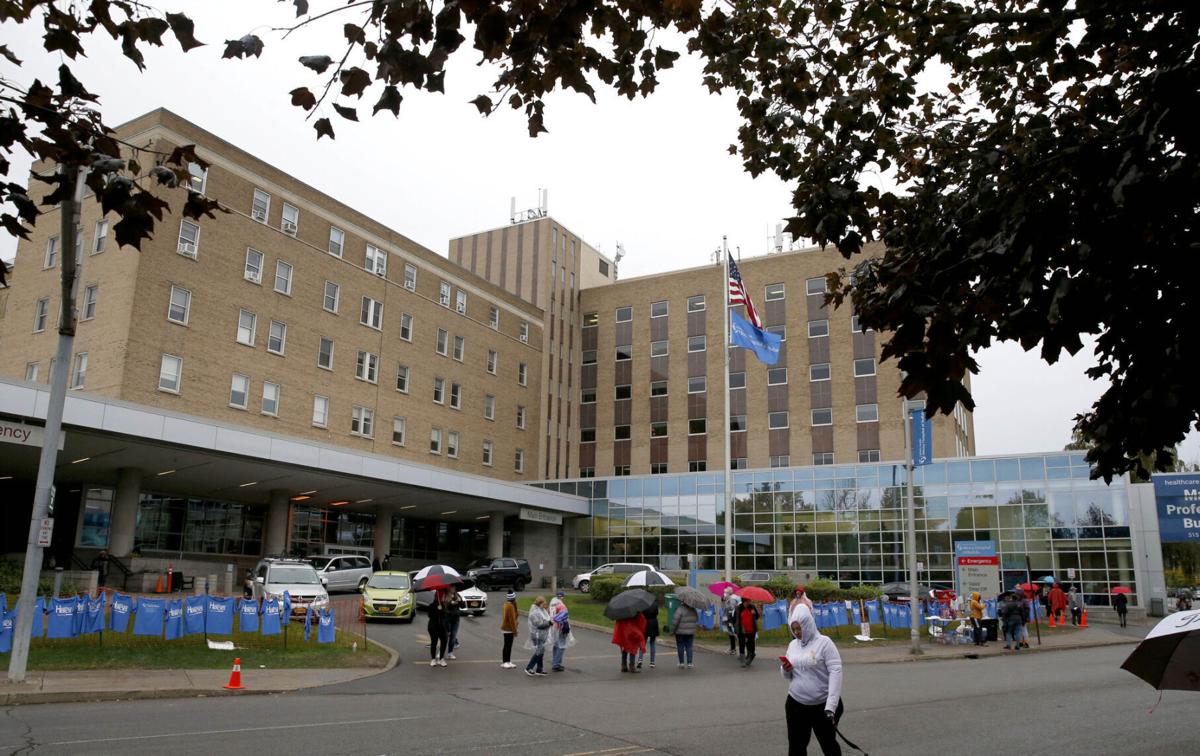
Momentum toward a tentative agreement between Catholic Health System and the union representing 2,500 of its workers came with a compromise Wednesday: The hospital system would reallocate some staffing resources to hit the staffing ratios the Communications Workers of America sought.
By 9 p.m. the next day, a tentative deal was signed and, 35 days into a strike, the picket lines were suspended.
Now, those union members who walked off the job Oct. 1 will review and vote on a deal that many health care officials in Western New York view as setting the bar in future health care labor discussions in the region and beyond, especially as Catholic Health competitor Kaleida Health prepares to negotiate new deals that involve more than 7,000 of its workers.
The deal the workers will vote on – voting times are scheduled Saturday, Sunday and early Monday – includes specific staffing ratios, a difficult guarantee to get from hospitals because ratios increase costs and can often hinder flexibility, health care officials say. If members ratify the four-year agreement, about 2,000 workers could be back within the walls of Mercy Hospital by Wednesday.
People are also reading…
"The staffing ratios we’ve won in this historic tentative agreement are some of the strongest in the country and can serve as a model for other hospitals," CWA Area Director Debora Hayes said in a statement Friday.
Catholic Health said it is one of most progressive staffing plans around, a plan that "goes far beyond" New York's safe staffing law that is set to go into effect in January.
Gov. Kathy Hochul took notice of the agreement in her hometown, issuing a statement just before midnight.
"This contract could be a national model for recognizing our health care workers, and I urge both sides to make their agreement permanent as soon as possible so that together, Mercy Hospital and its workers can continue to play their critical role in servicing and caring for the Buffalo community," Hochul said.
Contract details
Catholic Health and the CWA – Locals 1133 and 1168 – weren't talking Friday about the deal reached the night before, staying quiet to allow union members to digest the contract's details before voting on it. The tentative agreement was reached on six labor contracts across Mercy Hospital, Kenmore Mercy Hospital and Sisters of Charity Hospital, St. Joseph Campus. Each hospital and bargaining unit will vote to ratify its own contract.
The deal includes wage increases each year, according to a summary of the agreement the union posted online.
In the first year, the average registered nurse wage increase is 6.3%, while service, technical and clerical staff will see an average increase of 8.4%, with those raises retroactive to June.
General wage increases will follow: 2% effective June 2022, then 2.5% in June 2023 and 2.75% in June 2024.
In addition, the union's summary notes, "no worker will start below $15 an hour." Some union workers, particularly dietary aides and environmental services workers, currently make as little as $13.45 an hour, a low wage that has made it difficult to retain the staff needed to keep the hospital clean and operating.

Competition for low-wage workers has intensified as employers struggle to find entry-level and part-time employees, giving those workers more employment options to consider.
On benefits, the union said health care cost-sharing for current employees will remain the same, and there are no changes in the pension plan.
The highlight of the deal, however, is the staffing agreement.
The union said the staffing language includes ratios that will need to be in effect by Jan. 1, 2023. That is the same day New York's safe staffing legislation mandates that hospitals in the state implement staffing plans, which must be adopted and submitted to the Health Department by July 1, 2022. The first step in the safe staffing legislation is for hospitals to create a staffing committee by Jan. 1, 2022.
Those ratios include:
• In critical care, a registered nurse-to-patient ratio of 1:2 or 1:1, dependent on acuity, with a ratio of 1:5 for ancillary staff such as nurse's aides and immediate treatment assistants.
• In step-down units, a nurse-to-patient ratio of 1:3, and 1:6 for ancillary staff.
• The medical-surgical ratios vary by the type of unit and patient acuity, but include nurse-to-patient ratios of 1:4 during the day and 1:5 at night.
Catholic Health also has committed to hiring more than 250 new positions. The union views the ratios as a major win, something that was a priority after some of its registered nurses reported caring for as many as 10 patients a shift during the pandemic.
And, the union summary notes, strong language in the agreement requires Catholic Health to hire staff to meet the ratios with specific timelines. Last, there is bonus pay for workers who pick up additional shifts, as well as an additional penalty added to that bonus if the staffing ratios are not met. That penalty begins immediately once workers return.
"Our staffing model is the most progressive approach to address staffing shortages of any hospital in our region," Sullivan said in a statement Thursday night.
The deal's influence
So far, nobody is arguing with Sullivan's statement.
Historically, hospitals have been averse to staffing ratios, seeing them as cost-heavy and inflexible, said Larry Zielinski, a former president of Buffalo General Medical Center who noted the practice of staffing ratios started in California.
"They require shift-by-shift management," said Zielinski, an executive in residence for health care administration at the University at Buffalo School of Management. "If you have a call-in or an unexpected absence, they’re very difficult to respond to and just to track administratively."
Importantly, he noted, after reading that union summary on the deal, that the agreed-upon ratios vary in some cases by acuity, essentially the measure of a patient's severity of illness.
That should provide some flexibility to the hospital, which will be spending more money to hire people, meet ratios and provide bonus pay. Zielinski also said those added expenses have to go somewhere, predicting it could influence the hospital during negotiations with insurance companies.
"They could ultimately be passed on to insurance companies and then employers and consumers," he said.
Beyond the costs, Zielinski and others believe the Catholic Health deal will have a big influence on upcoming negotiations in Western New York.
Look no further than Kaleida.
Michael Hughes, senior vice president and chief administrative officer at Kaleida, confirmed the health system has a total of 7,307 union employees whose contracts expire at the end of May. Hughes did not provide a comment on how the Catholic Health deal will influence upcoming talks at Kaleida.
But CWA Local 1168, which represents a couple hundred workers at St. Joseph Campus and was involved in the Catholic Health talks, represents 3,660 employees at Kaleida, according to a count Hughes provided Friday.
"It's going to be negotiated by the same CWA-level people from the region, and they’re going to be absolutely emphasizing the same things," Zielinski said. "I’m sure that Kaleida is going to have the same kind of issues that Catholic Health had, especially with the staffing ratios."
He likened it to an auto worker negotiation in Detroit: "When Ford strikes a deal, it affects GM."
What the Catholic Health-CWA talks also make obvious, Zielinski said, is that it's a different era for these kinds of agreements. For Kaleida and others, he noted how an urgency to get a deal done long before the deadline could be the way to go.
Otherwise, negotiators could find themselves bargaining deep into the night, weeks into a strike, just like Catholic Health and the CWA did at the Gateway building in Hamburg.
But late Thursday night in Hamburg, both sides were able to grab carts, load up their paperwork and supplies and pack up their vehicles.
Then, they went home, without a need to come back for the first time in months.

