

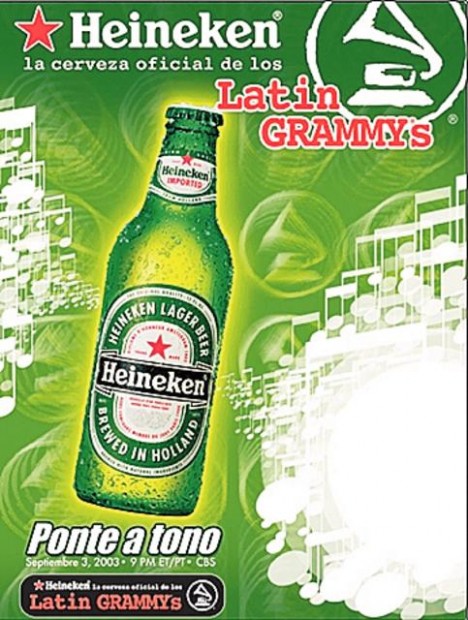
When Heineken beer centered an advertising campaign in the mid-1990s around the company's trademark red star on a green background, it didn't sit well with Cubans in Florida, including some beer distributors who temporarily refused to sell the beer.
Today the Dutch beer sponsors the Latin Grammy Awards and has affiliated itself in other ways with popular forms of Latin music while still focusing on the mainstream market.
Reaching the Hispanic market requires considering both sides of the "Hispanic equation," said Antonio Ruiz, a partner with the New York-based Vidal Partnership. Ruiz, whose company has coordinated advertising campaigns for Heineken, Wendy's and MasterCard, spoke to a crowd of about 150 at a Tucson Advertising Federation luncheon. The event was sponsored by Tucson Newspapers and La Estrella de Tucson.
"The basic message that I focus on the most is about relevance. It's about making your brand, your product or your service, whatever it is, be alive on both sides of what I call the Hispanic equation," Ruiz said after the presentation. "Regardless of what kind of product or company you are, if you're trying to communicate with these consumers in order to effect a transaction or establish something or get a consumer to do something, you have to be doing it on both sides of that equation."
People are also reading…
In Heineken's case, the company failed to consider its Cuban customers, many of whom associated the red star with communism. After that, Heineken decided to court Hispanics by sponsoring music-related events, a strategy that continues today.
Hispanic consumers, while part of America's mainstream, are still heavily influenced by the food, music and values of countries from which their families came. Advertisers err in thinking that these consumers choose one culture or the other.
"They (advertisers) don't think of biculturalism as a destination," Ruiz said.
Ruiz showed side-by-side images of brands popular with Hispanics and comparable mainstream brands. He placed a coffee brand popular with Cubans called Café Bustelo alongside an image of the Starbucks logo. Hispanic coffee drinkers may buy from both brands.
Thus, reaching Hispanic consumers requires reaching out through both mainstream and Hispanic-oriented avenues.
"I never thought about it that way," said Carlos Assante, Health Net of Arizona's manager for Latin programs.
Lori Lieber, a graphic designer who is helping to market a multimillion-dollar development in Rocky Point, Sonora, said she plans to keep Ruiz's advice in mind.
"A lot of it was common sense no matter what kind of advertising you were doing," Lieber said. "I did think it was really helpful in reminding us how to make our advertising relevant. It's something visually that I have to keep in mind for when a client tells me this is what I have in mind."