

Growing demand for the minerals that lie deep inside Arizona's earth has triggered economic and environmental growing pains in a state where history is entwined with mining.
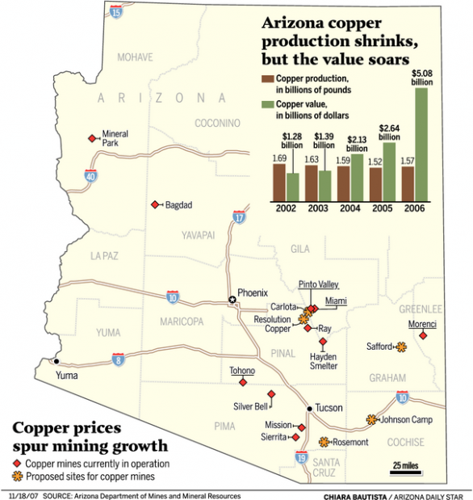
Copper — at one time the state's dominant industry — has jumped in price from under $1 per pound in 2003 to more than $3 per pound for most of the last two years, sparking a surge in copper profits and an eagerness for exploration.
Five new coppers mines are in various stages of development in Southern Arizona. One near Safford was embraced by the community for the jobs it promises and is expected to begin production as early as the end of the year. A proposed new mine 30 miles southeast of Tucson in the Santa Rita Mountains has raised strong opposition from some residents and politicians.
While some believe the stepped-up mining activity could be a boon for the state, others balk at revitalizing an industry from Arizona's past and digging or drilling in scenic areas.
People are also reading…
The only thing both sides agree on is that in the middle of the debate stands a public largely ignorant about the consequences of proceeding or inaction.
The impact
Arizona has 402 mines in operation, from gravel quarries to large, open pits, and they generated $6.7 billion in minerals in 2006, according to the Arizona Department of Mines and Mineral Resources.
Jobs in the mining industry increased 22 percent from October last year to 9,300 in October this year with paychecks averaging $40,000 or more, according to the Department of Economic Security.
This mining renaissance could keep the economic floor under Arizonans feet amid the real estate slump, according to one economist.
"It's definitely good for Arizona's economy," said George Leaming, an economist with the Western Economic Analysis Center who produces economic-impact reports for the Arizona Mining Association. "It has already helped to soften the blow of the downturn in housing and construction. The skills can go back and forth."
Southern Arizona's biggest mining employers are the former Phelps Dodge Mining Co., now a unit of Phoenix-based Freeport-McMoRan Copper & Gold, with 4,900 full-time equivalent employees in 2006 and Tucson-based Asarco LLC with 1,950.
University of Arizona economist Marshall J. Vest said those job figures are insignificant.
"Copper mining used to be a very important component, but the economy got bigger," said Vest, a senior economist at the Eller College of Management. "Copper prices are volatile and the U.S. is a marginal producer. We've built much more on ideas and brainpower versus brawn. I don't see the possibility or desirability of retracing those steps."
The demand
China's seemingly insatiable appetite for copper has driven up — and is keeping up — the price, experts say.
"In the late 1980s, there was 2,000 miles of paved road in China," said James A. Briscoe, president and CEO Liberty Star Uranium & Metals Corp., based in Tucson.
"Today they have 20,000 miles of divided superhighways. China is adding cities the size of Los Angeles every year," he said. "It's so big, it's difficult to get your mind around."
If the U.S. comes to depend on a foreign supply of copper, it must be ready to compete with foreign demands for resources.
Copper is in everything from vehicles to computer wires to electricity connections.
"Everything we do has to have copper," said Briscoe, who started his career working for Asarco 40 years ago and is a registered professional geologist in Arizona and California.
He predicts copper prices will remain in the profitable $2 to $4 per pound range for the next 40 years.
"It's the one necessity that we can't live without," Briscoe said.
That need, and the desire not to import more, explains the pressure for more U.S. mining projects, he said.
"The easy stuff has been found," Briscoe said. "Now, it's getting deeper and more expensive to mine."
Currently, 60 percent of copper is imported and 40 percent produced in the U.S., according to the U.S. Geological Survey. The region of Arizona, New Mexico and Sonora is the world's second-richest source of copper after Chile, according to geologists.
Eager to explore
Multiple projects are being proposed or are at different stages of development across the state.
The discovery of a major copper deposit more than 7,000 feet below the surface near Superior is one of the most significant in two decades, industry experts say.
Resolution Copper Mining expects to yield up to 600,000 tons of copper a year, for at least 40 years. The project hinges in part on a thorny proposed land swap with the federal government.
And Freeport-McMoRan is conducting a "pre-feasibility" study on reopening the Lavender Pit in Bisbee, which has been dormant for 30 years, said Ken Vaughn, the company's manager of mining communications.
In Pima County, Augusta Resource Corp. is proposing a new open-pit mine in the Rosemont Valley southeast of Tucson.
With copper prices holding at more than $3 a pound, interest is high. In 2006 nearly 900,000 acres of federal and state land in Arizona was under exploration, but only a tiny fraction of that will result in mining activity, experts say.
Still, some environmentalists want to see those eager to drill the earth settle down.
"This boosterism the industry has is really about getting its hands on the stuff before the price drops," said Roger Featherstone, Southwest circuit rider for Earthworks, a nonprofit organization that sounds the warning bell for what it believes is the destructive impacts of mining.
"We're in the middle of a cycle," he said of mineral prices. "Even if it's a big one, it's still a cycle."
Resistance and stigma
Despite Arizona's rich mining history, the industry is clouded by the sins of its forefathers.
The state, along with the Environmental Protection Agency, is still sorting through the cleanup of mining towns and allegations of pollution-caused illness from the days of chemicals dumped in water streams and toxic smelter emissions.
"The industry is very proud these days," said Nyal Niemuth, chief mining engineer with the Arizona Department of Mines and Minerals. "It's just living with the stigma of years ago … with images of the past."
Mining professionals scoff at being associated with mid-20th-century mining.
In the past three decades "geology and mining have really come as far as medicine," said Liberty Star's Briscoe.
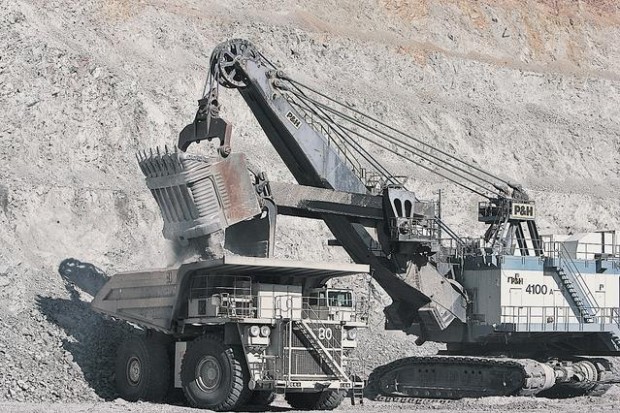
"The old pick and shovel has been replaced with multimillion-dollar trucks guided by GPS," said Vaughn of Freeport-McMoRan. "Most people would be surprised by the technology involved in mining today."
Featherstone, of Earthworks, said environmentalists acknowledge that technology has improved the industry.
"But to say that mining is benign is just not true," he said.
State and federal regulation and oversight of mining operations is strict, said Steve Owens, director of the Arizona Department of Environmental Quality.
"By and large, the mining companies get it," he said. "They understand the environmental regulations and requirements needed to be good corporate citizens in the community."
Owens said past mistakes are costing companies millions today, so prevention of environmental damage is prudent.
"In the 21st century, they understand that," he said. "In the 19th century — even in the 20th century — they didn't."
Emotions versus consumption
The issue of mineral consumption and supply is not a topic readily understood by the general public, said Mark Barton, professor of geology at the University of Arizona.
"We're naturally concerned about the unknown that has a big impact," he said of public hesitancy toward new mines. "The easy choice is to say 'No.' "
Some find environmental concerns about mining ironic in light of the fact that U.S. citizens are the biggest consumers of those very products.
"We're gluttonous about resources, and pay the biggest lip service" to conservation, said Eric P. Jensen, vice president and senior geologist with Tucson-based Bronco Creek Explorations Inc.. The company has mine claims on 45,000 acres throughout Arizona.
He estimates the average U.S. citizen uses four to five times the copper of the average citizen in China.
As Arizona's urban development booms, the mineral resources unique to this region are lost for good. For example, housing and commercial development sterilized one copper deposit in Pinal County that contained the equivalent of one year's worth of U.S. consumption, Barton said.
Yet high-tech living is creating bigger demands for those resources.
"So long as we use raw materials, we have to get them from somewhere," Barton said. "What worries me is that we're making decisions that are, in effect, fairly permanent about resources."
Did you know …
Copper has long been a pillar of Arizona's economy, and a key figure in the industry around statehood was an Alabama-born mining engineer, John Campbell Greenway.
Greenway fought with Teddy Roosevelt and the Rough Riders during the Spanish-American War and came to Arizona in 1899.
He developed the New Cornelia Mine in a huge copper deposit near Ajo, about 120 miles west of Tucson.
Greenway died in 1926 at the age of 53. A sign of his stature and the importance of copper in Arizona: His statue, erected in 1930, is one of two representing Arizona in Statuary Hall at the U.S. Capitol. Fittingly, the statue is in bronze — a copper alloy.
The second statue? It honors Father Eusebio Francisco Kino, who wasn't enshrined until 1965.
Source: The Architect of the Capitol