

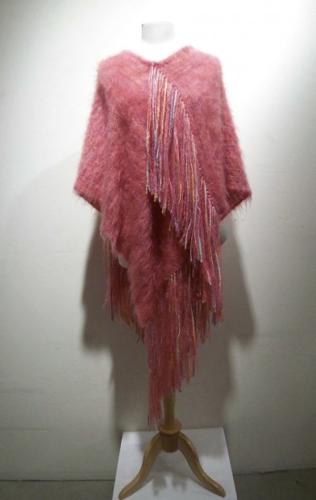
This summer, the Star is profiling some of the artists who call the Old Pueblo home. Today: handweaver Crane Day.
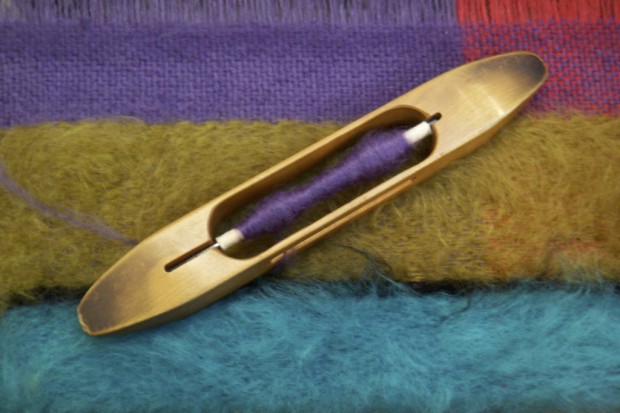
Run the shuttle through the yarn. Watch that selvage edge. Change, and beat.
Brush with a hard-bristled brush on occasion and repeat.
That is the mantra of handweaver Crane Day.
The process is slow, taking hours, days, to create finished piece of his wearable art.
It also requires an infinite amount of patience.
But for Day, this is the life he has enjoyed for decades.
And that others have enjoyed - his pieces are sold locally and in galleries in Sedona, Santa Fe, N.M., and Silver City, N.M.
His work has been worn by celebrities, including Aretha Franklin and the late Hollywood dancer Ann Miller. Another was presented to Pope John Paul II in 1988 at a beatification ceremony.
People are also reading…
Impressive for an artist who started out intending to design restaurant interiors.
FINDING THE LOOM
Day was on a traditional route - he received a degree in sociology and anthropology at the University of Notre Dame and went to graduate school at Michigan State University.
Initially, Day pursued hotel restaurant management but later transferred to interior design.
In order to understand fabrics, he took a weaving course. It changed his life.
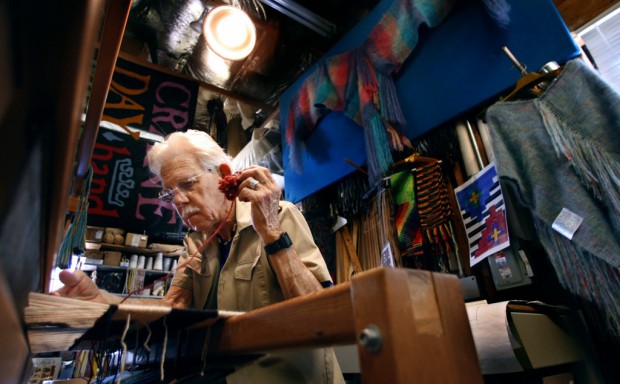
"My professor said I kicked and screamed all the way into the room," Day recalls in an interview is his Downtown studio, which is packed with four looms - different ones for different sizes and materials - and brightened with his colorful creations.
"But I just remember going in, sitting down at the loom and feeling totally in control of my universe in a way that I never had before."
And he fell in love.
After graduating with a master's in interior design, Day moved to Tucson in 1969 to teach home economics at the University of Arizona.
He opened a yarn shop in 1971, but left for New York City for two years in 1973.
When he returned to the Old Pueblo, he opened shop as a weaver and has been married to his loom ever since.
WEARABLE WOVEN WORKS
Day's tapestries, which are made of wool, are typically geometric in design, inspired by the Southwest.
His table runners are made of linen rayon and jute, a strong fiber used in rugs and to tie boxes.
"It makes a really nice dramatic stage for Indian pottery and Mexican hand-carved bowls," he says.
"So I've really made them as a background for the Southwest."
Before he sits at the loom, he knows where he's headed.
"A weaver has to know basically what it's going to look like when it's finished before it starts," he says.
The design has two versions - the first has the mathematical calculations for each geometric shape, the second is the design with color.
Once the fabric is on the loom, he will use a felt pen to mark spots on the threads where he needs to stop and change the colors and the direction of the shapes.
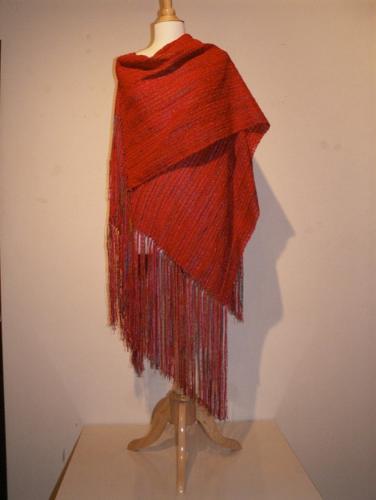
The garments, which are inspired by Native American and Southern Mexico styles, are made out of mohair, the belly hair of Angora goats.
"I don't know why I love mohair," he says. "But it has this wonderful fuzzy woolly quality."
A popular piece is called the Abrazo, Day's adaptation of a traditional Mexican poncho, Quechquemit'l.
Named after the feeling of being "embraced" by the clothing, the Abrazo is an open-front poncho with fringes.
Day also weaves the Abrazo with rayon fabric to add variety to his work and for the drama that the fabric brings.
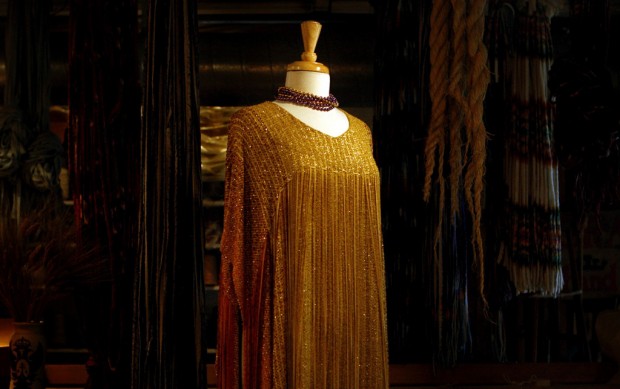
In the 1980s, Day produced a garment called the Ultimate Cocktail Poncho, a poncho with some real flair- and fringe.
Also known as the disco dress, the poncho has fringe dangling from head to toe, giving it a light and airy feel.
"It all stems from the fact that I bought four balls of yarn and I started making a warp," he says.
"It (the yarn) felt like a tassel in my hand and I tried to interpret what the yarn basically could say by itself in a garment, which I think is the essence of art: letting your media speak and you're the interpreter."
To make these woven creations is time consuming.
Tapestries can be finished in a week if made in eight hour days. Table runners take about four hours.
The Abrazo takes roughly six hours to make if it's made of mohair, 12 hours if it's rayon.
Cocktail dresses can easily take almost 40 hours to create; a quarter of the time is needed for hand knotting the fringes.
A DAY IN THE LIFE
Currently Day has yarn set up in his looms, working on multiple pieces, including a tapestry, at the same time.
Day plans on trying something with the Osage hands of friendship in it, adding more challenge to the piece because of the absence of easy geometry.
One day he hopes to make a tapestry he designed in 1980 but has yet to start.
The work says "deo gratias," which is Latin for "thanks be to God."
He has the design and color concept planned out but doesn't know when he will start it.
"It's been a long time coming," Day says. "But I need to do it because I'm not getting any younger."
Artist Crane Day
• Where to see his work: At his studio, by appointment.
• Price range: $95 to about $3,000.
• Contact Day at: craneday@comcast.net
• On the Web: www.craneday.com
Serena Valdez is a University of Arizona journalism student who is apprenticing at the Star.


