

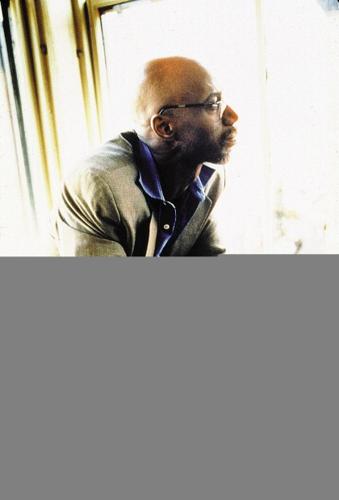
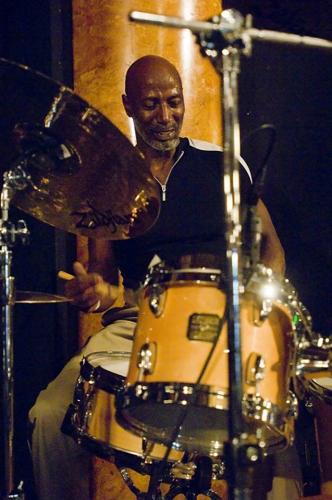
As jazz gears up for its second century of new sounds and lively improvisation, there couldn't be a better time to re-appreciate the eccentric genius of pianist and composer Thelonious Sphere Monk.
Credit the man's own son - also named Thelonious Sphere Monk, but best known as drummer T.S. Monk - with reinvigorating the public's appreciation for the unexpected chords and rhythms that sounded so quirky 50 years ago.
"Most of the time, my father never spoke much, but I am more than delighted to speak out for his music," T.S. said on the phone from his home in New Jersey. "I consider that God touched me to do this."
On Sunday, T.S. brings his group of 10 (said to be Monk's favorite-sized ensemble) to Centennial Hall for a performance of "Monk on Monk," a tribute to his father, who died in 1982.
"It will be all my father's music," T.S. said. "A couple of quartet things, some sextet things and the full band things.
People are also reading…
"Some of the tunes have ensemble sections that are based on solos Thelonious played, but all the guys on stage are playing their own solos. None of that is written out.
"He would never stand for that."
Most remarkable is how contemporary Monk's music sounds today. Though he deserves the title of Most Misunderstood Genius in Jazz, he was clearly 50 years ahead of his time. At least.
The Oxford Grove Music Encyclopedia remembers: "His piano style was unorthodox, using a distinctive 'clanging' timbre, crushed notes clusters and unconventional harmonies. His economical use of material emphasized his often humorous sense of rhythmic anticipation and delay, tempo suspension and silence, allowing him to explore themes with unusual rigor."
Other musicians of the 1950s said Monk's playing sounded "nutty." Comments of the professional jazz critics were downright insulting.
"If there was a guy the critics didn't get (it was Monk). They would say the chord changes are wrong, because the changes were so different," T.S. explained.
Listening with today's ears, Monk doesn't sound erratic at all. It is the bebop of Charlie Parker that is starting to sound dated.
With understanding comes appreciation. In 2006, Monk was posthumously awarded a Pulitzer Prize for his career contributions to jazz as a composer - a mere 24 years after Monk had passed away with little ceremony.
The pieces he wrote, such as "Round Midnight," "Straight No Chaser," "52nd Street Theme" and "Blue Monk," have been considered standards in every jazzer's songbook for decades. After all, Monk was featured on the cover of Time magazine on Feb. 28, 1964.
As jazz in general has found more solid footing with audiences in the new millennium, so has appreciation grown for other Thelonious Monk compositions.
"Monk's music is more popular now than it has ever been before," T.S. said with certainty. "He has been receiving so much recognition.
"Every young musician, it seems to me, who is putting out his first album always includes something by my father."
For T.S. Monk, seeing these players who are the future of jazz begin their careers with Thelonious Monk's music, the satisfaction must be sweet indeed. As T.S. always likes to say about his "Monk on Monk" concert performances, "This is guttural, visceral, tap-your-feet music, and we're going to swing you to death."
IF YOU GO
T.S. Monk plays "Monk on Monk," a tribute to Thelonious Monk.
• Presented by: UApresents.
• When: 7 p.m. Sunday.
• Where: Centennial Hall, 1020 E. University Blvd., on the University of Arizona campus.
• Tickets: $22-$46, with discounts available.
• Reservations, information: www.uapresents.org or 621-3341.
• Et cetera: Monk also will lead a workshop for AzJazz Week. Details on Page C5.


