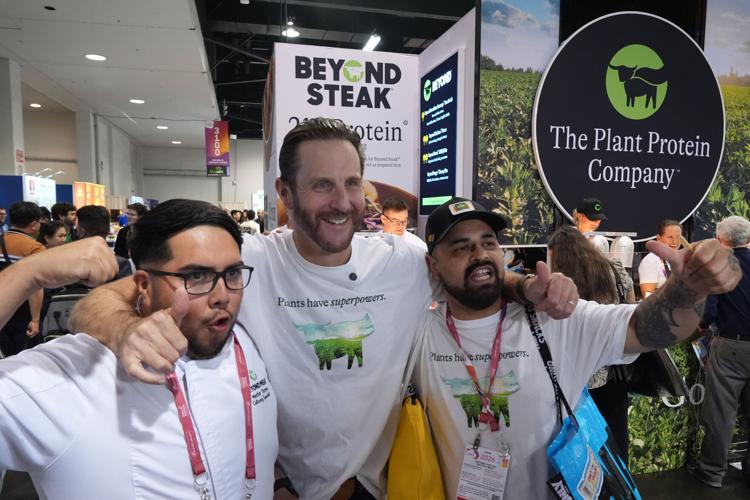
Beyond CEO Ethan Brown, the company's founder, center, with Beyond Meat kitchen assistant, Hector Torres, left, and Antonio Partida, senior kitchen prep, right, at their Beyond booth as the company transitions from Beyond Meat to just Beyond on Thursday at the Natural Products Expo West 2026 at the Anaheim Convention Center in Anaheim, Calif.
Beyond Meat is dropping “meat” from its name as it moves beyond the struggling market for plant-based burgers, sausages and tenders and expands into new categories like protein drinks.
The company, rebranded as Beyond The Plant Protein Co. — or simply Beyond on its packaging — changed its website and social media channels last week. Beyond introduced its first beverage, a sparkling protein drink called Beyond Immerse, in January and plans to release a protein bar this summer.
The refresh could be critical for the brand. U.S. sales of plant-based meat alternatives are flagging and have dragged Beyond down with them. The company's net revenue dropped 14% in the first nine months of 2025. Its shares have been trading below $1 since the start of this year.
"For me, it is an opportunity to reshape the company around very real food that is directly from plants,” said Beyond President and CEO Ethan Brown, who founded the company in 2009. “It’s about delivering all those benefits of the plant kingdom to the consumer in ways that they’re going to be able to easily integrate it into their lives.”
People are also reading…
Beyond is not the only vegan food company making a pivot. Consumer demand for protein is skyrocketing, and several companies are scrambling to serve up more plant-based options.

A plant-based diet centers on eating whole plant foods such as fruits, vegetables, whole grains, legumes, nuts, and seeds.
Eat Just, which makes plant-based eggs, introduced a protein powder made with mung beans last spring. In January, Impossible Foods announced a partnership with Equii Foods to develop protein-packed breads and pastas. Silk, a plant-based dairy brand, also unveiled a protein drink in January.
Chris Costagli, a food thought leader at NIQ, said plant-based brands have struggled in recent years as customers scrutinized their labels and found unfamiliar ingredients, added sugars or high sodium content.
After peaking in 2020, U.S. retail sales of plant-based meat have plummeted, falling 26% over the past two years, according to NIQ.
“There’s a lot of fillers and gums and texturizers and things that give those products a more familiar feel,” Costagli said. “I think as people have been paying closer and closer attention to what they’re actually ingesting, it’s causing some products to stumble.”
Costagli said reformulating products to make them simpler and healthier helped some brands in the plant-based dairy market. He thinks new products and recipes could also boost plant-based meats.

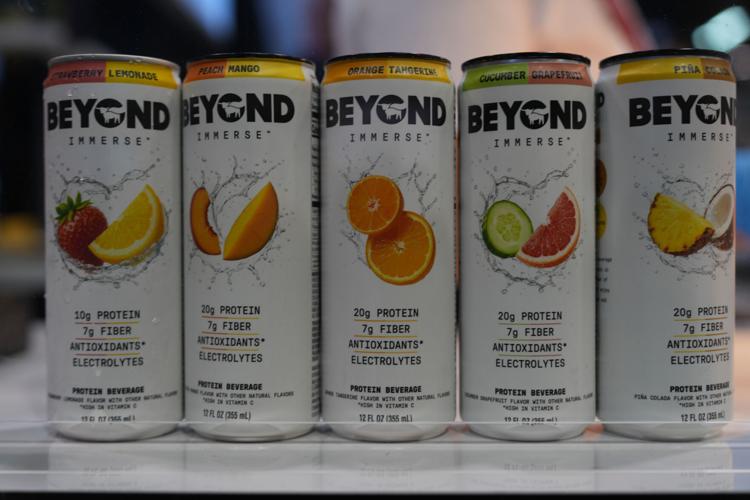
The new Beyond Immerse, Beyond's new sparkling plant‑protein drink flavors, positioned as a lighter, "sippable" protein beverage, is showcased at the Natural Products Expo West 2026 on Thursday at the Anaheim Convention Center in Anaheim, Calif.
That’s what Beyond is betting. In 2024, it revamped its flagship burger to make it healthier. Last summer, it introduced Beyond Ground, which contains just four ingredients – faba bean protein, potato protein, psyllium husk and water – and doesn’t have the word “meat” on its packaging.
Brown said the company will increasingly focus on products that showcase plants, like chickpea sausages or faba bean strips. Brown said Beyond wants to “celebrate the realness” of its products and its simplified ingredients. He also hopes the new products will lead customers back to its plant-based meats.

“Hopefully, at some point people will say, 'Wait a minute, how did we get here, where protein taken from red lentils, peas and brown rice and oil taken from avocado and mixed together into a burger is somehow not good for you?'” Brown said.
For now, new products like Beyond Ground and Beyond Immerse are available only online through a website the company has dubbed Beyond Test Kitchen. Brown said the company wants to innovate and collect feedback quickly, but will eventually put its products in stores.
El Segundo, California-based Beyond will continue to make plant-based burgers, chicken and other products designed to mimic meat, Brown said. They remain popular in Europe, where Beyond’s burgers and nuggets are found on McDonald’s menus.
Brown still believes plant-based meat will be a “much more dominant choice” over the next decade or two, but the company has to navigate what he calls “a period of confusion.”
“It's just not the moment for plant-based meat right now,” he said.
What to know about flexitarian eating
What to know about flexitarian eating

While plant-based diets have been rising in popularity, only an estimated 2% of people in the U.S. consider themselves vegan. An all-or-nothing approach to a plant-based diet is not for everyone, either due to allergies, health restrictions, cultural traditions, or other factors. Many people are more comfortable with the plant-forward concept of flexitarianism, which primarily involves eating plant-based foods as well as occasionally eating animal products in moderation. Animal-based foods, however, are not the main focus of the meal but rather serve as complements.
Reducing the consumption of animal products requires creativity as traditional culinary arts and teachings focus on animal products as a base. For example, Meatless Mondays are just what the name suggests: Mondays set aside for trying delicious, plant-based recipes and foods. Incorporating more meatless days during the week as time goes on can be a comfortable way to ease into a plant-based lifestyle. Another flexitarian approach is Vegan Before 6, or VB6, a meal plan created by New York Times food journalist Mark Bittman. On the VB6 plan, people stick to plant-based foods before 6 p.m., and also avoid sugar, white flour, white rice, and pastas during the day. At dinnertime, they eat what they'd like—though in moderation, ideally.
Those interested in adopting a flexitarian way of eating should be wary of consuming so-called vegan junk food, or the “french fry diet.” Highly processed meat substitutes can be high in sodium. Just because something is made from plants does not automatically make it good for the body. For instance, in a comparison between Burger King’s Impossible Whopper and its traditional Whopper sandwiches, both had around the same macronutrients, but the Impossible Whopper had more than 250 more grams of sodium than the traditional meat option.
As flexitarianism comes with several caveats, Thistle outlined what to know about flexitarianism, from the more casual approach to a plant-based diet. Read on to learn how this lifestyle not only impacts individuals but also the planet as a whole.

Flexitarianism is one of the fasting growing trends in the food industry

In a January 2021 One Poll survey, nearly half of Americans described their diet as flexitarian. They have significantly cut down on the number of animal products they consume and replaced these foods with plant-based alternatives. Additionally, research and analysis firm Research & Markets predicts plant-based foods will be a significant driver of the 4.1% annual growth of the U.S. processed foods industry. Kendall Dabaghi, CEO of food technology startup Kingdom Supercultures, said the growth of the plant-based food industry is well above double-digit percentage points annually. “In particular, this year we expect to see innovations in a variety of categories beyond plant-based meats, such as plant-based dairy products,” Dabaghi said.
Flexitarianism grew largely out of the vegan movement, appealing to a wider consumer base

“Vegans, vegetarians, and pescatarians use the most plant-based dairy and meat alternatives,” said Jennifer Mapes-Christ, food and beverage publisher at market research firm Packaged Facts, in a 2020 press release. However, omnivores and flexitarians still make up a large percentage of those who eat these products, largely because there are more flexitarians than plant-based individuals. Younger consumers, in particular, are eating more plant-based foods, which suggests flexitarianism is gaining widespread acceptance. Additionally, Mapes-Christ expressed the current and future market for plant-based foods depends on omnivores and flexitarians eating more of these foods.
Plant-based substitutes for meat and dairy make veggie-centric diets increasingly convenient

For beginner flexitarians, reaching for substitutes for familiar foods can be one of the easiest ways to transition to a plant-based diet. Instead of learning a new recipe for black bean meatballs, working with a premade soy- or pea-protein-based meatball means little adjustment to the usual spaghetti and meatball dinner. Familiar flavors and textures make the transition away from meat more seamless as well.
In a November 2021 survey of more than 1,000 people by the International Food Information Council, nearly 65% of respondents reported they tried plant-based meat and dairy alternatives within the past year. Specifically, 20% said they ate plant-based foods weekly, and 22% said they consumed them daily. Among those who said they had not tried plant-based foods within the last year, 12% said they would consider doing so in the future.
Reducetarianism has grown out of the greater flexitarian movement

Reducetarianism, or consciously reducing one’s consumption of animal products, includes anyone who wants to consume less meat, eggs, dairy, and fish, including vegans and vegetarians. The reducetarian movement has gained popularity because not everyone wants to or is able to follow an all-or-nothing diet. While the success of diets is highly dependent on the individual, some reducetarians—if they aren’t following a french fry diet—have reported lower cholesterol and are at a lower risk for diabetes. Reducetarianism takes the pressure off of committing to a vegan or vegetarian lifestyle while still letting people reap the health and ethical benefits of plant-based diets.
Scientists say a global reduction in meat consumption is necessary to curb the effects of climate change

A 2021 study published in Nature Food found the production of animal-based foods accounted for 57% of global greenhouse gas emissions, while plant-based food production accounts for almost 30%. These findings confirmed those of previous studies: The production of animal-based foods is far worse for the environment than plant-based foods. Atul Jain, corresponding author of the study and a climate scientist at the University of Illinois, told The Guardian the results were at the high end of what he and his colleagues expected. “Policymakers may want to use the results to think about how to control greenhouse gas emissions,” said Jain.
Consumers perceive health benefits from flexitarian eating

In a 2021 survey of more than 1,000 people by the International Food Information Council, 39% ranked the perceived healthfulness of plant-based meat alternatives among the top-three reasons they incorporated these foods into their diet. The most sought-after health benefits of meat alternatives included high quality or complete protein (43%), heart health (41%), and protein content.
While plant-based diets have health benefits, many processed and fake meat products contain more sodium than the real thing. When the nutrition label of a popular plant-based meat alternative was compared with that of 85% lean, grass-fed beef, the plant-based product had more sodium per 4-ounce serving than real beef. Diets are not one-size-fits-all as different bodies need different nutrients, so it’s important to consult with a doctor before making a drastic dietary shift.
Some consumers go flex in support of animal welfare

In a 2014 study in Ecology of Food and Nutrition, Belgian researchers found concern for animal welfare and the environment were the strongest motives for becoming a vegetarian. In the study, vegetarianism was defined as eliminating all meat from the diet. In 2016, a team led by German researchers found, via an online survey, that, compared to vegetarians, vegans rated animal welfare as a more important motive for their dietary choices. But not everyone can take an all-or-nothing approach. According to the Reducetarian Foundation, replacing animal products with plant-based alternatives by any amount can greatly improve animal welfare.
This story originally appeared on Thistle and was produced and distributed in partnership with Stacker Studio.