


Everyone has their own favorite way to celebrate St. Patrick’s Day. Your yearly tradition might include corned beef and cabbage or perhaps a big pot of Guinness beef stew. For me, there’s nothing better than a cool and creamy Shamrock Shake.
Introduced by McDonald’s around 1970, the Shamrock Shake is a green, mint-flavored milkshake topped with whipped cream. This popular seasonal treat is only available during February and March to celebrate St. Patrick’s Day. Want to learn how to make it at home? This creamy green shake comes together with just a handful of basic ingredients. Here’s our easy recipe.
Shamrock Shake
Yield: About 2 ½ cups (2 servings)
For the milkshake
- 1 pint vanilla ice cream (about 2 cups)
- 2/3 cup whole milk
- ½ teaspoon peppermint extract
- 8 drops liquid or 4 drops gel green food coloring
People are also reading…
Garnish options
- Whipped cream
- Green sprinkles
- 2 maraschino cherries
Directions
Let ice cream sit out at room temperature until starting to soften, 10 to 15 minutes (softened ice cream will blend with ease and require less milk to get things moving). Give the container a squeeze — it shouldn’t be rock hard and should give slightly when it’s ready. Meanwhile, chill the glasses.
If you have room in your freezer, stick two tall drinking or milkshake glasses in there, or else chill the glasses in the refrigerator. This will ensure the milkshake stays cold as long as possible.
Place milk, peppermint extract, food coloring and the softened vanilla ice cream in a blender.
Starting on the lowest speed and working your way up to medium speed, blend until the milkshake is smooth and pourable, about 1 minute. Stop the blender and scrape down the sides or stir as needed to keep things moving.
Divide the milkshake between the glasses. Garnish with whipped cream, green sprinkles, and two maraschino cherries if desired. Serve immediately.
___
Buttered boiled potatoes with chives
Potatoes deserve to be piled high next to thin slices of corned beef for this year’s St. Patrick’s Day celebration. Ever so versatile, potatoes offer big satisfaction for the buck.
Servings: 4
Ingredients
- 8 to 12 small (golf-ball sized) red or golden potatoes, about 1 to 1 ¼ pounds
- Salt
- 2 tablespoons salted butter, at room temperature
- Freshly ground pepper
- Thinly sliced fresh chives, fresh dill fronds or green onion tops (or a combination)
Directions
Scrub whole potatoes clean. Put into a saucepan large enough so they fit in a single layer. Add cold water to cover by 1 inch. Stir in 1 teaspoon salt. Heat to a boil, then reduce the heat to a gentle simmer. Cook until a thin metal skewer or tip of a knife comes out easily, about 15 minutes. Tip off all the water from the pan, leaving the potatoes in the pan.
While the pan and the potatoes are still hot, add butter, a few pinches of salt and plenty of grinds of fresh pepper. Serve hot showered with chives.
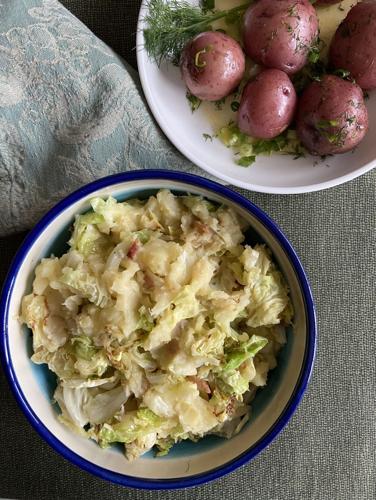
Buttery mashed potatoes and celeriac with Savoy cabbage
Servings: 6
Ingredients
- 6 large (2 pounds total) golden potatoes, cut into 1 ½ inch chunks
- 1 medium-size celery root (celeriac), about 1 pound, peeled, cut into 1 inch chunks
- Salt
- 2 or 3 thick cut slices of bacon, diced (or 2 tablespoons olive oil)
- ½ of a Savoy cabbage or ¼ of a green cabbage, cored, cut into 1-inch chunks, about 4 cups
- 1 cup milk (or whipping cream or crème fraiche or a combination of all)
- 4 tablespoons butter or bacon drippings (or a combination), at room temperature
- Freshly ground black pepper
Note: Rutabaga or turnips can take the place of the celery root. Or, simply use more potatoes.
Directions
Put potato chunks and celery root chunks into a large saucepan. Add cold water to cover by 1 inch. Stir in 1 teaspoon salt. Heat to a boil, then reduce the heat to a gentle simmer. Cook until a thin metal skewer or tip of a knife comes out easily, about 15 minutes. Tip off all the water from the pan.
While the potatoes cook, put bacon into a large skillet and cook over medium heat, stirring, until golden brown and crisp, about 5 minutes. (Or, heat oil in the skillet if not using bacon.) Add cabbage. Stir to coat with the bacon fat or oil and cook until cabbage browns slightly and wilts to tenderness, about 8 minutes. Remove from heat and season with salt and pepper to taste.
Push potatoes and celeriac to the edges of the saucepan so the pan bottom is revealed. Pour milk into the center of the pan; add the butter. Set the pan over low heat and watch until the milk is hot. Then use an old-fashioned potato masher and mash everything into the milk and butter until as smooth as you like. Fold in the cabbage with their pan juices. Season to taste with about ½ teaspoon salt and ¼ teaspoon pepper.
—JeanMarie Brownson, Tribune Content Agency
___
Irish food sometimes gets a bad rap for being unapologetically bland and relying too heavily on root-based brassicas, tubers (which were introduced to Ireland in the late 16th century) and dairy. But really, is that such a bad thing? Cooked with the right seasonings and protein, cabbage and potatoes in a soup or stew can actually be pretty tasty. Both ingredients are also easy to find in just about any grocery store or farmers market for not too much money — no small thing these days, when feeding a family on a budget can feel challenging.
And if you pair said soup or stew with a homemade bread slathered in butter? It might be a humble dinner, but it also will be a good one.
Granny’s Irish Soda Bread
PG tested
No matter how many times I make this family favorite, I never get sick of it. My husband and I don’t agree, however, if it should be made with or without raisins.
I say, if you’re going to serve it with soup, leave the raisins out; if you’re eating it for breakfast with butter, pile them in.
The recipe was handed down from my mother-in-law, Catherine, who learned to make it as a child from her mother, Nellie Kerrigan Foy, who was born in Bundoran, County Donegal, in 1892.
- 2 cups unsifted all-purpose flour
- 2 tablespoons sugar
- 1 teaspoon baking powder
- 1 teaspoon baking soda
- ½ teaspoon salt
- 3 tablespoons butter, softened
- 1 cup seedless raisins, half dark and half golden, optional
- Approximately 1 cup buttermilk
Preheat oven to 350 degrees. Lightly grease cookie sheet.
In large bowl sift flour, sugar, baking powder, baking soda and salt. Cut in softened butter with pastry blender or fork until it looks like fine crumbs. Add raisins. Add buttermilk, starting with a little less than a cup, and mix with fork only until dry ingredients are moistened, adding additional milk as needed to get the right consistency.
Turn out on lightly floured board and knead gently about 1 minute. Shape in a ball and place on cookie sheet; flatten into a 7-inch circle (dough will be about 1½ inches thick) and press a large floured knife into center halfway through to the bottom. Repeat at right angle to form a cross.
Bake 30-40 minutes or until top is golden brown and loaf sounds hollow when tapped.
Remove to wire rack to cool. Optional: Melt another tablespoon of butter and pour over the top.
Makes 1 loaf.
— Catherine Foy McKay
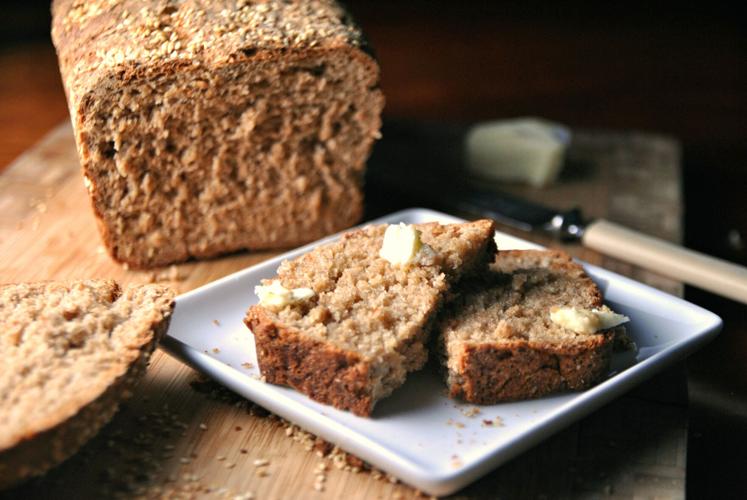
Ballymaloe Brown Yeast Bread
PG tested
This is a perfect yeast loaf for novice bakers because it only has to rise once. (I used dried yeast instead of fresh yeast.)
Don't skimp on the sesame seeds — they add a great nutty crunch. Delicious right out of the oven with (preferably Irish) butter, but just as good the next morning as toast.
- 3¾ cups whole-wheat flour OR
- 3⅓ cup whole-wheat flour plus ⅓ cup all-purpose flour
- 1 teaspoon salt
- 2 cups water at room temperature, divided
- 1 scant teaspoon molasses
- ¾-1 ounce fresh yeast
- Sunflower oil, for greasing pan
- Sesame seeds for topping, optional
Preheat oven to 450 degrees.
Mix flour with salt in a large mixing bowl. Measure out ½ cup of water into a small bowl, stir in molasses and crumble in yeast. Set aside in a warm place for 5 minutes to allow the yeast to start to work.
Meanwhile, grease a 5- by-8-inch loaf pan with oil. Check to see if yeast is rising — it should have a creamy and slightly frothy appearance on top.
Give the yeast a quick stir and pour over the flour, along with the remaining water. Mix well to form a loose, wet dough; the mixture should be too wet to knead. (I had to add additional water.)
Put the mixture into the greased pan, and sprinkle the top with sesame seeds, if using.
Transfer the pan to a warm place and cover the top with a clean towel to prevent a skin from forming. Set aside for 10-20 minutes, depending on the temperature of your kitchen, or until the bread rises just to the top of pan.
The bread will continue rising in the oven. (This is called “oven spring.”) Don't allow it to rise above the top of the pan before it goes into the oven or it will continue to rise and flow over the top.
Bake the bread in hot oven for 20 minutes, then reduce heat to 400 degrees and bake for another 45-50 minutes, or until it looks nicely browned and sounds hollow when tapped on the bottom.
If you like a crisper bread, remove it from pan about 10 minutes before the end of cooking and put it back into the oven to crisp all around. Cool on wire rack.
Makes 1 loaf.
— “30 Years at Ballymaloe” by Darina Allen
Dublin Coddle
PG tested
Every Irishman or woman has his or her own variation of a Dublin coddle, but this hearty, one-pot meal always combines four Irish staples: potatoes, onions, bacon and pork sausage. It is sometimes simmered in a light broth made with Guinness Stout. I used Italian sausage.
- 12 ounces bratwurst or mild Italian sausage (around 3 fat links)
- 2 tablespoons olive oil
- 6 slices unsmoked bacon, chopped
- 1 onion, peeled and sliced
- 4 cups diced potatoes
- 4 medium carrots, peeled and thickly sliced
- 4 cups water or chicken stock
- Salt and pepper, to taste
- 3 sprigs of thyme, leaves picked
- 2 handfuls of finely shredded kale or cabbage
Remove the skins from the sausages and roll them into little meatballs.
Heat two tablespoons of olive oil in a wide, heavy-based pan. Fry the sausage meatballs until they get a little color, then set them aside but don’t wipe out the pan.
Add diced bacon and fry until crispy at the edges.
Add onion to the pan and sauté for a minute or so until it softens.
Add potato and carrots and return the sausage to the pan. Pour in the stock, season with salt, pepper and thyme. Simmer gently for 25 minutes, then add finely shredded kale or cabbage. Simmer for a further 5 minutes until the potatoes are just cooked through.
Taste for seasoning, then ladle into bowls.
Serves 4-6
— adapted from The Irish Times
Kelli Foster is a culinary producer for TheKitchn.com, a nationally known blog for people who love food and home cooking. Submit any comments or questions to editorial@thekitchn.com.

