

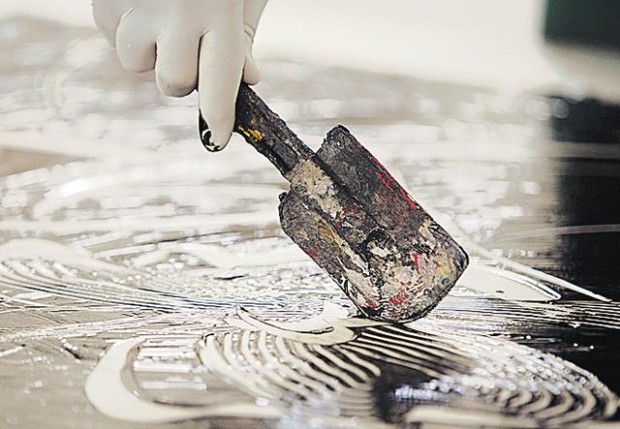
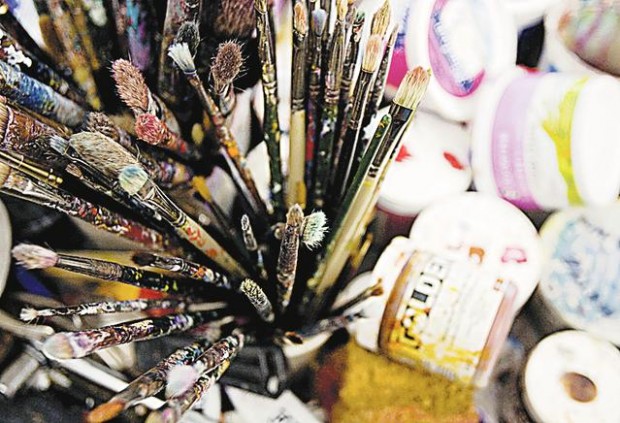
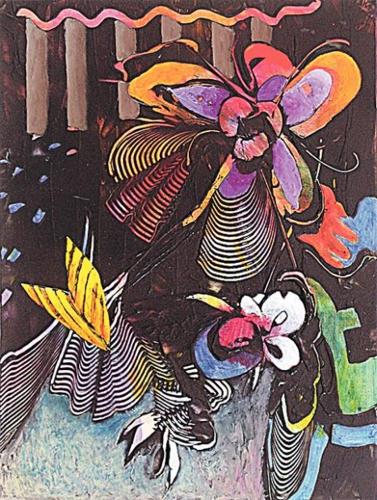
Jim Waid works wonders with a kitchen spatula. • We're not talking about whipping up a scrumptious soufflé or delectable dessert. • Waid — a prolific Tucson artist who has won widespread acclaim for his vibrantly colorful abstract paintings of lush imagined gardens — often uses a spatula to lay on paint here or smear it to perfection there. • "A spatula is sometimes just the right thing for the manipulation of paint," says Waid, who also employs painting tools ranging from traditional brushes to scrapers, knives, trowels and comblike instruments. • "I'm always looking for new kinds of color, new kinds of viscosity, new ways of applying paint," he says. • That quest has led to a bold, unique and compelling artistic vision that consistently draws praise from critics and lovers of fine art.
"Jim Waid, a painter of high ambition, has been able to regain both the physicality and the true mission of painting through non-minimalist abstraction, landscape reveries, floral dreamscapes, process and textural swoops, yelps, swipes and epiphanies," wrote New York art critic John Perreault in a museum guide to one of Waid's shows.
People are also reading…
"His method of scraping or combing through dark overlays to the luminous color beneath makes light palpable," Perreault continued. "His use of complex, often opposing textures and tonalities lets color sing. . . . Through his work we see nature and painting with new eyes."
Waid, 66, who has lived in Tucson since 1968, says he traces much of the inspiration for his work to the early 1970s, when he was teaching drawing and painting at Pima Community College.
"I started taking students out into the desert to draw," he says. "I don't know if the students got anything out of it, but I found myself seduced by the incredible range of forms and natural processes I observed."
The shapes, textures and colors of the desert were but a starting point.
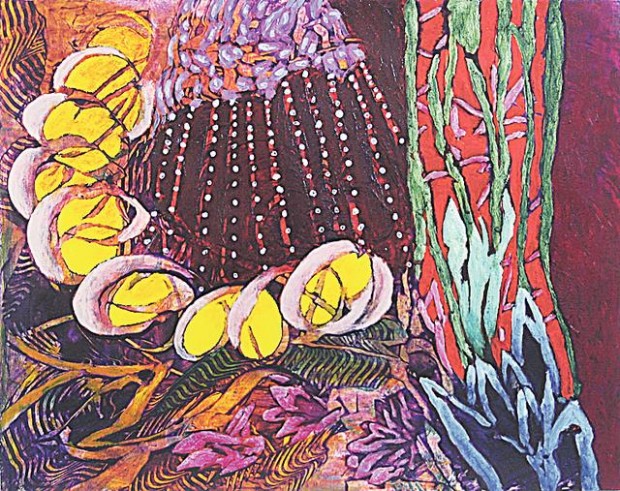
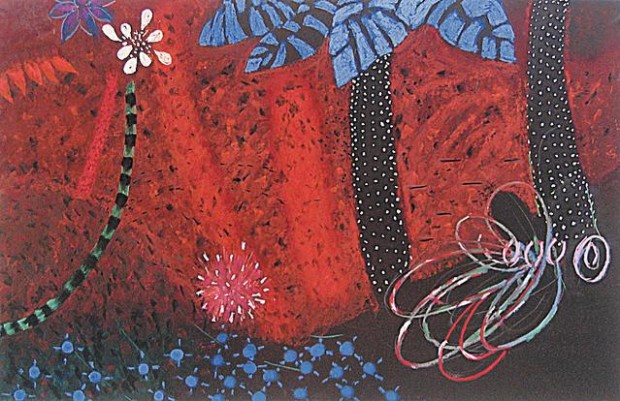
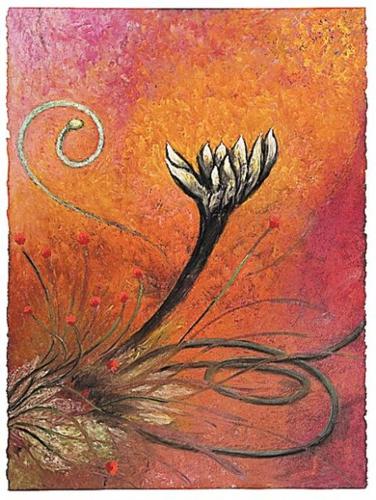
As you'll see in the paintings on these pages and in two current exhibitions in Tucson, Waid's finished work fairly explodes beyond the desert landscape — often invoking exotic tropical vegetation or psychedelic fantasy.
Read on to learn about Waid's background as an artist, his typical workday and techniques, his own favorite painters and more.
Waid, who was born in Elgin, Okla., caught the art bug as a youngster.
"I was one of those kids who was always drawing," he says. "I took art classes in school, and I got a lot of reinforcement.
"But in Oklahoma in those days, nobody said you could be a fine artist. They said you could be a commercial artist."
Later, after moving with his family to New Mexico, Waid "dreamed of being an artist, but I also considered studying history."
The scales tipped toward art while Waid attended the University of New Mexico. He was married to his wife, Beverly, in 1963 while working toward a bachelor's degree in art that he received in 1965. The couple went on to have three children and now have three grandchildren.
The Waids moved to New York City in 1965, and Waid earned a living as an insurance investigator while spending his spare time in galleries and art museums and painting at night.
"I'm sort of an art junkie to this day," he says. "I love going to museums."
After three years in New York, Waid and his wife decided to move to the West and landed in Tucson in June of 1968.
They spent their first night at Rancho Linda Vista, an artists' colony near Oracle.
"There was a coyote outside the window! It was all so exotic," Waid recalls. "This was the place."
Waid continued painting, and also worked as a gardener and school bus driver to pay the bills.
He enrolled at the University of Arizona in 1969, earned a master's degree in art in 1971 and went on to teach drawing, painting and design at Pima College from 1971 to 1980.
"That's when I started getting seduced by the desert," Waid says.
He began incorporating the exotic forms and textures of the desert landscape into his paintings, which often emerge as fantastic garden landscapes — reflecting the "bones," or basic shapes, of the desert but bursting the bounds of the desert color scheme.
"It's kind of a dialogue with nature," he says of his work, which has continued to evolve over the years. "It's not just the desert — but all of nature. Some of my things look like they come from the tropics."
Today, Waid lives and works in a West Side house on spacious grounds vegetated lushly — though not as lushly as some of his paintings — with shapely desert trees and shrubs.
The artist at work
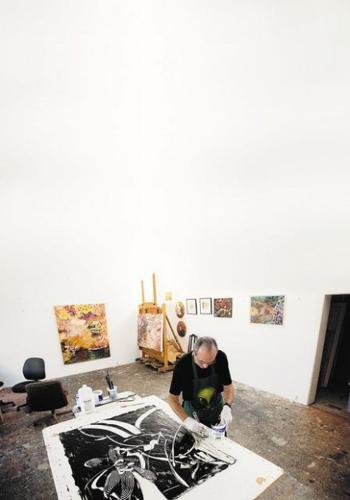
Waid typically pads out of the house and into his studio at about 9 a.m. — sometimes much earlier. He'll work until noon, take a break, and return to the studio from about 1:30 to 5 p.m. After another meal break, he will often resume painting at 7 p.m. and stay at it until 10 p.m. or so.
"I do some art every day, with a few exceptions," Waid says.
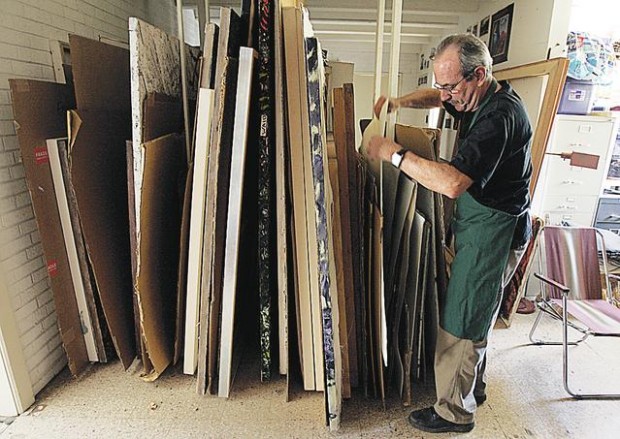
The studio is an open, beckoning space, bathed in natural light streaming in the windows. Practically every square inch of the room's brick floor is spattered with paint. A bowl of dried pears stands by for snacking.
Waid preps for work by pulling on rubber gloves and a favorite apron imprinted with the words "Roswell, N.M." and the image of an E.T.-like space alien.
He's not one of those painters who sits before an easel, dabbing delicately at the canvas.
Waid often works — especially in the early stages of a painting — on a canvas placed horizontally on a table. He all but dances around the painting — squeezing paint directly out of a tube onto one part of the picture, then swiping away layers with the spatula to reveal a shape or color that apparently has cried out for exposure.
"I want energetic, alive paintings," he says.
When working on a table isn't quite right, Waid paints with the canvas on an easel or propped against a wall.
His productions typically are anything but little drawing-room ditties.
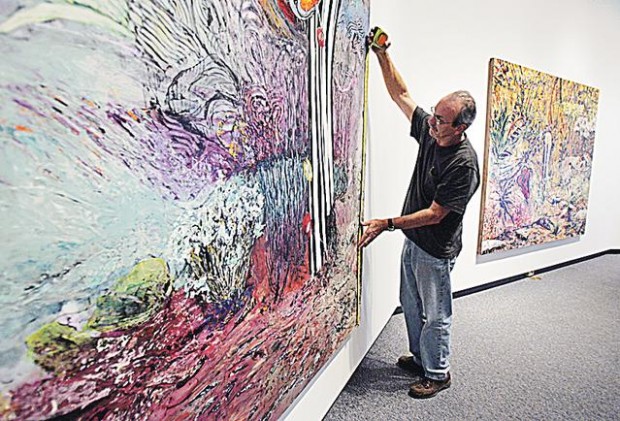
Many of the canvases in his studio and his current show at Pima College are Dutch-masters big — 7 by 10 feet in one case, 7 by 11 feet in another.
And those aren't his largest works. A mural he created for the federal courthouse in Tucson measures 9 by 50 feet. Another of his murals, at the Columbus Branch of the Pima County Public Library, is 5 by 59 feet.
Many of Waid's large-scale paintings are acrylic on canvas, but he works in other forms as well — including acrylic on paper, pastels on paper, watercolor, pen and ink, and monoprints.
His works in those other forms are often much smaller in scale than his large acrylic-on-canvas pieces. The paintings in Waid's current show at the Temple Gallery, 330 S. Scott Ave., are in that smaller range.
Prices for his pieces range from $1,000 to $45,000.
While he still mentors others and teaches occasional classes, he no longer is a full-time instructor. He makes his living from painting — and says he's deeply grateful for that.
"I'm incredibly lucky," he says as he takes a final spatula swipe at a patch of paint. "I'm very fortunate."
Philosophy and technique
An artist's approach to the creative process is best observed in the art itself. But a verbal description can be helpful in understanding the work. Waid — who is represented by the Riva Yares galleries in Scottsdale and Santa Fe, N.M., and the Jean Albano Gallery in Chicago — shared some comments about his approach to painting:
● "The work is improvised into existence, not planned beforehand. It's almost as if each painting gets its own personality as it's developing."
● "I think art can be made out of anything, but traditional painting and the traditional rectangle kind of do it for me."
● "I work on more than one painting at a time. . . . Sometimes I'll just clean my brushes out on a canvas and think of that as a background or underpainting. Then I'll lay on some color — sometimes black, sometimes not — over it and then begin scraping away, mining for the color under it."
● "Sometimes I'll use a kitchen spatula to expose what's underneath. Or a notched spreader from a hardware store. I'll scrape the wet paint out to create a basic structure . . . then I might lay paint on top, so it really looks radiant."
● "Sometimes I'll squeeze paint straight out of the tube to get real intensity."
● "It's about creating a convincing light space that your mind can be in."
● "The paintings are more or less abstracted. They are not illustrations, but rather enactments of the world around me."
● "I like the viewer to feel like you're in the work — like you're entering the painting, not just looking at it."
Influences
Waid, when asked about some of his favorite artists and influences on his work, reels off names from Gorky and Kandinsky to de Kooning and Pollock.
"Others of interest to me are Joan Mitchell and Joan Snyder," he adds, noting that his list of favorites is very long and has varied from time to time.
Then there's jazz.
"I've long been interested in jazz, and the ideas of improvisation have always been important to me," he says. "That has to do with my method of working."
Hands-on
Watching Waid at work in his studio, or joining him in a gallery where his work is on display, reveals a man full of passion and hands-on intimacy with his creations.
And we mean that "hands-on" bit quite literally.
One day recently, in the Louis Carlos Bernal Gallery on the West Campus of Pima Community College, Waid was enthusiastically answering a reporter's questions about one of his paintings hanging there.
In trying to explain his application of color on the piece, valued at $45,000, he began running his fingers over the paint surface to demonstrate his technique.
Running his fingers over a painting on display in a gallery!
"Sir, please stop touching the painting or we'll have to ask you to leave," a reporter said jokingly.
Waid smiled, slightly embarrassed, but then continued his hands-on tutorial — explaining that "I get to do this. It's my painting!"
Needless to say, gallery and museum etiquette strictly forbids the rest of us from touching the artwork.
A curator's view
"A key to Jim Waid's work is how he visualizes energy and vibrancy," says Julie Sasse, chief curator at the Tucson Museum of Art.
"He sort of extrapolates the essence of nature," Sasse says. "What you see is that sense of energy that is buzzing through all of plant and animal life. His works are never tranquil. They're lively. They celebrate nature in all of its colorful glory."
Sasse says part of the appeal of Waid's work is that he is a painter who "marches to his own beat."
"He doesn't feel he has to follow certain canons of abstraction," she says. "He can throw in something representational when he wants to. He can blend realism and abstraction, and he makes it work."
Waid, Sasse says, not only produces magnificent works of art, but also helps art flourish in Tucson.
"He is a real part of the community," she says. "He's active at the Tucson Museum of Art, he teaches on occasion, and he supports other artists. He knows how to take the artistic experience to its wonderful limit."
In the galleries
Waid currently has two shows on exhibit in Tucson:
Jim Waid: Botanical Improvisations
• Where: Temple Gallery, 330 S. Scott Ave.
• When: 10 a.m. to 6 p.m. Mondays through Fridays and prior to Arizona Theatre Company performances. The show continues through Dec. 3.
• Admission: Free.
Natural Selections: Jim Waid Paintings
• Where: Louis Carlos Bernal Gallery, Pima Community College, 2202 W. Anklam Road.
• When: 10:30 a.m. to 5 p.m. Mondays and Wednesdays, 10 a.m. to 5 p.m. Tuesdays and Thursdays, 10 a.m.to 3 p.m. Fridays, and before most evening performances in the Center for the Arts theaters. The show continues through Dec. 5.
• Admission: Free.
On StarNet: Watch Jim Waid at work at go.azstarnet.com/localvideos