
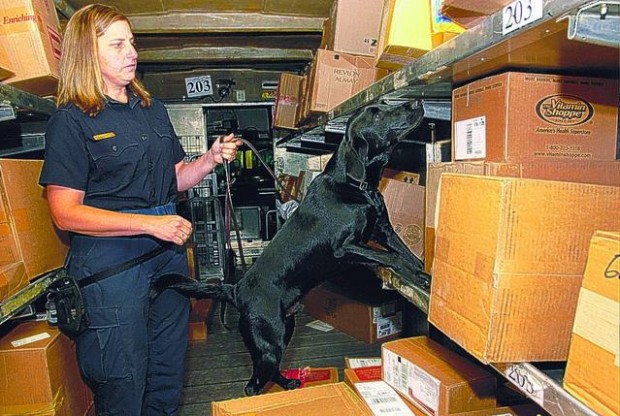
It's just after dawn inside a UPS warehouse when Bart strikes pay dirt in his fight against invading pests.
The black-lab mix rummages inside a big brown delivery truck and scratches at a cardboard box incorrectly marked as fresh artichokes from Castroville, Calif. The package slipped through human detection, but it didn't get past Bart's 200 million scent receptors.
Inside, Bart's handler finds artichoke plants with the roots still carrying soil — a favorite hangout for aphids and other dangerous pests capable of crippling the state's $32 billion agriculture industry.
Alerting humans to these types of plants is why Bart makes the big doggy treats.
He works four days a week for Contra Costa County's agriculture department, inspecting thousands of packages at express-mail centers.
People are also reading…
Although international airports and border stations have plant-sniffing canines, it's rare for counties to have dogs snuffling through express mail. Only a dozen dogs nationwide — in California's San Bernardino County, Florida and Hawaii — have jobs like Bart's and his Contra Costa colleague Bella's.
After an intense 10-week training class, Bart and his handler, Mariah Slusser, in December took jobs in a U.S. Department of Agriculture pilot program aimed at stopping pests from entering the state.
"It's perfectly legal to send agricultural material as long as you mark the packages so they can be inspected," said Lisa Beckett, who helped train Bart at the USDA National Detector Dog Training Center in Orlando, Fla.
"But if they're not marked, the dogs find them. Pest eradication is expensive, and the whole point is to keep them from coming in the first place."
Case in point is the light brown apple moth, a fruit- and plant-eating insect discovered in Berkeley, Calif., earlier this year — its first detection in the continental United States. No one knows how the moth made it here, but the infestation encompasses an area from Napa to Monterey. It could cause $100 million in crop damage and loss of export markets, state agriculture experts say.
They depend on front-line troops like Bart and Bella to keep that from happening.
The two dogs came to government work on the strength of their noses — 40 times more sensitive than humans' — despite a rocky puppyhood of hyperactivity and disobedience.
Bella had to drop out of a breeding program because she was too hyper. Bart lived on a farm, but he was shot after ignoring commands to stop chasing chickens. He still has buckshot in his hindquarters.
"Those attributes that made Bart a horrible farm dog make him a great worker here," said Slusser, a county agricultural biologist who often receives his slobbery kisses. "He's very high-energy. I try to give him breaks and he won't have it."
Bart was dumped off at a Florida pound a couple of years ago, but he didn't stay long. He and Bella were picked for an elite training program and learned how to detect five basic odors — apple, citrus, guava, mango and stone fruit. They can now differentiate synthetic smells from the real ones. For example, the dogs will pass by a mango air freshener but easily identify a fruit basket.
Three-year-old Bart finished his training in September and reported to Contra Costa County on Dec. 1. He now starts his days at 4 a.m. with breakfast followed by some running around at his kennel. Slusser brushes the animal's teeth every day to sharpen his sense of smell. The two arrive at express mail centers around sunrise, when crews sort through packages.
Bart jumps up on conveyer belts and wades through boxes as if he's walking on a personal treadmill. About 4,000 packages later, he's back at the kennel by 10 a.m. Bart finds about three unmarked plant packages a day — usually one is from a pest area and is sent back or destroyed.
Bart hit the agricultural jackpot a while back at a FedEx in South San Francisco.
He identified an unmarked package with contents that looked like leis from Hawaii. But inspectors found an A-rated exotic pest, the most dangerous classification and one that can cause severe economic losses if it spreads. The package containing adults and eggs of the "lesser snow scale" — which eats palm trees, lemons and other plants — was buried at a landfill.