PARIA PLATEAU, Northern Arizona
It's moments before dawn on a cold February morning.
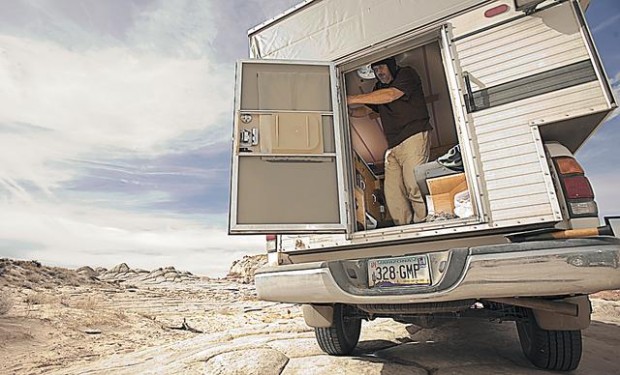
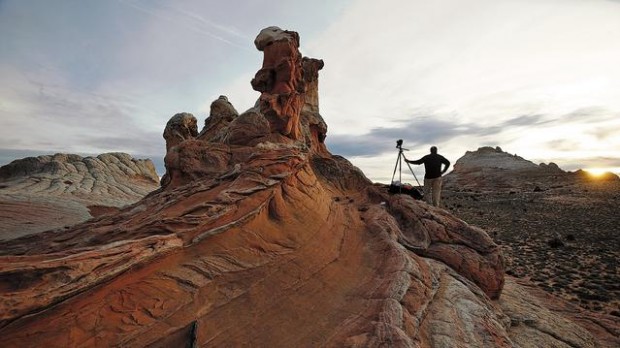
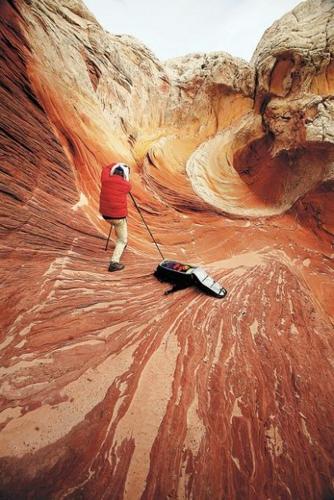
Racing the light, Jack Dykinga ducks out from his pop-up camper with a rectangular backpack of camera equipment ready to go.
He forges out over the rolling sandstone rocks about 30 yards beyond the camp and sets down the camera for the shot he's composed over and over again in his head.
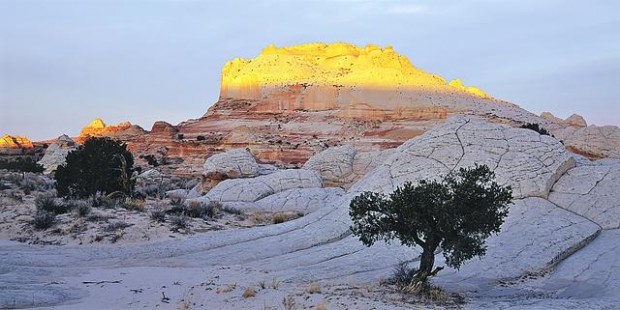
Coyotes howl in the distance. A half-moon smiles fully as the sky slowly becomes pink and purple beyond a creamy shale and sandstone butte that turns yellow and orange like a Hawaii sunset when the light hits it just right.
The light is nearly perfect. Then he sees footprints in the pale pink sand that frosts the smooth red rock formation. He sweeps his hat across the sand trying to erase them and save the shot.
People are also reading…
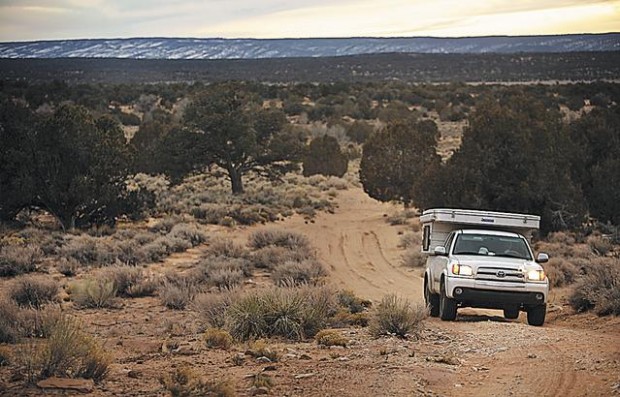
"Someone walked across my shot," the Tucsonan said, pacing a bit and looking for a way around the dilemma. It's hard to imagine many people visit this seemingly desolate place beyond crisscrossing dirt roads that require four-wheel-drive vehicles, but a few broken beer bottles indicate someone's been hanging around.
"This is a shot I've been trying to get for years."
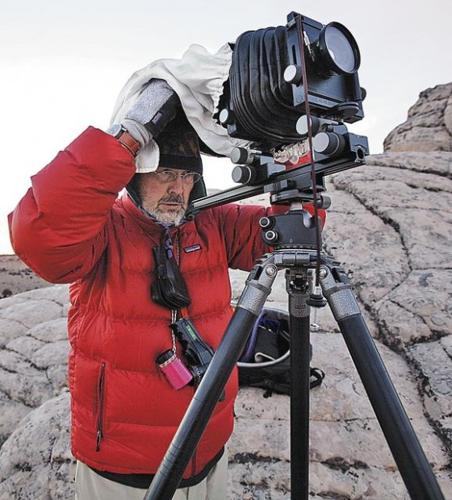
Still, he stays focused as he moves his 4-by-5 large-format camera to the right and lines up a new detailed shot of a swirling red rock formation. This rocky landscape of the Paria Plateau is part of Vermilion Cliffs National Monument, which then-President Bill Clinton designated in 2000.
Dykinga pulls his head out from under the dark cloth. "The light's already here. I'm dead."
Of course, this is an exaggeration from a man whose obsessive attention to detail coupled with his innate connection to the land have made him one of the most respected landscape photographers today. His credits include fine-art photography, landscape books and photo spreads in magazines, including Arizona Highways and National Geographic.
Dykinga is persistent. As his eyes sweep over the land, he scouts out new terrain and finds detail shots of swirling rock.
He wasn't dead at all. He shoots.
Two shots in one morning is a great day, he says.
It's time for breakfast, and a nap.
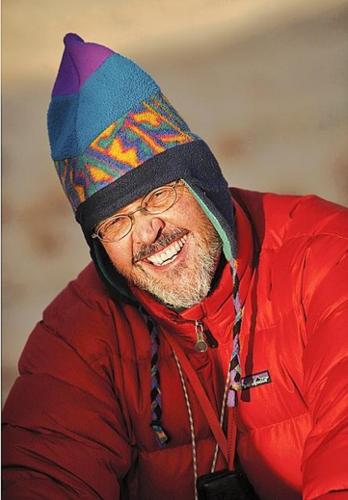
Dykinga, 64, grew up in Chicago and won a Look magazine photo contest in high school. He was dyslexic, he said, and was a poor student; photography gave him an outlet. By the age of 20 he was working at the Chicago Tribune. Two years later he moved to the Chicago Sun-Times. It was then that he became familiar with shooting photos for a cause.
In the beginning of his photography career, he was forging through civil rights marches, rather than wilderness.
"People were calling us scum," he said about photographing Chicago's civil rights march. "I'd see a shadow of a bird and think it was a rock coming at me. This was big time. I was watching history and being in the spotlight."
In 1971, he won the Pulitzer Prize for feature photography for pictures of the Lincoln and Dixon State Schools for the Retarded printed in the Chicago Sun-Times.
"I was going around kicking things, grousing that morning because I thought I had lost. Then I got called into the newsroom and everyone applauded. It felt great."
Then in 1976, he came to Arizona to be the photo editor at the Arizona Daily Star. Five years later, he left to shoot landscapes.
It wasn't that he abandoned photojournalism so much as he just changed his beat, he said. "It's always about a cause. My journalistic background serves me well, I think. It's not that I'm doing anything different now. It's just a different camera. I've made the environment my beat."
Over the last two and a half decades, Dykinga has made Arizona and the Southwest his own personal project — producing four advocacy books on the area. He takes his passion seriously.
"Documenting death and destruction is great for a newspaper, but not a book. You have to come in the back door."
He shoots the beauty of a place, rather than the destruction of the environment, to inspire the public and politicians to protect it.
The desert wins out over other places because it's here that the light creates stunning photographs.
"The Southwest is a vast area without dense foliage and allows the light to sweep horizontally across the landscape. The light is what is magic and gives things color and texture," he said.
When he's out in the sprawling desert, alone, Dykinga said he works best.
"By virtue of little rain, not a lot of people are out there. It's so quiet you can hear your heart beat."
His passion for the environment is deep and profound.
"When the light is great, you sort of get a sense of the divine — or what you think the divine should look like. The images are how I communicate, and if they bring on a sense of what I felt when I shot it, then that's a sense of spirituality."
On this February trip to the Paria Plateau, he sits in his camper at night and discusses threats to the environment with his friend and fellow photographer Jeff Foott of Jackson, Wyo., and they share ideas from the books they're reading.
"I see global warming anecdotally all the time," Dykinga later said. "The receding ice fields. Saguaros dying. The fear is we're going to be recording pictures for a museum of what the land was once like."
He often donates photographs to environmental groups trying to protect land. These images, he hopes, will fuel their cause.
"With his wilderness ethic and care for the land, he targets areas where potential problems are occurring, and he's able to raise the awareness of the public and public officials to the beauty and the value of this land as it exists in nature," said Arizona Highways photography editor Peter Ensenberger, who's been working with Dykinga at the magazine since 1984.
He's watched Dykinga's transition from photojournalist to fine-art photographer. "Even then (in 1984), he had a great insight into the landscape, but he's grown a lot since then. He developed a much more eloquent style."
That style includes juxtaposing warm and cool colors, lush vegetation and stark geology and, of course, finding just the right light to make a landscape come to life.
"Light is the subject. Most people think of it as just the illumination," Dykinga said. "The cliché is the 'God light' at the Grand Canyon. Or the cloud line 1,000 feet below you on Mount Rainier when you're climbing. You have to be pretty jaded not to feel that."
His camera allows him to manually control the lens aperture and shutter and to focus the image well enough to make large, clear prints.
He's shown his work in the Tucson Museum of Art, the Phoenix Art Museum and the University of Arizona's Center For Creative Photography, and sells at Etherton Gallery. Images, which are as large as 30 by 40 inches, range in price from $750 to $1,500.
The landscapes stand out the most when they're blown up, but his attention to detail and eye for light and composition still shine in a magazine format, said Sarah Leen, a senior photo editor at National Geographic and a former Arizona Daily Star intern who worked for Dykinga in the late '70s.
"I think his work has a subtle kind of beauty. His sense of light is very nice and so is his composition, but it's kind of a quiet sort of landscape with a great amount of details because of the large format."
Soft colors and understated details elevate an image from a great shot to fine art, Dykinga said.
"The real gonzo pictures are good for publication," he said. "But after awhile you don't want them up on your wall. The ones that make the jump (to being fine art) are more subtle. You can live with them for a long time."
It's not uncommon for him to hike around looking for a shot that tells a bigger story only to find a detail that becomes art. Instead of shooting a body of water in a canyon, he ends up straddling a rock to shoot the clovers floating in the water.
"You have to be open to surprises," he said. "I'm always surprised and always trying to learn more."
Each trip is a chance to find a photograph, even if he doesn't get it that time around. His friend and former Arizona Daily Star columnist Jim Kiser remembers when Dykinga brought him to Mexico's Baja Peninsula, where he had scouted a shot and woke up before the sunrise to set up his equipment.
"I knew it was windy, and I didn't think he could take the picture because of the long exposure he needs, but I watched him work, adjusting the tripod and changing the lenses, putting a leg up on a rock. . . . I watched for about 15 minutes, and he said, 'You know, Jim. I'm just going through the motions.' . . . I thought that attention to detail even though he couldn't take the picture shows the kind of intensity that he brings to the process."
Dykinga is meticulous, and his technical ability combined with his eye, his journalistic background and his love of the land are what make him stand out among his peers.
"His photographs are technically perfect, but what separates his images from other 4-by-5 images that are technically perfect is that he's telling a story," Ensenberger said. "He's learned how to tell a huge story in one shot."
Sometimes Dykinga and Foott will travel to an isolated place just to get that one shot. "We call it the Dykinga squat," Foott said. "He'll find a picture he wants and just sit there until he's got it. He's more obsessive than most."
Foott and Dykinga met at Coyote Buttes near the Arizona-Utah border years ago, and several weeks a year they go on photographic adventures together.
"We're out here looking for experiences as much as the photos," Foott said.
Dykinga spends as many as 200 days a year out shooting photos, teaching workshops or guiding photo tours. It's out shooting the land that he loves the most.
"It's a game to see if we can do it," said Foott. "All you've got at the end of your life is what you've done."
And that drive to record the places that make life worth living is what keeps Dykinga going.
As for his future, he said, he has too many ideas.
"There are real causes in Mexico and areas that are put aside and not protected. You produce a book and do a show, and it puts pressure on people.
"If you're alive, why not do something? I can't imagine the idea of retirement."
See more photos of Jack Dykinga at work at azstarnet.com/accent