

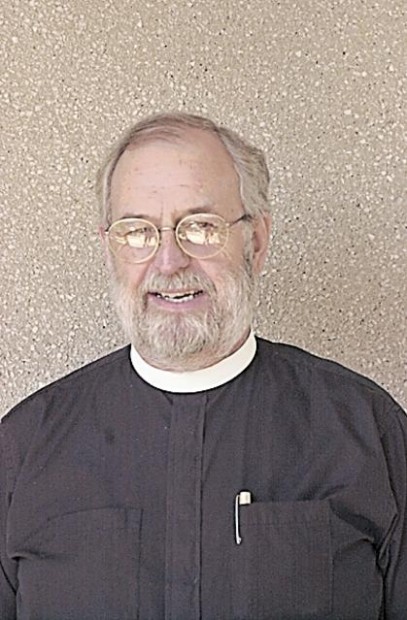
After 23 years as a trailblazing Episcopal leader in Tucson, the Rev. Gordon McBride recently retired, saying it's time for younger leaders to push the church forward.
A former history professor who specialized in Tudor and Stuart England, McBride is known for incorporating narratives and colorful history into his entertaining sermons. He's also been outspoken on challenging tradition.
McBride for years has avoided using the word "Lord" at his church.
"If you need God to be a source of power, then great," he said. "But if you think that's not who God is, then it's a useless term. That's where I am. The notion of the big guy in the sky, it's just not viable anymore."
Grace St. Paul's Episcopal Church was one of the first local churches to adopt an official statement welcoming gays and lesbians to worship there.
People are also reading…
The church also made a local mark by bringing such prominent, controversial theologians as Marcus Borg and John Shelby Spong to Tucson.
Both created waves by challenging literal interpretations of the Bible, arguing that its stories are metaphorical.
Spong, an Episcopal priest, is also known as an early advocate for full inclusion of homosexuals in the church.
With about 1,000 worshippers, Grace St. Paul's is now searching for a permanent rector. In the meantime, the Rev. Harold Clinehens Jr. will lead the Midtown church on an interim basis.
McBride will continue in his role as chairman of the Episcopal Diocese of Arizona's Commission on Ministry, which helps select, ordain and train clergy.
His second novel, "Ghost of Midsummer Common," is expected to be released this year, and a third, "The Vicar of Bisbee," is in the works.
He'll remain in Tucson, where he lives with his wife, Kari McBride, a University of Arizona associate professor of women's studies.
Rev. McBride took part in a Q&A this week with the Arizona Daily Star about his career, and about the bitterly divided worldwide Anglican Communion, to which the Episcopal Church belongs:
Q: Beginning July 16, leaders of the Anglican Communion — among them Episcopal Diocese of Arizona Bishop Kirk S. Smith — will gather for the Lambeth Conference at the University of Kent in Canterbury, England. Do you wish you could be there?
A: "No! I don't like things like that. I've never been a deputy at a General Convention of this church. They are too big and pompous. I'm not a particularly political person."
Q: The Lambeth Conference is held once every 10 years. About 250 conservative bishops plan to boycott it. They are angry that Archbishop of Canterbury Rowan Williams has not disciplined North American bishops for ordaining homosexuals and blessing same-sex unions. What do you think of that divisiveness?
A: "Yes, it is about (openly gay Episcopal Diocese of New Hampshire Bishop) V. Gene Robinson and those issues. But it's much deeper than that.
It has more to do with post-colonialism in Africa and other parts of the world and Western dominance. . . . I think there's resistance to the Bush administration's foreign policy. There are many things tied up in this.
"The other piece, that I think is more specifically theological, is that there's always been a struggle in the Anglican Communion over authority. . . . There have always been those who would like to have the top-down structure that the Roman Catholic Church has, where it's very clear who is in charge — the pope.
"I think many would like to see the archbishop of Canterbury, or some kind of council, be the final arbiter of all things social, political and theological in the Anglican Communion."
Q: Do you think your denomination will survive?
A: "Yes. I think all churches are changing a lot now. Certainly the Roman Catholic Church is, despite its denial of that. I think it is a time of enormous change, and I have no idea where it's going.
"That's one of the reasons I decided to retire. I didn't have a vision of where things were going. I think there are younger people who have a vision of the church that is fresh and different.
"I am getting a sense of it — less arrogant, pompous and more about service and compassion. I think it will look quite different than it does right now."
Q: Any other reason you decided to retire?
A: "I was tired. I'm almost 67. There are some other things I want to do. I love the parish. The hardest part about retirement is that I'm pretty much forbidden to set foot on the place, minimum for a year, probably closer to two."
Q: Do you think you are leaving Grace St. Paul's in good shape?
A: "I hope so. Big changes will occur; there's no question about that. My last Sunday, on June 1, was truly a remarkable experience; it overwhelmed me. There was a big party; they named the parish hall for me. It was quite wonderful. I really miss them."
Q: What are your best memories of being a religious leader in Tucson?
A: "The highlight of my ministry here was the merger of the two parishes (St. Paul's and Grace) in 1991. There's no question about that. . . . I also like my interfaith connections.
"In terms of broader, more community things, I guess I've been very moved by two things. One is the birth and growth of the Primavera Foundation and its caring for homeless men, who are such a huge part of the homeless population. . . . It's been important, and I've appreciated it.
"The second thing is the actions in the desert having to do with the people coming across from Mexico — the No More Deaths and the Samaritans, various organizations" (faith-based groups that give food, water and medical aid to illegal immigrants crossing the Arizona desert on foot).
"It seems to me the religious community in Tucson has taken a pretty clear position — even many of the more conservative ones.
"I think we've tended to agree on the need to stop the dying, and that has certainly been important. We've been involved with that continuously at Grace St. Paul's."
DID YOU KNOW
On Palm Sunday in 1991, the Rev. Gordon McBride led a procession of worshippers out the front door of what was then St. Paul's Episcopal Church, a small stucco church at East Speedway and North Vine Avenue that is now a University of Arizona building.
They walked to what was then Grace Episcopal Church, 2331 E. Adams St. — the city's oldest Episcopal parish, organized in 1881 — and never looked back. The two churches merged into what is now called Grace St. Paul's.
McBride had served as rector at St. Paul's since 1985 and became rector of the merged church in 1991. He retired last month at age 66.
AT A GLANCE
The Episcopal Diocese of Arizona (includes most of Arizona)
Worshippers: 30,000
Churches: 65
Bishop: Kirk S. Smith
Governing body: Part of the worldwide Anglican Communion (about 80 million worshippers)