

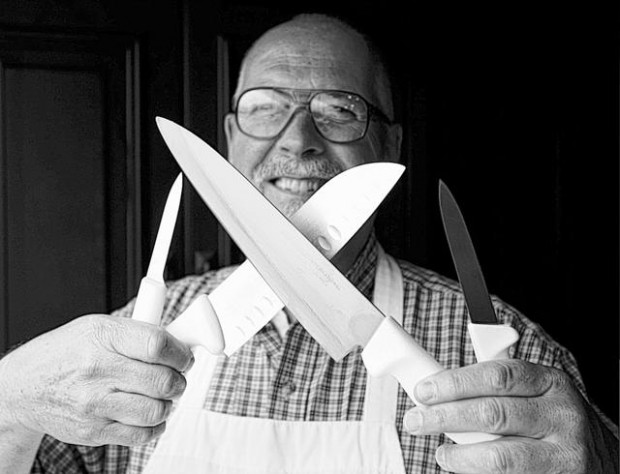
If pare, peel, scrape, bone, fillet and julienne aren't typical kitchen procedures for you, your cooking skills might not be cutting-edge.
You might need to sharpen up your knife drawer.
We've been told that we need high-quality knives to improve our cooking skills, but that quality doesn't have to be expensive. The home cook should be able to come up with a basic set of knives for about $50, caterer Phil Dunn said.
You need a "small knife for a small job, and a big knife for a big job," he said.
Dunn, a former restaurant owner who has trained many Kentucky chefs, recommends that the home cook buy an 8-inch French knife, a serrated knife, a santoku and several paring knives.
The classic chef's knife is a must-have, and some cooks are choosing the Japanese equivalent, the santoku. Compared with a classic chef's knife, the santoku typically is shorter and has a thinner blade, a stubbier tip and a straighter edge.
People are also reading…
Cook's Illustrated has published and updated reviews over the past few years, and the recommended chef's knife continues to be the Victorinox Fibrox 8-inch version.
As for the paring knife, you want one that has a stiff blade, because the tip often is used laterally, such as when you peel an onion or scrape skin off a piece of ginger, said Peter Hertzmann, author of "Knife Skills Illustrated" (W.W. Norton, $29.95).
Choose a paring knife with a straight tip rather than a rounded tip. A curve near the tip makes it hard to make tight curved cuts. With a blade of 2 1/2 to 4 inches, a paring knife looks like a miniature chef's knife, but its use is very different. The paring knife is great for peeling fruits and vegetables, coring an apple, scoring designs and patterns on the surfaces of food, or removing the ribs from a pepper.
Serrated knives, with their scalloped, toothlike edges, are ideal for cutting through foods with a hard exterior and softer interior, such as a loaf of crusty bread. The principle behind a serrated knife is similar to that of a saw: The teeth of the blade catch and then rip as the knife smoothly slides through the food. It cuts cleanly through the resistant skin and juicy flesh of a ripe tomato without crushing it. Crusty bread is easier and neater to cut using a serrated knife because the crust will splinter less.
For all knives, the key to quality is balance. The weight should be equally balanced between the handle and blade. But it's the knife's sharpness that makes for a better cook.
A knife can go dull in a few minutes, especially if you're cutting through bone.
Dunn recommends buying a honing steel for regularly maintaining a sharp edge, and a sharpening stone for intermittent sharpening. There's a difference between tuning up a relatively sharp knife and sharpening a dull knife.
The sharpening steel is a tune-up device. Running the knife blade over the steel simply realigns that edge and makes it straight again. It can't reshape a truly dull blade that's rounded and worn down, according to Cook's Illustrated. That's when you need a sharpener that can cut away metal and restore the standard 20-degree angle of each side of the edge.
Dunn prefers the Norton sharpening system that uses three sharpening stones — fine, medium and coarse. Lubricating the stones with oil (Dunn uses mineral oil) helps float away metal and abrasive dust that will clog and neutralize the stone.