

Editor’s note: This is the next in our series exploring Tucson neighborhoods – the homes, the vibes, the people. Look for the Where We Live series monthly in the Home + Life section of the Arizona Daily Star.
In the 1940s, Sam and Judy Goddard saw their beloved desert shrink as subdivisions rose from the Tucson sand.
Sam Goddard, who became Arizona’s 12th governor in 1965, dreamed of creating a Tucson neighborhood where folks had a place to stretch their legs. He wanted to preserve the desert and its creatures, and bring together like-minded, friendly neighbors.
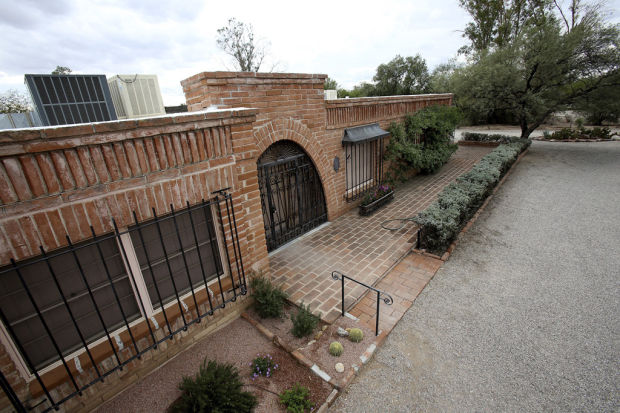
That vision remains today in the historic Aldea Linda neighborhood on Tucson’s east side. The Goddards built their home in Aldea Linda – Spanish for beautiful little village — in 1946. Strict deed restrictions were put into place, requiring homes to be on large lots set far back from the street, and ensuring the neighborhood would remain residential.
People are also reading…
Today the neighborhood, not far from South Swan Road and East 22nd Street, is home to an enclave of 14 homes, the Unitarian Universalist Church of Tucson, the Wat Buddhametta Thai Buddhist Temple and three vacant lots that once served as a grass farm.
Among the noted architects were Josias T. Joesler, William Goldblatt, Tom Gist and Emerson Scholer.
Very little has changed in the neighborhood in 67 years.
Martha Lepo and her two younger sisters, Louise and Maude, moved into Aldea Linda as young children in 1959. Their father, William Waller, died in the home in 1977, and their mom, Frances Waller — known as Aldea Linda’s grand dame — died at the home earlier this year at age 92. She was the neighborhood’s longest resident, at 54 years.
“She said she would never leave, and she didn’t,” Lepo said.
Lepo recalls seeing the house for the first time.
“It was built in 1957 by a woman from Texas who built houses named Nancy Kidd,” she said. “She had great big hair and a big accent, and she was crazy about the color pink. She had a pink Cadillac and a white poodle that she dyed pink.”
Kidd painted the interior of the Sonoran Revival-style home pink, and much of that color — ranging from baby-girl pink to Pepto-Bismol pink — remains today.
“We never wanted to take away the pink glow,” Lepo said.
Aldea Linda was a great place to be a kid. Lepo recalls swimming in the Goddard’s pool and having the run of the desert that surrounded the homes, which were mostly built between the ’40s and late ’60s.
“We rode our bikes and rescued injured bunnies and we made forts,” Lepo said. “We ran around in the desert. We had a really cool childhood — no one was fussing over us.”
Her mom would take the girls to Kiddieland, a small amusement park not far away. The family would load up the car and head for the nearby Cactus Drive-In. She vividly remembers an Air Force jet crashing into the Food Giant about a mile away on Dec. 18, 1967, killing four.
Lepo said the house and the neighborhood has a good vibe.
“My mother loved the house, she loved the neighborhood,” Lepo said. “She so passionately wanted to protect the neighborhood. It was a safe, unique, fortunate place for us to grow up.”
Phoenix lawyer Terry Goddard, who served as mayor of Phoenix and Arizona attorney general, was a few months old when his family moved into the neighborhood’s first home, which sat on five acres. His grandfather, Samuel “Daddy Sam” Goddard, lived next door.
As the oldest of three boys, it was an idyllic place to grow up.
“My folks from the beginning wanted to preserve the desert,” Goddard said. “They loved the spot and thought they had gone just far enough out of town to keep it pristine.”
Neither Swan nor 22nd Street was paved in 1946. “People made fun of them for going so far out of town,” Goddard recalled. “Their first vehicle was a Jeep. They used it to pull people out of the arroyo on Swan Road.”
While urban sprawl took over surrounding areas, Aldea Linda was — and is — preserved.
Goddard’s father had an affinity for anything that grew, and he planted 1,000 trees. He built a greenhouse and cultivated orchids and other exotic plants. “For a long time, he had the biggest eucalyptus tree in the United States.”
Horses from the El Conquistador Hotel on Broadway would wander onto the property to eat the bark from the fruit trees.
“We always had javelina in our yard,” Goddard said. “We had great floods when it rained. We would go hunting for sand rubies.”
His father sold lots to people he liked, including watercolor artists Gerry Peirce and Kay Bonfoey. He helped start the Tucson Watercolor Guild and the Tucson Festival of Arts from his living room, and he donated the land for the Unitarian Universalist Church.
“It was a lovely place to grow up,” said Goddard, whose parents sold the house in 1972. “The emotional ties were extraordinary.”
Tucson lawyer Nanette Warner and her husband, Robert Crago, moved into the neighborhood in 1989.
They were combining families, and finding the right neighborhood was a challenge.
“I didn’t want to drive far to work,” said Warner, who was a Pima County Superior Court judge. “I wasn’t moving to the foothills.”
Crago wanted space. “It was almost a deal-breaker,” Warner said.
Then Warner found the 3,500-square-foot ranch-style house in Aldea Linda listed for sale.
“It was a wreck,” she recalled of the home on 2½ acres. “Nothing worked. Those weren’t cracks in the floor — they were fault lines. Every room had a different-colored shag carpet. You opened the oven and the door fell off.”
But they saw the potential, and a quarter of a century later, they still love the home and the neighborhood.
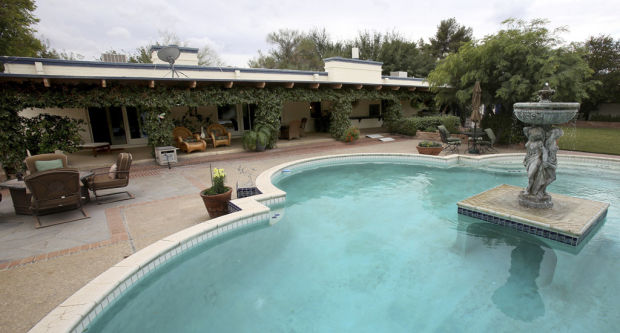
Their four children — Stephen, Andrew, Melissa and Teresa — are now grown. Stephen was recently married in the lovely backyard with ample grass, views of the Santa Catalina Mountains and a spectacular, clover-shaped pool with a fountain in the center.
The fountain that once stood outside of Steinfeld’s department store in El Con Mall is said to be patterned after the pool in Warner’s backyard.
Warner loves the quiet of the neighborhood, along with the wildlife.
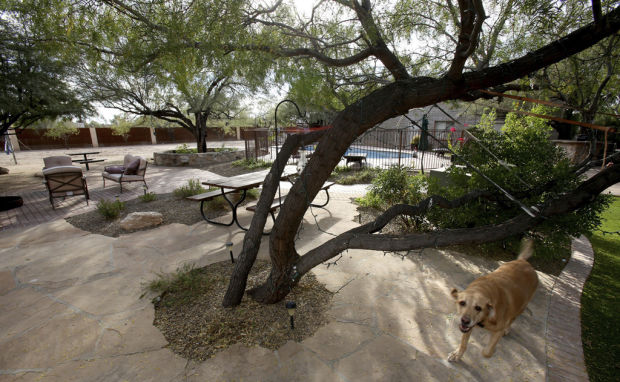
“In the spring, coyote pups sit in the front yard,” Warner said. “We have peregrine falcon, red-tailed hawk, Cooper’s hawk, Harris’ hawk, great horned owl, cardinals, heron. The Reid Park ducks get in the pool. We have raccoons, skunk, bobcat, squirrels, rabbits, reptiles, snakes, lizards, geckos. We have it all.”
From the backyard, no other houses can be seen.
“My boys loved this area,” Warner said. “They had go-kart trails set up in the back and they could play paintball. On the grass we played croquet, volleyball, badminton and baseball. We always had a house full of kids.”
She loves being close to Reid Park, downtown and the airport.
“People come here and stay until they die,” Warner said. “And by maintaining the open space, we are creating an urban-wildlife habitat. It preserves this area for the community.
Kathy Kline and her husband, Ted, bought their home in Aldea Linda in 1998. They needed more room for the family’s toys — a motor home, boat and big sand toys.
The home was offered for sale by a woman who was battling cancer. Living with her in the home was Arnold Snortzenegger, a potbellied pig who came and went as he pleased through a doggie door. When she moved out, she left the pig, who was relocated to a good home by the Klines.
Needless to say, the house needed work.
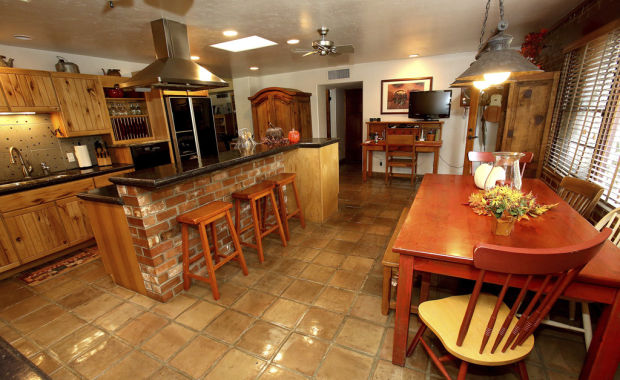
They remodeled and expanded the ranch-style home, and it is now 4,300 square feet.
The Klines and their children — Brad and Megan, who are now grown — loved the open space, and the sand volleyball court the family built in the yard.
“It’s a great place to raise kids,” Kline said. “It’s got great history.”