

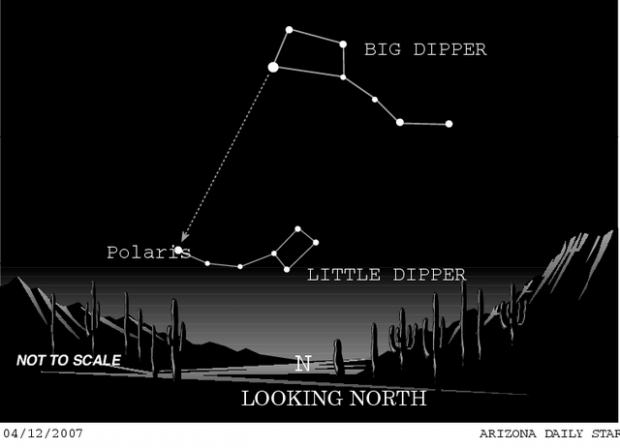
Polaris, the North Star, is so named because it's close to the North Celestial Pole.
The Earth's complete rotation about its axis every day makes the stars appear to circle around a point in the sky — the North Celestial Pole in the Northern Hemisphere and the South Celestial Pole in the Southern Hemisphere. These points are just projections of the Earth's axis into the sky.
If you stood at the North Pole, Polaris would be overhead. Because Tucson is at latitude 32 degrees north, Polaris is about 32 degrees above the northern horizon. At the equator, you can find Polaris just on the horizon. Polaris is not at the exact polar point but falls within 1.5 degrees of it. This means Polaris actually circles around the North Celestial Pole once a day, but this motion is too small to be noticed.
Because of this, Polaris has served as a navigator's benchmark for hundreds of years. If you know the sky and if it is clear at night, you can always find north by locating Polaris. The Southern Hemisphere is not blessed with such a bright star at its pole, so direction-finding at night is much more difficult.
People are also reading…
Polaris is not the brightest star in the sky, though it is fairly bright. It's in the constellation of Ursa Minor, the Little Dipper — at the tip of the handle. You can also use the two stars in the end of the Big Dipper to guide you to Polaris.