

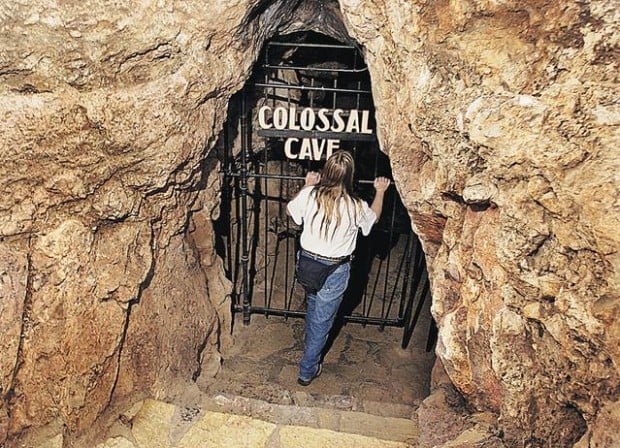
In 1879, Solomon Lick, the owner of the nearby Mountain Springs Hotel and Stage Station, was out searching for stray cows when he came upon what he thought was either "a very extensive old mine or a wonderful cave." Today we know that his second thought was correct.
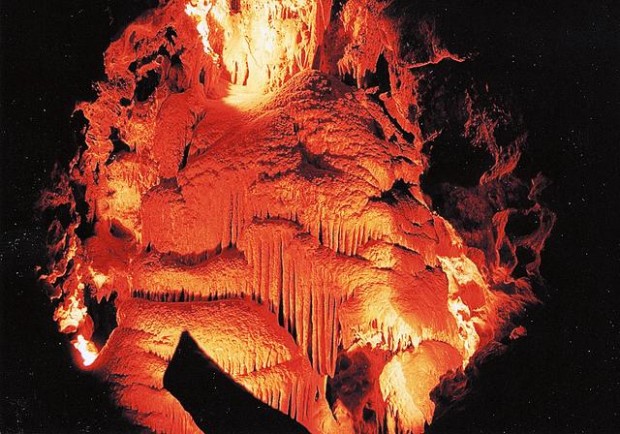
Named Colossal Cave, with more than two miles of passageways that have been explored and mapped, it is likely that there are still areas that have never been seen. Tours of the cave, where the temperature is always a comfortable 70 degrees, provide an opportunity to view many of the beautiful formations traditionally found in limestone caves, including some that are quite rare.
The geologic history of Colossal Cave is complicated. Recent research indicates that it had two sources of water. The first, which was the water that formed the cave's passageways, probably seeped through 10 million to 15 million years ago. Hot and laden with sulfuric acid, it welled up from below. At some point, it cooled or was cut off and no longer came into the cave system.
People are also reading…
The water we normally associate with a limestone cave seeps in from above, depositing the crystals that eventually grow into stalactites, stalagmites and other formations. In Colossal Cave, this probably occurred several hundred thousand years ago.
Then, as the mountains formed and the valley floors dropped below, the cave was left perched on the hillside, where it lies above the water table with little soil or vegetation above to hold moisture. Because of these conditions, coupled with the fact that there are now many openings that allow a high degree of air exchange with the arid climate outside, Colossal Cave is now what is known as a "dry" or "dormant" cave.
The cave formations that were formed under the previous "wet" conditions still exist, but they are no longer growing. Cross sections of stalactites, like tree rings, can provide valuable information about past climate conditions. Research done in Colossal Cave indicates it has been dry for the past 2,000 to 10,000 years.
The first known human use of the cave occurred about a thousand years ago. The Hohokam Indians had a thriving farming community in the valley below Colossal Cave. Indications are that they used the cave for shelter, storage and for religious purposes. The cave was later used by the Sobaipuri Indians (around 1440-1850 A.D.), as well as more recently by the Apache and Tohono O'odham. Following the cave's rediscovery by Lick in the late 1800s, it also served as a hideout for bandits and escaped prisoners.
By the 1920s, a German immigrant, Frank Schmidt, was running guided tours of the cave. He outfitted his intrepid guests with ropes and lanterns before leading them through the unimproved passageways. In 1934, the Civilian Conservation Corps came to Colossal Cave and began an extensive project to construct trails, handrails and lighting in the cave. Using the limestone blocks found in the area, they also constructed a number of the buildings still in use today.
The cave tour is considerably less strenuous these days, although you will have to walk up and down about 6 1/2 stories. The half-mile tour takes about 45 minutes, during which your guide will tell you about the cave's history, legends and geology.
But the cave tour is only the beginning. A visit to La Posta Quemada Ranch Museum provides an opportunity to see some of the ancient artifacts that have been found in the cave, two full-color murals about life in the mouth of a cave (with a particular focus on bats) and rare images from the Arkenstone Cave, one of two wild caves within the park boundaries. The two are live (wet) caves, and in order to protect their delicate environments, access is limited to a few researchers. Thus far, seven new species of invertebrate fauna have been identified in Arkenstone Cave.
From the beautiful formations in ancient Colossal Cave to the new discoveries being made in Arkenstone Cave, Colossal Cave Mountain Park is truly a local treasure, with much to teach us about our past and our present.
Tune-up your mind
Look for these related books:
"Caves and Caverns," by Gail Gibbons (Voyager Books, $7)
"I Wonder Why Stalactites Hang Down and Other Questions About Caves," by Jackie Gaff (Kingfisher, $9.27)
"Limestone Caves," by Roy A. Gallant (F. Watts, $6.95)
"Painters of the Caves," by Patricia Lauber (National Geographic Society, $17.95)
Examples of formations
As you tour the cave, see if you can identify examples of these formations:
● Boxwork: One of the older cave formations, boxwork is created when calcite seeps into cracks and crevices in the limestone. Eventually the limestone deteriorates and only the delicate calcite boxes remain.
● Columns: Also known as stalactons, they form when stalactites and stalagmites meet to form solid pillars.
● Draperies: Water seeping along cracks on a sloping ceiling deposits draperies that are often translucent enough to show banding of colors due to traces of different minerals. Cave bacon is a type of drapery. Usually smaller in size, it is distinguished by its light and dark colors (created by minerals).
● Flowstone: Can form a variety of structures including cave bacon and drapery.
● Helictites: Stalactites that have a central canal with twig-like or spiral projections that appear to defy gravity.
● Soda straws: A type of stalactite that forms on the ceiling from slowly dripping water. As each droplet falls, it leaves behind a minute deposit around its border, and a thin, hollow tube grows slowly toward the floor.
Ancient cave paintings
Discussion questions for the whole family to consider:
The most ancient art that has ever been found was in a cave. Lascaux is a complex of caves in southwestern France famous for its Cro-Magnon cave paintings. Discovered in 1940 by some teenagers and a dog, the caves contain some of the earliest known art, possibly dating back as far as 25,000 B.C. or farther. Although no drawings were found on the walls of Colossal Cave, a Hohokam mortar dating from 900 to 1450 A.D. was found. Mortars were used to crush the colored clays for pigments to paint their pottery, suggesting that the Hohokam may have created some works of art while in the cave.
Why do you think ancient art is often found in caves? Consider both the reasons that the ancient people might have had for choosing a cave as a site for their art as well as the conditions needed for preservation over thousands of years. Visit www.crizmac.com and click on the "Roads Scholar" link for ideas to guide your discussion.
Home to 7 species of bats
Did you know that Colossal Cave Mountain Park provides a home or refuge for hundreds of species of animals including, of course, bats. There are seven species of bats that live at least part time in the Cave.
If you are near the cave, especially when the weather is humid, you may notice a not-very-pleasant smell.
Obnoxious odor notwithstanding, bat droppings, or "guano," is a very valuable substance. In addition to providing a source of food for many other cave-dwelling creatures (known as troglobites), guano is highly prized as fertilizer. In 1905, a 75-foot tunnel was excavated into Colossal Cave in order to mine bat guano. More than seven train cars were filled before the supply was exhausted. Today the tunnel serves as one of the openings for the bats going in and out of the cave.
If you go
What: Colossal Cave Mountain Park
Where: 16721 E. Old Spanish Trail, Vail
When: Summer hours through Sept. 15 are 8 a.m.-6 p.m. Mondays through Saturdays and 8 a.m.-7 p.m. Sundays.
Admission: $5 per vehicle (up to six people) or $1 each for more than six people.
Cave tours: $8.50 adults, $5 ages 6-12 and free for ages 5 and younger.
Information: 647-7275 or www.colossalcave.com online.