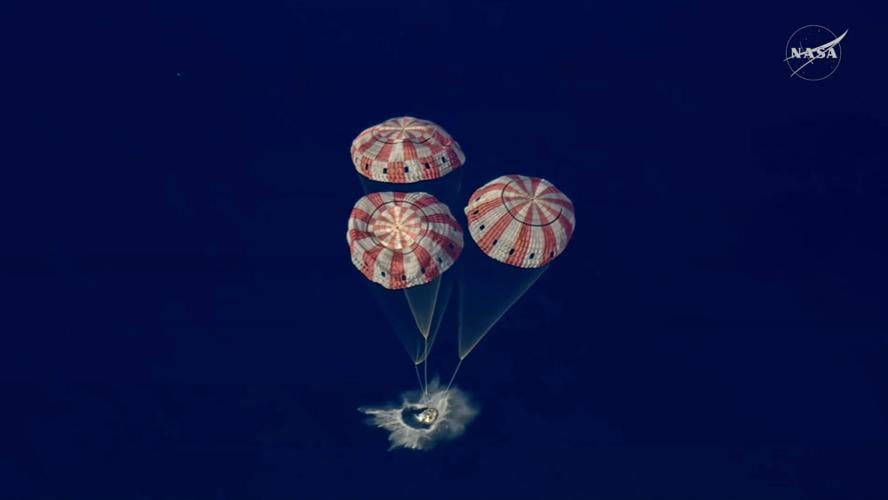
HOUSTON — Artemis II’s astronauts returned from the moon with a dramatic Pacific splashdown Friday, closing out humanity’s first lunar voyage in more than a half-century.
They emerged from their bobbing capsule into the sunlight one by one. It was a triumphant homecoming for the crew of four whose record-breaking lunar flyby revealed not only swaths of the moon’s far side — never seen before by human eyes — but a total solar eclipse.

The Artemis II Orion capsule splashes down Friday in the Pacific Ocean.

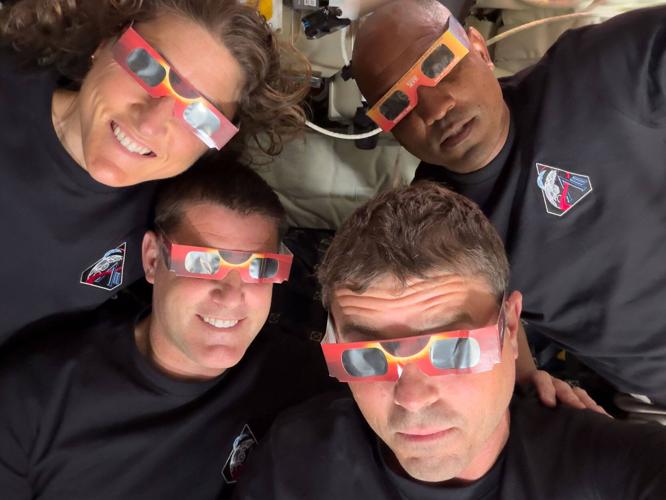
The Artemis II crew, counterclockwise from top left, Mission Specialist Christina Koch, Mission Specialist Jeremy Hansen, Commander Reid Wiseman and Pilot Victor Glover pose with eclipse viewers Monday during a lunar flyby.
Commander Reid Wiseman, pilot Victor Glover, Christina Koch and Canada's Jeremy Hansen hit the atmosphere traveling Mach 33 — or 33 times the speed of sound — a blistering blur not seen since NASA's Apollo moonshots of the 1960s and 1970s. Their Orion capsule, dubbed Integrity, made the plunge on automatic pilot.
Tension in Mission Control mounted as the capsule became engulfed in red-hot plasma during peak heating and entered a planned communication blackout.
People are also reading…
All eyes were on the capsule's life-protecting heat shield that had to withstand thousands of degrees during reentry. On the spacecraft's only other test flight — in 2022, with no one on board — the shield's charred exterior came back looking as pockmarked as the moon.

Like so many others, lead flight director Jeff Radigan anticipated feeling some of that "irrational fear that is human nature," especially during the six-minute blackout that preceded the opening of the parachutes. The recovery ship USS John P. Murtha awaited the crew's arrival off the San Diego coast, along with a squadron of military planes and helicopters.
The astronauts' families huddled in Mission Control's viewing room, where cheers erupted when the capsule emerged from its communication blackout and again at splashdown.
The last time NASA and the Defense Department teamed up for a lunar crew's reentry was Apollo 17 in 1972.
"A perfect bull's-eye splashdown," Mission Control's Rob Navias reported.


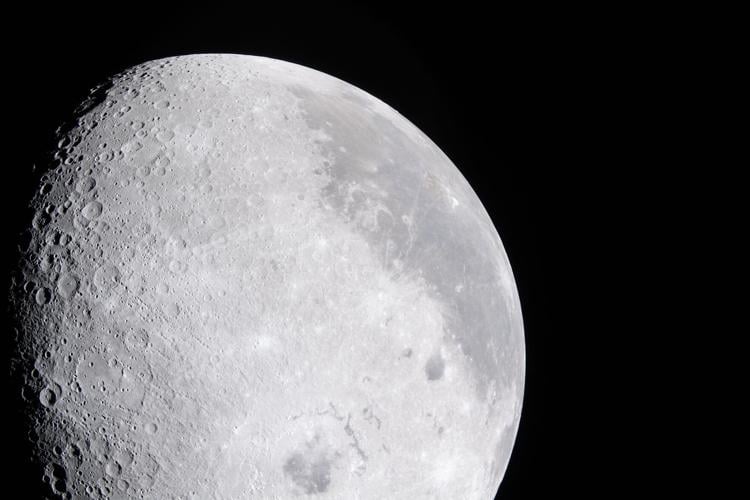
A bright portion of the moon is photographed Monday by the Artemis II crew.
Artemis II's record flyby and views of the moon
Launched from Florida on April 1, the astronauts racked up one win after another as they deftly navigated NASA's long-awaited lunar comeback, the first major step in establishing a sustainable moon base.
Artemis II didn't land on the moon or even orbit it. Still, it broke Apollo 13's distance record and marked the farthest that humans ever journeyed from Earth when the crew reached 252,756 miles.
Then in the mission's most heart-tugging scene, the teary astronauts asked permission to name a pair of craters after their moonship and Wiseman's late wife, Carroll.

During Monday's record-breaking flyby, they documented scenes of the moon's far side never seen before by the human eye along with a total solar eclipse. The eclipse, in particular, "just blew all of us away," Glover said.
Their sense of wonder and love awed everyone, as did their breathtaking pictures of the moon and Earth. The Artemis II crew channeled Apollo 8's first lunar explorers with Earthset, showing our Blue Marble setting behind the gray moon. It was reminiscent of Apollo 8's famous Earthrise shot from 1968.

"We are back in the business of sending astronauts to the moon, bringing them back safely and to set up for a series more," NASA Administrator Jared Isaacman said Friday from the recovery ship. "This is just the beginning."
Their moonshot drew global attention as well as star power, earning props from President Donald Trump; Canadian Prime Minister Mark Carney; Britain's King Charles III; Ryan Gosling, star of the latest space flick "Project Hail Mary"; Scarlett Johansson of the Marvel Cinematic Universe; and even Captain Kirk himself, William Shatner of TV's original "Star Trek."
“This is an incredible test of an incredible machine,” NASA Associate Administrator Amit Kshatriya said. “This has been a gift to the world from NASA.”

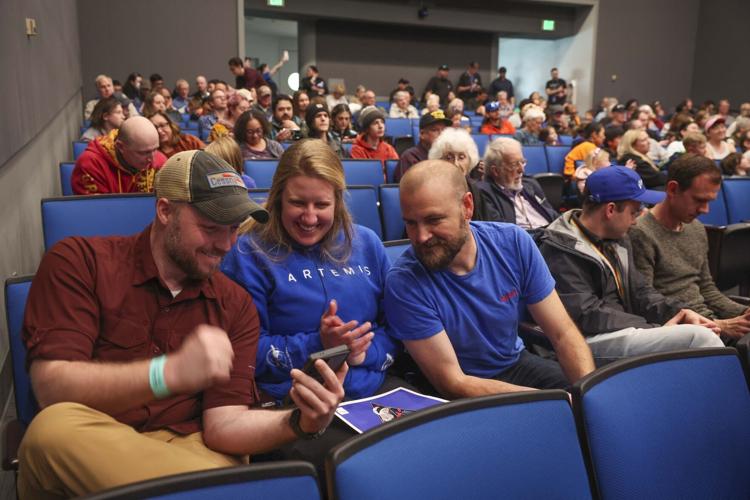
Matthew Trees, left, an experimental flight test engineer who worked on the space launch system for Artemis I, his girlfriend Katherin Rohlfing, center, and friend Jordan Stringfield, who is also an experimental flight engineer, celebrate Friday as Orion returns to Earth during an Artemis II splashdown viewing party at the Museum of Flight in Seattle.
Test flight for future moon missions
Despite its rich scientific yield, the nearly 10-day flight was not without technical issues. Both the capsule's drinking water and propellant systems were hit with valve problems. In perhaps the most high-profile predicament, the toilet kept malfunctioning, but the astronauts shrugged it all off.
"We can't explore deeper unless we are doing a few things that are inconvenient," Koch said, "unless we're making a few sacrifices, unless we're taking a few risks, and those things are all worth it."
Added Hansen: "You do a lot of testing on the ground, but your final test is when you get this hardware to space and it's a doozy."

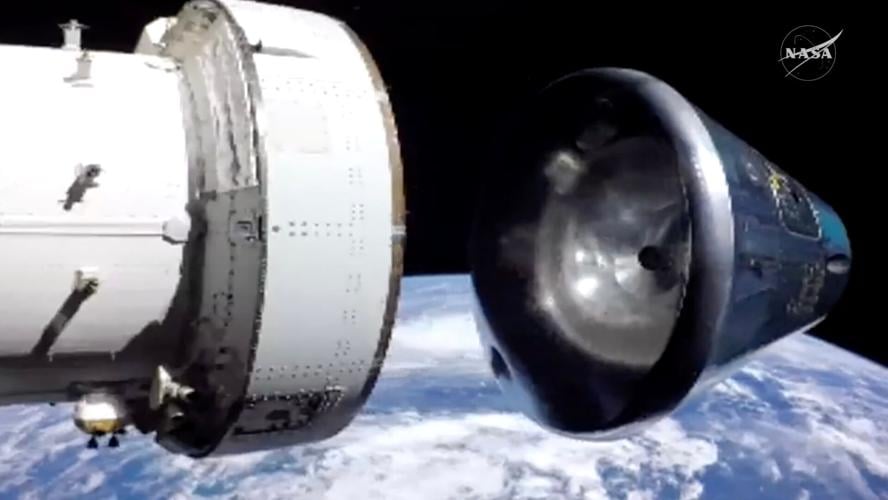
The Artemis II Orion capsule, right, separates from the service module Friday above the Earth in preparation for splashdown in the Pacific Ocean.
Under the revamped Artemis program, next year's Artemis III will see astronauts practice docking their capsule with a lunar lander or two in orbit around Earth. Artemis IV will attempt to land a crew of two near the moon's south pole in 2028.
The Artemis II astronauts' allegiance was to those future crews, Wiseman said.
"But we really hoped in our soul is that we could for just for a moment have the world pause and remember that this is a beautiful planet and a very special place in our universe," he said, "and we should all cherish what we have been gifted."
Artemis II astronauts conduct historic NASA mission

In this photo provided by NASA, the Orion spacecraft with Artemis II crewmembers aboard approaches the surface of the Pacific Ocean for splashdown off the coast of California, Friday, April 10, 2026. (Bill Ingalls/NASA via AP)

People look up at the sky during a watch party for the return of NASA's Artemis II in Coronado, Calif., Friday, April 10, 2026. (AP Photo/Gregory Bull)

In this photo provided by NASA, U.S. Navy divers prepare to deploy in small boats from the well deck of USS John P. Murtha to recover Artemis II crew members NASA astronauts Reid Wiseman, commander; Victor Glover, pilot; Christina Koch, mission specialist; and CSA (Canadian Space Agency) astronaut Jeremy Hansen, mission specialist and NASA's Orion spacecraft in the Pacific Ocean off the coast of California, Friday, April 10, 2026. (Bill Ingalls/NASA via AP)

Astronauts , from left, Mission Specialist Jeremy Hansen, of Canada, Pilot Victor Glover, Commander Reid Wiseman and Mission Specialist Christina Koch leave the Operations and Checkout Building for a trip to Launch Pad 39-B and a planned liftoff on NASA's Artemis II moon rocket at the Kennedy Space Center Wednesday, April 1, 2026, in Cape Canaveral, Fla. (AP Photo/Chris O'Meara)

Employees of the Canadian Space Agency react during the successful launch of the Artemis II moon mission, at the Canadian Space Agency, in Longueuil, Quebec, on Wednesday, April 1, 2026. (Christopher Katsarov/The Canadian Press via AP)

Ottawa city councillor Tim Tierney wears a costume astronaut helmet as he joins others watching the launch of Artemis II on a livestream displayed on the Kipnes Lantern of the National Arts Centre in Ottawa, Ontario, Wednesday, April 1, 2026. (Justin Tang/The Canadian Press via AP)

NASA's Artemis II moon rocket lifts off from the Kennedy Space Center's Launch Pad 39-B Wednesday, April 1, 2026, in Cape Canaveral, Fla. (AP Photo/Chris O'Meara)

NASA emplyees react as astronauts leave the Operations and Checkout Building for a trip to Launch Pad 39-B and a planned liftoff on NASA's Artemis II moon rocket at the Kennedy Space Center Wednesday, April 1, 2026, in Cape Canaveral, Fla. (AP Photo/Chris O'Meara)

Photographers set up remote cameras near NASA's Artemis II moon rocket on Launch Pad 39-B just before sunrise at the Kennedy Space Center Tuesday, March 31, 2026, in Cape Canaveral, Fla. (AP Photo/Chris O'Meara)

Artifacts sit in the Apollo Mission Control room at Johnson Space Center on Thursday, July 24, 2025, in Houston. (AP Photo/Ashley Landis)

Members of the Cleveland Guardians warm up as NASA'S Artemis ll rocket is seen prior to launch from Launch Complex 39B at Kennedy Space Center on the big screen above them prior to a baseball game against the Los Angeles Dodgers, Wednesday, April 1, 2026, in Los Angeles. (AP Photo/Mark J. Terrill)

NASA's Artemis II moon rocket lifts off from the Kennedy Space Center's Launch Pad 39-B Wednesday, April 1, 2026, in Cape Canaveral, Fla. (AP Photo/John Raoux)

People react on Elgin Street as the Artemis II moon rocket lifts off, on a livestream displayed on the Kipnes Lantern of the National Arts Centre in Ottawa, Ontario, Wednesday, April 1, 2026. (Justin Tang/The Canadian Press via AP)

NASA's Artemis II moon rocket lifts off from the Kennedy Space Center's Launch Pad 39-B Wednesday, April 1, 2026, in Cape Canaveral, Fla. (AP Photo/Terry Renna)

Mission Commander Reid Wiseman makes a heart with his hands as he leaves the Operations and Checkout Building for a trip to Launch Pad 39-B and a planned liftoff on NASA's Artemis II moon rocket at the Kennedy Space Center Wednesday, April 1, 2026, in Cape Canaveral, Fla. (AP Photo/Chris O'Meara)

In this photo provided by NASA, guests watch the launch of the Space Launch System (SLS) rocket and Orion spacecraft for the Artemis II mission to the moon at NASA's Kennedy Space Center in Florida on Wednesday, April 1, 2026. (Bill Ingalls/NASA via AP)

This photo provided by NASA shows the exterior of the Orion spacecraft Integrity during the Artemis II mission en route to the moon on Friday, April 3, 2026. (NASA via AP)

In this image provided by NASA, the Artemis II crew photographed the Moon's crater on Monday, April 6, 2026. (NASA via AP)

This image from video provided by NASA shows the Artemis II crew, from left, Commander Reid Wiseman, mission specialist Christina Koch, pilot Victor Glover and Canadian astronaut and mission specialist Jeremy Hansen as they answer media questions during a video conference Wednesday, April 8, 2026. (NASA via AP)

In this image provided by NASA, the Artemis II crew captured this image of Orion spacecraft pictured from one of the cameras mounted on its solar array wings on Tuesday, April 7, 2026. (NASA via AP)

In this image provided by NASA, The Artemis II crew captured this view of an Earthset on Monday, April 6, 2026, as they flew around the Moon. (NASA via AP)