HOUSTON — Lunar love knows no bounds.
Now hurtling home from the moon, the Artemis II astronauts took a poignant page from Apollo 8 this week, proposing deeply personal names for a pair of lunar craters.
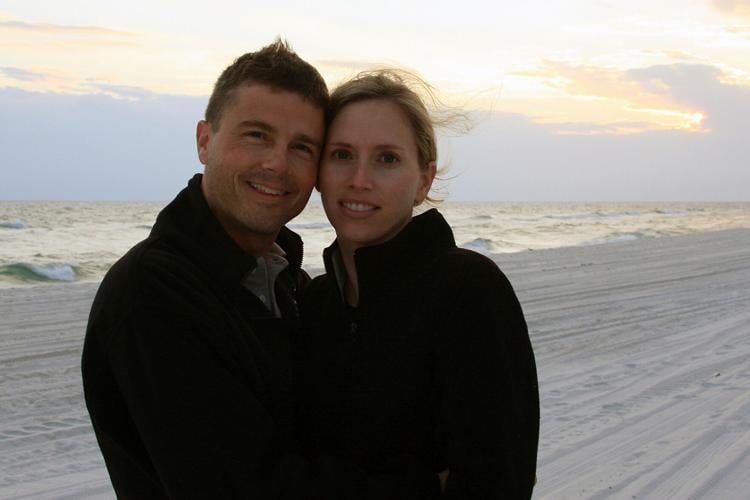
Commander Reid Wiseman and his crew asked permission to name one small, fresh crater after their capsule called Integrity and another after his late wife, Carroll. Canadian astronaut Jeremy Hansen made the request right before Monday's lunar fly-around. Wiseman was too emotional to talk.
Carroll Wiseman, a neonatal nurse, died of cancer in 2020.

NASA astronaut Reid Wiseman with his wife, Carroll Taylor Wiseman.
During Apollo 8 in 1968, astronaut Jim Lovell bestowed his wife's name upon a prominent lunar peak: Mount Marilyn. It was humanity's first trip to the moon and she anxiously awaited his return home in Houston.
The three Americans and one Canadian of Artemis II are the first lunar visitors since Apollo 17 closed out that grand epoch in 1972, and their crater-naming request temporarily left ground controllers speechless.
People are also reading…
"It was definitely a very emotional moment. I don't think most of us knew it was coming," NASA lunar scientist Ryan Watkins said Wednesday from Johnson Space Center in Houston. "There was not a single dry eye."

Mission Control's lead scientist Kelsey Young worked with the Artemis II crew before launch, quietly helping them choose the two bright, relatively young craters, which they quickly spied once they were close enough to the moon through zoom lenses as well as their naked eyes.
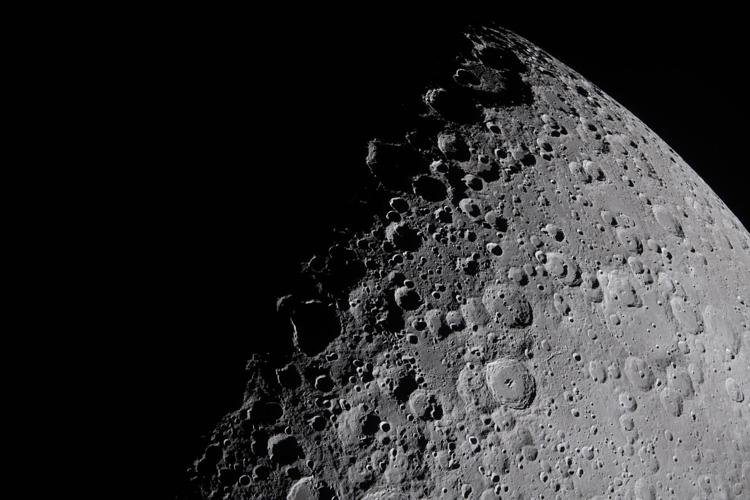
Proposed Carroll Crater is at the moon's left limb on the boundary of the moon's near and far sides, and occasionally visible from Earth. It's rather shallow and approximately 3 miles across, according to Watkins. The slightly bigger Integrity crater is completely on the lunar far side.

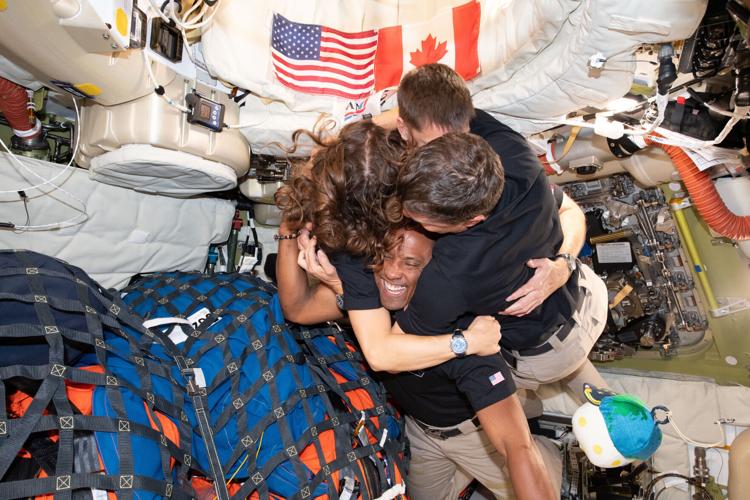
The Artemis II crew members, clockwise from left, Christina Koch, Jeremy Hansen, Reid Wiseman and Victor Glover, share a group hug Wednesday in the Orion spacecraft.
Their request came shortly after they broke Apollo 13's distance record for deep-space travelers. All four astronauts wept as they embraced in a group hug.
"We lost a loved one. Her name was Carroll, the spouse of Reid, the mother of Katie and Ellie," Hansen radioed, his voice breaking. "It's a bright spot on the moon and we would like to call it Carroll."
Mission Control fell silent for nearly a minute before replying: "Integrity and Carroll crater, loud and clear."
The emotion-drenched scene was vastly different from the 1960s and 1970s Apollo moonshots in more ways than one. NASA's Apollo all-male test pilots were for the most part all business and tear-free.
"This is no fault of Apollo," Watkins said. "I think we're seeing just a more human aspect."

Once back on Earth, the crew will submit the two proposed names to the International Astronomical Union.
Almost a half-century passed between Apollo 8 and the union's sign-off of Mount Marilyn in 2017.
The IAU's Ramasamy Venugopal promised a decision on Carroll and Integrity in about a month, the norm "for straightforward requests."

Part of the moon comes into view Monday along the terminator, the boundary between lunar day and night, during the Artemis II's flyby.
There already are 81 astronaut-named lunar features on the group's approved list, including Apollo 16's Baby Ray and Gator, and Apollo 17's Lara named for the lead female character in the 1965 film "Doctor Zhivago."

Some Apollo-era nicknames didn't make the cut.
Apollo 17 commander Gene Cernan, the last astronaut to walk on the moon, dubbed a split boulder "Tracy's Rock," after his young daughter in 1972.
In 1969, Apollo 12 commander Pete Conrad nicknamed his touchdown spot "Pete's Parking Lot."
Artemis II astronauts embark on historic NASA mission as the full moon glows, in photos

Employees of the Canadian Space Agency react during the successful launch of the Artemis II moon mission, at the Canadian Space Agency, in Longueuil, Quebec, on Wednesday, April 1, 2026. (Christopher Katsarov/The Canadian Press via AP)

NASA's Artemis II moon rocket lifts off from the Kennedy Space Center's Launch Pad 39-B Wednesday, April 1, 2026, in Cape Canaveral, Fla. (AP Photo/Terry Renna)

In this photo provided by NASA, guests watch the launch of the Space Launch System (SLS) rocket and Orion spacecraft for the Artemis II mission to the moon at NASA's Kennedy Space Center in Florida on Wednesday, April 1, 2026. (Bill Ingalls/NASA via AP)

A bird flies past a full moon over Panama City, Wednesday, April 1, 2026. (AP Photo/Matias Delacroix)

NASA's Artemis II moon rocket lifts off from the Kennedy Space Center's Launch Pad 39-B Wednesday, April 1, 2026, in Cape Canaveral, Fla. (AP Photo/Chris O'Meara)

Spectators leave the A. Max Brewer Bridge after viewing NASA's Artemis II moon rocket launch, Wednesday, April 1, 2026, in Titusville, Fla. (AP Photo/Phelan M. Ebenhack)

NASA's Artemis II moon rocket lifts off from the Kennedy Space Center's Launch Pad 39-B Wednesday, April 1, 2026, in Cape Canaveral, Fla. (AP Photo/Chris O'Meara)

The full moon rises behind the statue of St. George atop of a bilding in Moscow, early Thursday, April 2, 2026. (AP Photo/Pavel Bednyakov)

Artifacts sit in the Apollo Mission Control room at Johnson Space Center on Thursday, July 24, 2025, in Houston. (AP Photo/Ashley Landis)

Photographers set up remote cameras near NASA's Artemis II moon rocket on Launch Pad 39-B just before sunrise at the Kennedy Space Center Tuesday, March 31, 2026, in Cape Canaveral, Fla. (AP Photo/Chris O'Meara)

Astronauts , from left, Mission Specialist Jeremy Hansen, of Canada, Pilot Victor Glover, Commander Reid Wiseman and Mission Specialist Christina Koch leave the Operations and Checkout Building for a trip to Launch Pad 39-B and a planned liftoff on NASA's Artemis II moon rocket at the Kennedy Space Center Wednesday, April 1, 2026, in Cape Canaveral, Fla. (AP Photo/Chris O'Meara)

Mission Commander Reid Wiseman makes a heart with his hands as he leaves the Operations and Checkout Building for a trip to Launch Pad 39-B and a planned liftoff on NASA's Artemis II moon rocket at the Kennedy Space Center Wednesday, April 1, 2026, in Cape Canaveral, Fla. (AP Photo/Chris O'Meara)

People ride a roller coaster past the full moon on the funfair in Frankfurt, Germany, Wednesday, April 1, 2026. (AP Photo/Michael Probst)

NASA emplyees react as astronauts leave the Operations and Checkout Building for a trip to Launch Pad 39-B and a planned liftoff on NASA's Artemis II moon rocket at the Kennedy Space Center Wednesday, April 1, 2026, in Cape Canaveral, Fla. (AP Photo/Chris O'Meara)

The NASA Artemis II SLS (Space Launch System) rocket with the Orion spacecraft launches at the Kennedy Space Center, Wednesday, April 1, 2026, in Cape Canaveral, Fla. (AP Photo/Chris O'Meara) CORRECTION: photographer is Chris O'Meara, not John Raoux

Members of the Cleveland Guardians warm up as NASA'S Artemis ll rocket is seen prior to launch from Launch Complex 39B at Kennedy Space Center on the big screen above them prior to a baseball game against the Los Angeles Dodgers, Wednesday, April 1, 2026, in Los Angeles. (AP Photo/Mark J. Terrill)

Ottawa city councillor Tim Tierney wears a costume astronaut helmet as he joins others watching the launch of Artemis II on a livestream displayed on the Kipnes Lantern of the National Arts Centre in Ottawa, Ontario, Wednesday, April 1, 2026. (Justin Tang/The Canadian Press via AP)

People react on Elgin Street as the Artemis II moon rocket lifts off, on a livestream displayed on the Kipnes Lantern of the National Arts Centre in Ottawa, Ontario, Wednesday, April 1, 2026. (Justin Tang/The Canadian Press via AP)

NASA's Artemis II moon rocket lifts off from the Kennedy Space Center's Launch Pad 39-B Wednesday, April 1, 2026, in Cape Canaveral, Fla. (AP Photo/John Raoux)