CAPE CANAVERAL, Fla. — Four astronauts embarked on a high-stakes flight around the moon Wednesday, humanity's first lunar voyage in more than half a century and the thrilling leadoff in NASA's push toward a landing in two years.
Carrying three Americans and one Canadian, the 32-story rocket rose from NASA's Kennedy Space Center where tens of thousands gathered to witness the dawn of this new era. Crowds also jammed the surrounding roads and beaches, reminiscent of the Apollo moonshots in the 1960s and '70s. It is NASA's biggest step yet toward establishing a permanent lunar presence.
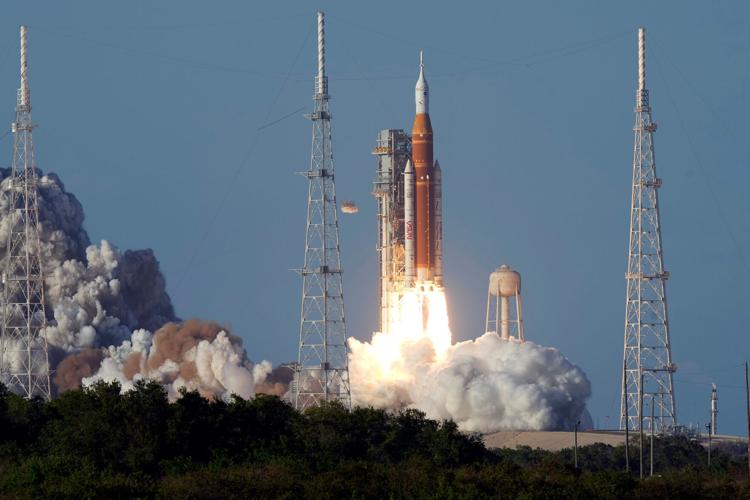
Artemis II set sail from the same Florida launch site that sent Apollo's explorers to the moon. The handful still alive cheered this next generation's grand adventure as the Space Launch System rocket thundered into the early evening sky, a nearly full moon beckoning about 248,000 miles away.
People are also reading…

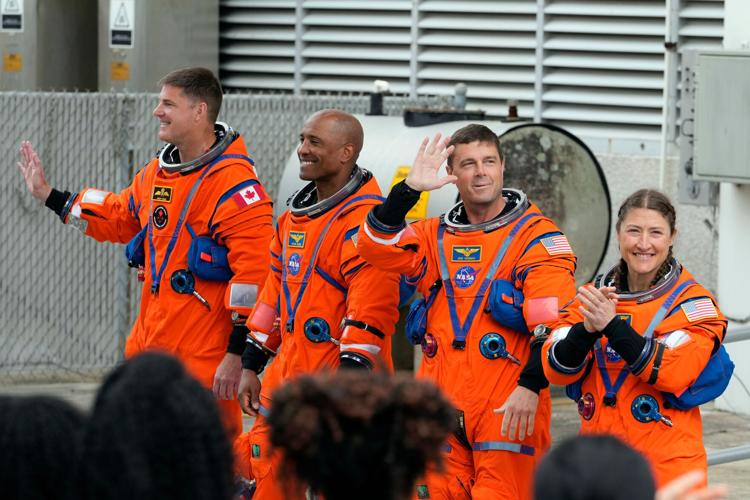
Astronauts, from left, Mission Specialist Jeremy Hansen of Canada, Pilot Victor Glover, Commander Reid Wiseman and Mission Specialist Christina Koch leave the Operations and Checkout Building on Wednesday for a trip to Launch Pad 39-B and a planned liftoff on NASA's Artemis II moon rocket at the Kennedy Space Center in Cape Canaveral, Fla.
Artemis II commander Reid Wiseman led the charge into space with "Let's go to the moon!" accompanied by pilot Victor Glover, Christina Koch and Canada's Jeremy Hansen. It was the most diverse lunar crew ever with the first woman, person of color and non-U.S. citizen riding in NASA's new Orion capsule.
They shaped their hands into hearts as they said goodbye to their families and boarded the astrovan for the ride to the pad and their awaiting space chariot. "Love you guys," Glover said.
The astronauts will stick close to home for the first 25 hours of their 10-day test flight, checking out the capsule in orbit around Earth before firing the main engine that will propel them to the moon.
They won't pause for a stopover or orbit the moon like Apollo 8's first lunar visitors did so famously on Christmas Eve 1968, reading from Genesis. But they stand to become the most distant humans ever when their capsule zooms past the moon and continues another 4,000 miles beyond, before making a U-turn and tearing straight home to a splashdown in the Pacific.

NASA's Artemis II moon rocket lifts off Wednesday from the Kennedy Space Center's Launch Pad39-B in Cape Canaveral, Fla.
Once settled in a high orbit around Earth, the astronauts planned to assume manual control and practice steering their capsule around the rocket's detached upper stage, venturing within 33 feet. NASA wants to know how Orion handles in case the self-flying feature fails and the pilots need to take control.
Four days later during the lunar flyby, the moon will appear to be the size of a basketball held at arm's length. The astronauts will take turns peering through Orion's windows with cameras. If the lighting is right, they should see features never before viewed through human eyes. They'll also catch snippets of a total solar eclipse, donning eclipse glasses as the moon briefly blocks the sun from their perspective and the corona is revealed.
All of NASA's moon plans — a surge in launches over the next several years leading to a sustainable moon base for astronauts assisted by robotic rovers and drones — hinge on Artemis II going well.
It's been more than three years since Artemis I, the only other time NASA's SLS rocket and Orion capsule soared. With no one aboard, the Artemis I capsule lacked life-support equipment and other crew essentials like a water dispenser and toilet.
These systems are now making their space debut on Artemis II, ratcheting up the risk.

NASA employees react Wednesday as astronauts leave the Operations and Checkout Building for a trip to Launch Pad 39-B and a planned liftoff on NASA's Artemis II moon rocket at the Kennedy Space Center in Cape Canaveral, Fla.
"There's always been a lot riding on this mission," NASA's Lori Glaze said ahead of launch. But the teams are even more "energized" now that the space agency is finally accelerating the lunar launch pace and laser-focusing on surface operations — seismic changes announced recently by new administrator Jared Isaacman.
Until Isaacman's program makeover, Artemis III was crawling toward a moon landing no sooner than 2029. The billionaire spacewalker slid in a new Artemis III for 2027 so astronauts could practice docking their Orion capsule with a lunar lander in orbit around Earth. Astronauts' momentous landing near the moon's south pole shifted to Artemis IV in 2028 — two years before an anticipated Chinese crew's arrival.
Like Apollo 13 — astronauts' only moon landing miss — Artemis II will use a free-return, lunar flyby trajectory to get home with gravity's tug and a minimum of gas. The gravity of both the moon and Earth will provide much if not most of the oomph to keep Orion on its out-and-back, figure-eight loop.
Speaking with FRANCE 24's Sharon Gaffney, Dr David Brown, Senior Research Fellow in the Astronomy and Astrophysics Group at Warwick University, hopes that the Artemis II mission "is the start of a new era of human spaceflight", adding that "it is incredibly exciting and inspiring to see that this is still something that wa can do and something that people can aspire to do".
The danger is right up there for Artemis II. NASA refused to release its risk assessment for the mission. Managers contend it's better than 50-50 — the usual odds for a new rocket — but how much more is murky.
The SLS rocket leaked flammable hydrogen fuel during ground tests, a recurring problem that engineers still do not completely understand. The hydrogen leaks and unrelated helium blockages stalled the flight for two months, coming on top of years of vexing delays and cost overruns. Both problems also thwarted Artemis I, whose capsule returned with excessive heat shield damage.
To NASA's relief, Wednesday's countdown was leak-free but a few issues cropped up in the final hours.
"It is our strong hope that this mission is the start of an era where everyone, every person on Earth, can look at the moon and think of it as also a destination," Koch said at a weekend news conference.
"It's the story of humanity," Glover added. "Not Black history, not women's history, but that it becomes human history."
30 breathtaking images from NASA's public library
30 breathtaking images from NASA's public library

The National Aeronautics and Space Administration (NASA) in 2017 opened the digital doors to its image and video library website, allowing the public to access more than 140,000 images, videos, and audio files. The collection provides unprecedented views of space. Stacker reviewed the collection to select 30 of the most breathtaking images, curated here with further information about the captured scenes.
NASA officially began operations on Oct. 1, 1958, as the primary organization for U.S. civil aerospace research and development. In just 11 years, NASA in 1969 landed the first human on the moon. In the 1970s, the focus shifted to developing a space station. Skylab was launched, unmanned, in May 1973. Three crewed missions followed during the next seven months to repair the station and conduct experiments. The first international space station partnership was the Apollo-Soyuz Test Project in 1975, which brought American and Soviet crews together.
The space shuttle program became fully realized in April 1981 with the manned launch of the Columbia. In 135 missions flown with five shuttles, there were two catastrophic accidents—Challenger and Columbia. Discovery delivered the Hubble Space Telescope into orbit. The 30-year shuttle program was significant in setting the foundation for future Earth-to-orbit transportation and sustained space stays.
Shuttle technology led to the construction of the International Space Station, the largest structure humans have put into space. Two hundred thirty people from 18 countries have lived there since 2000, conducting experiments and documenting life in space.
Achievements like these make up the substance of the NASA Image and Video Library, featuring the best of the agency’s work in aeronautics, astrophysics, Earth science, human spaceflight, and more. Keep reading to see 30 of these stunning images.
You may also like: Space discoveries that will blow your mind
The moon from Apollo 11

On July 20, 1969, Apollo 11 astronauts Neil Armstrong and Edwin Aldrin made history by landing on the moon while pilot Michael Collins remained in lunar orbit. While returning home on July 21, the crew captured this picture of the full moon. Earth’s only natural satellite, it circles us from an average distance of 238,900 miles away.
Earth from the International Space Station

An astronaut aboard the International Space Station shot a picture of Earth from 250 miles over Australia. Airglow—the orange hue—comprises diffuse bands of light created by atoms colliding in the atmosphere near the interface of Earth and space. Studying airglow is helping scientists to understand the connections between Earth weather and space weather.
Hurricanes on Earth

Several large hurricanes were brewing in the Atlantic Ocean in September 2017. By assembling several images taken in one day by the Visible Infrared Imaging Radiometer Suite, NASA could provide a vibrant look at this weather pattern. Views like this help communities make decisions about disaster preparedness, response, and recovery.
Shuttle space walk

In 2006, NASA astronaut Robert L. Curbeam Jr. and European Space Agency astronaut Christer Fuglesang continued construction on the International Space Station (ISS). Below them lie New Zealand and Cook Strait in the Pacific Ocean. The ISS must be maintained and repaired regularly so that its inhabitants can complete missions and experiments through at least 2024.
Shuttle in silhouette

An ISS crewmember captured a picture of the space shuttle Endeavour as it neared docking in February 2010. It was Endeavour’s 10th flight to the ISS with the mission of delivering Tranquility (a berthing, life support, and exercise module) and Cupola (a robotics work station).
Eruption on the sun

NASA’s Solar Dynamics Observatory documented a dramatic solar event on March 2, 2012. This explosion, appearing on the right side of the sun in the photograph, is called a “prominence eruption.” The prominence is made up of plasma—matter in an ultra-high-energy state even more volatile than gas—and can loop thousands of miles into space.
Raikoke volcano eruption

Raikoke Volcano sits on the remote Kuril Islands in the Pacific Ocean. On June 22, 2019, an ISS crew member captured an image of the volcanic plume of Raikoke’s first eruption in almost one hundred years. NASA satellites tracked the plume for activity that might affect aviation and climate.
Rover selfie

The Curiosity Mars rover provided a selfie as part of its 1,065th day of work on Aug. 5, 2015. A combination of multiple images taken by its Hand Lens Imager, the picture shows Curiosity on a rock called “Buckskin” on Mount Sharp. The mission to drill into Buckskin and collect a sample for analysis yielded the discovery of silica, which may show that liquid water once existed on Mars.
Cargo craft docks

The unmanned Cygnus cargo craft—the SS John Young—was photographed attaching itself to the International Space Station in November 2018 with a delivery of 7,400 pounds of supplies. The spacecraft was named after John Young, NASA’s longest-serving astronaut, who was an integral part of missions to the moon and the space shuttle program.
John Young on the moon

As part of the first extravehicular activity of its mission, Apollo 16 commander John W. Young jumps off the lunar surface while saluting the American flag in April 1972. Apollo 16 spent more than 20 hours on the surface, drove 16.6 miles in the lunar rover, and returned with 210 pounds of samples.
Canadian aurora

The snowy Quebec landscape is illuminated by the stars, the moon, and the aurora borealis in this picture from February 2012. Taken from the ISS, the image also shows airglow along the horizon. The Manicouagan Crater, seen in the lower right, was created by an asteroid impact approximately 214 million years ago.
Helix Nebula

Launched in 2003, the NASA Spitzer Space Telescope is orbiting 353 miles above Earth. In 2007, it took an infrared image of the Helix nebula (sometimes referred to as the "Eye of God"). This nebula is in the constellation of Aquarius, 650 light-years away.
The cracking Brunt Ice Shelf

In January 2019, NASA captured an image of Antarctica’s Brunt Ice Shelf as it neared a substantial break that will release an iceberg twice the size of New York City. The crack, at the top right of the image, is called the “Halloween crack,” as it first appeared in October 2016.
Cassini’s capture of Saturn

Cassini was in space for 20 years on a mission to explore Saturn and its rings and moons. In 2016, it took several images with a wide-angle camera which were combined to create one full depiction of the planet. Cassini completed its work, having delivered images and science results, by plunging into Saturn’s atmosphere.
The heart of Madagascar

A 2018 photograph of the heart of Madagascar shows great landscape changes in the region as captured from the ISS by NASA astronaut Ricky Arnold. The world’s fourth-largest island is experiencing the decimation of rainforests because of the demand for its unique resources.
The last landing

In 2011, the 30-year space shuttle program ended as Atlantis touched down at NASA’s Kennedy Space Center. With five shuttles ad 355 space flyers, the program completed 135 missions. Today, Atlantis is on display at the Kennedy Space Center Visitors’ Center.
The eye of the hurricane

The International Space Station captured the eye of a Category 4 hurricane in September 2018. Moving across the Atlantic toward the Carolinas, the hurricane’s winds were clocked at 130 miles per hour. Florence reached landfall on Sept. 14 with a record-breaking storm surge and rainfall.
International Space Station

During their separation on July 19, 2011, space shuttle Atlantis took this photograph of the International Space Station. Russian cosmonauts Andrei Borisenko, Sergei Volkov, and Alexander Samokutyayev, Japan Aerospace Exploration astronaut Satoshi Furukawa, and NASA astronauts Mike Fossum and Ron Garan were all aboard the ISS. The shuttle astronauts were Chris Ferguson, Doug Hurley, Sandy Magnus, and Rex Walheim.
Watercolor of the sea

Taken from observational satellite Landsat-8 in June 2018, this image of the Chukchi Sea illuminates colorful blooms of phytoplankton. Cool nutrient-rich water from the Bering Sea meet warm, less-salty Alaskan coastal water to create these patterns. The blooms can be seen even through deep Arctic ice cover.
The Great Red Spot of Jupiter

During a close pass of Jupiter in February 2019, NASA’s Juno spacecraft captured the gas giant planet and its Great Red Spot, which is the site of a massive storm on the planet’s surface. This view was created by citizen scientist Kevin M. Gill by compiling multiple images and data from the JunoCam. Juno was launched in 2011 and reached Jupiter in 2016. Its sole mission is to explore, study, and map the planet.
Monument Valley

In the Navajo Tribal Park on the border of Arizona and Utah, Monument Valley is one of the most recognizable areas of the American West. Red-rock formations and sandstone towers rise hundreds of feet above its sandy floor. The Operational Land Imager on Landsat-8 captured the elevation differences of the Valley in November 2016.
Flying through an aurora

Flying 200 miles above Earth has given the crew members on the International Space Station the opportunity to document the changes and events on their home planet from the Station’s unique perspective. In August 2014, the ISS flew through a green aurora. An aurora is observed when charged electrons from solar wind interact with Earth’s atmosphere.
Pillars of Creation

The Pillars of Creation are part of the Eagle Nebula, approximately 5,700 light years from Earth. This composite image uses data from NASA’s Chandra X-ray Observatory and the Hubble Space Telescope. The Pillars area of the nebula is an active star-forming region.
Total eclipse of the sun

The total solar eclipse of the sun on Aug. 21, 2017, offered a rare opportunity for NASA to collect data on the Earth-sun connection. Its long, uninterrupted path over land, starting at the Oregon coast where this image was captured, provided more time for scientists to study the sun's corona.
Untethered in space

In 1984, Mission Specialist Bruce McCandless II took the historic first untethered spacewalk. Floating a few meters away from Space Shuttle Challenger, he spent four hours in the Manned Maneuvering Unit (MMU). McCandless logged more than 300 hours in space during his long career with NASA.
Marbled Pluto

Pluto’s color variations were captured by NASA’s New Horizons space probe in 2015. The enhanced image shows the marbling effect of the dwarf planet’s diverse landforms. Pluto has mountains and plains with blue skies as well as ice and red snow.
The wild river

Captured by European Space Agency astronaut Thomas Pesquet in 2017, this image shows the 1,400-mile Dnieper River in snowy, icy February. The river runs from Russia to the Black Sea. The International Space Station orbits Earth 16 times each day and is keeping a visual record of our ever-changing planet.
Supermassive black hole

This computer-simulated image shows a supermassive black hole, weighing 17 billion suns, discovered in a sparsely populated area of the universe with the NASA’s Hubble Space Telescope and the Gemini Telescope in Hawaii. Black holes were previously believed to be located in very large galaxies in densely populated clusters. The black region in the center is the event horizon, where no light can escape from the black hole’s powerful gravity.
The space selfie

During a spacewalk to do maintenance on the International Space Station in March 2019, astronaut Nick Hague took a selfie. Documenting his first spacewalk, Hague was 250 miles above Earth. It wasn’t the first space selfie, though. Buzz Aldrin claimed that achievement during his moon walk in 1969.
An SLS test article

NASA’s Space Launch System (SLS) is a powerful rocket system designed to enable exploration far into the solar system. The rocket is intended to send Artemis 1, and the first woman lunar explorer, to the moon by 2024.