

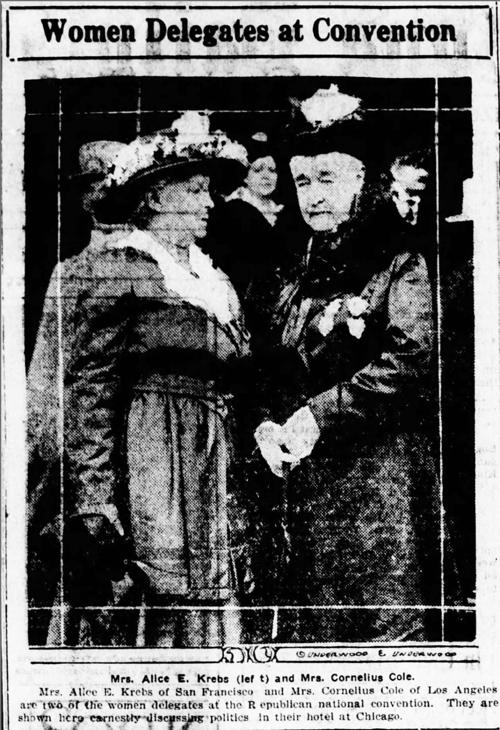
That women were admitted as delegates to the Republican National Convention in 1916 must have been a big deal, especially considering the fact that very few women would be able to vote in the presidential election.
Closer to home, danger lurked in the shadows for a Chinese merchant. From the Arizona Daily Star, June 11, 1916:
MERCHANT IS ASSAULTED AND STORE ROBBED
Highwaymen Brutally Beat a Chinaman, fracturing Skull; May Have Been Escaped Convicts; thugs Are Known
The boldest daylight robbery that has occurred in Tucson since the epidemic of assaults upon Chinese aroused the Chinese Six Companies last year, occurred yesterday afternoon at 12:30 o'clock, when Lee Shan Man, a merchant at Eighteenth and Convent streets, was assaulted, and between $50 and $100 taken from a cigar box that served as the merchant's cash register.
Lee was hit over the head with an iron bar as he was reaching for a piece of pie for which the highwayman-customer had called. His skull was fractured and he is in a serious condition, according to Dr. C. A. Schrader, who was called to examine the man's wounds. There are four other scalp wounds produced by the iron bar.
County Attorney Hilzinger visited the wounded man shortly after the robbery was reported and he was still conscious at that time, though suffering greatly. From the victim, officers learned the story of the robbery. At about 12:30 o'clock a man whom the Chinaman describes as being tall and sunburned, looking like an American, entered the place and bought a bottle of soda water. He drank this, went out, and in a few moments returned. This time he called for a piece of pie and as the merchant was reaching for it to serve him, the man grabbed him by the throat, while another man, described as a short, stocky Mexican, assaulted Lee with an iron bar, beating him down to the floor.
The men then rifled the cash box, located, it is believed, on the tall man's first trip to the store, and fled. They were seen running from the store by persons residing close by, who hurried into the store to find the merchant lying in a pool of blood.
Officers have as a witness a Mexican boy who claims to know the robbers, and any suspects arrested will be presented to him for identification.
Officers believe that the men may have been two of the escaped federal convicts and this theory was strengthened when it was learned that two of the convicts, Reynolds and Smith, had been arrested in the northern part of the city.
People are also reading…
In other news, ownership of a mule was in question. The mule had changed hands, as it were, a few times, so it is no wonder there was confusion.
INSPECTOR'S LETTER PROVES SENSATION
Advised Claimant of Mule to "Bar Out Other Brand"; Lopez Loses Suit
His right to possess one certain mule being questioned, in this case of James Westfall against Pedro Lopez, the defendant, Lopez, offered in evidence at the hearing of the case before Justice Comstock yesterday, a letter purporting to have been written by W. J. Bennett, livestock inspector at Benson. the letter proved a sensation and was taken possession of by Justice Comstock.
The letter, written on the stationery of a Benson hotel and dated December 27, 1915, was in reply, apparently to one that had been written Bennett by Lopez and said, in part:
"I would advise you to keep the mule. Bar out the other brand and say nothing about it to no one."
The writer of the letter advised Lopez that "they," the other claimants of the mule, could not obtain possession of the animal without replevin proceedings and expressed the belief that an attempt to obtain possession would not be made.
No evidence regarding the letter, whether or not there was an explanation that might controvert the literal sense of the words, was introduced, and in the absence of this the letter caused surprise, inasmuch as it is a serious offense to so change a brand.
After hearing the evidence, the court awarded the mule to the plaintiff, Westfall, and assessed the costs of the case against Lopez. The mule has a history that is more exciting that the ordinary, prosaic mule existence. It was taken up as a stray by the city poundmaster in 1912 and sold to the poundmaster. Prior to that the animal's life is veiled in mulelike obscurity. McCormick sold it to one McDaniels, McDaniels sold it to Albert Franco and Albert Franco sold it to James Westfall. From Westfall's premises the animal strayed to the premises of Pedro Lopez and when Westfall, learning of the mule's whereabouts, sent for it, Lopez, it is alleged, refused to surrender it. Thereupon, Westfall filed suit.
Since the filing of the suit, witnesses in the case have been called into court three times, traveling a distance of ninety miles to Tucson. The summons and subpoenas in the case now are mere tattered fragments. There was a touch of the pioneer ways of justice in this feature of the case. The deputy sheriff to whom the papers were sent by the justice, residing at Mammoth, instead of serving them and making a return, merely delivered them to Lopez. Lopez himself made the "return," inquiring of the court what they meant. As it turned out, they meant his dispossession of the mule.
The poor mule must have been confused as to its identity and home by this time. At least it was wanted by a number of people.
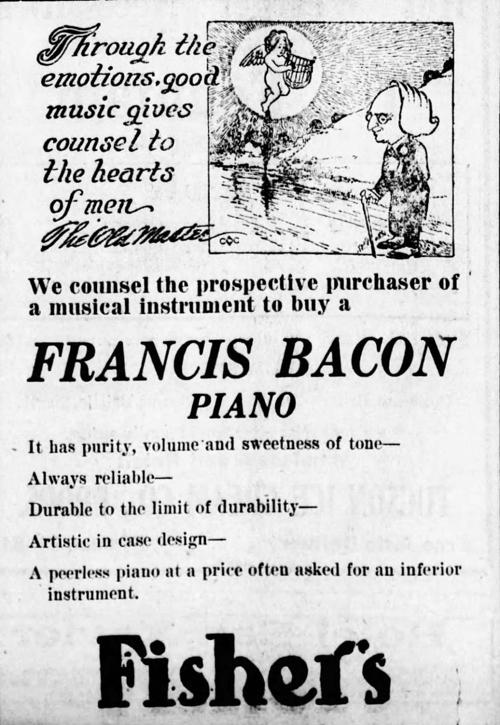
In the following advertisement, the Morgue Lady might have been more disposed to buy if the ad had contained a picture of a piano:
On a lighter note, it may be rare for the birthday party of a six-year-old to be news, but this one made the society page:
SIX-YEAR-OLD GIVES PARTY
Miss Pauline Margaret Hohusen, the winsome little daughter of Mr. and Mrs. J. P. Hohusen, celebrated her sixth birthday anniversary Thursday afternoon at her home, 316 South Sixth avenue, when she was showered with presents and congratulations by many playmates.
A particularly dainty color motif was evolved with quantities of pink sweet peas and feathery ferns, while the birthday tables were captivating with their exquisite decorations. Low crystal bowls centered each table, holding the fragrant blossoms. A large, pink birthday cake, radiant with six lighted tapers, held the interest of the children. Diminutive baskets, the handles tied with stunning bows of pink satin ribbons, and filled with bon bons, were the favors given to the little guests. It was an unusually pretty sight with the thirty-two small guests seated at the low tables, which had been placed in the garden.
During the afternoon all sorts of fascinating games were played by the merry children. Mrs. Hohusen was assisted in entertaining by Miss Elsie Siewart.
Those who shared Miss Pauline's birthday were: Pauline Seineke, Jessie Perry, Mary Langers, Audrey McClear, Helen Thorpe, Jane Thorpe, Genevieve Powers, Katherine Kindenfeld, Hortense Lindenfeld, Helen Schell, Wanda Hitchens, Sophie Pauli, Emily Pauli, Pauline Binkhorst, Margaret Stratton, Jane Butler, Alice Plumer, Edith Parker, Virginia Roberts, Gulie Caperton, Margaret Coberly, Ynez Ezekial, Dahlia Robles, Elsia Robles, Edna Arnold, Marguerite Yarbrough, Billy Schell, William Coberly, Harold McPherson, Mitchell, Hanovan, Knox Corbett, Billy Seineke.
The Morgue Lady can't help but wonder what will top this on the little girl's seventh birthday.
Note: This feature will not run tomorrow, June 12. The Arizona Daily Star did not publish on Mondays, including June 12, in 1916.


