
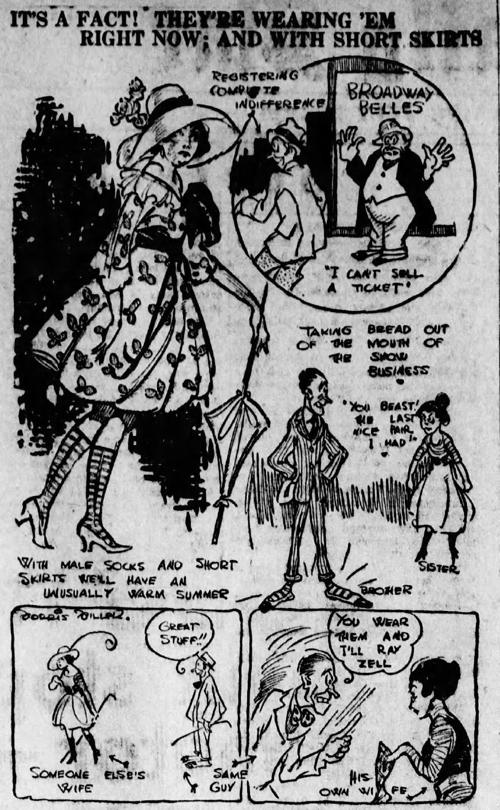
People were very concerned that women might show a couple of inches of bare leg between the bottom of a skirt and the top of the stockings. Those so concerned with a bit of skin are quite fortunate that could not see into the future and never saw the advent of mini skirts and short shorts.
From the Arizona Daily Star, Sunday, July 16, 1916:
IT’S A FACT! THEY’RE WEARING ‘EM RIGHT NOW; AND WITH SHORT SKIRTS
It may amuse, startle or enrage male readers to learn that the fashionable female young person is usurping masculine hose. There has been an advance in the price of full-length female hosiery—owing to the war or something—and the male sock has been found to be better quality, cheaper and just awfully cool and nice, declare these resourceful young women. Besides, you can almost never tell the difference.
Short skirts are shorter than ever just now. With the appearance of the make half-hose there has been apprehension felt in the more prudish circles over the alarming possibility of a gap or hiatus in the female costume. To be blunt about it, the top of the hose and the bottom of the skirt are seen to be at a remove of several inches. In this interval there is exposed to the night air and to the polite wonder of those about, a small portion of the wearer’s bicep, be it spare or plump.
It is very friendly of the women to help make the warm weather more tolerable. Men can’t walk the streets in bathing suits with any seemliness, but it will please them to see other men’s wives and sisters in relief from the heat. You go down the street any hot day and here comes a young woman with the northern exposure mentioned and you feel refreshed. You do at least if you get a good look.
People are also reading…
In other news, a doctor in New Mexico was outraged that a Tucsonan had stolen a quart of whiskey (kept for medicinal purposes, of course) and other items from him. The whiskey seemed to bother him the most.
COMBS SOUTHWEST FOR MAN WITH QUART
Local Police Asked to Intercept Doctor Who Got Away With Booze
Righteous indignation over the loss of $5, a quart of whiskey and a pair of automobile gloves, is expressed in a letter to the Tucson police from Dr. F. M. Sexton, of Lake Arthur, N. M., in which he charges that Dr. C. K. Crawford is responsible for his loss. The letter of Dr. Sexton’s is certified by an accompanying letter from H. C. Henry, justice of the peace, who writes, “Dr. Sexton is a perfect gentleman.”
Justice Henry states that Crawford was arrested with others at the Santa Fe depot in Lake Arthur, and that he turned Crawford lose with the understanding that he was to “refund” the $5 and the quart of whiskey to Dr. Sexton.
“But he (Crawford) did not do this and ran off for parts unknown,” Justice Henry writes.
Hence the indignation of Dr. Sexton. He brands Crawford, whom he thinks may be in Tucson, with many undesirable epithets and requests the police to show him the letter, declaring that he will have Crawford “jugged” if he does not “come across.”
Dr. Sexton does not wish it understood, however, that the whiskey is for “personal use.” In a postscript he writes:
“I usually keep a little whiskey for medical use and not for my own palate. . . . I never indulge in drink. He was given but a short time to get of of this section.”
The indignation of Dr. Sexton over the loss of one quart of the bonded stuff may be understood when it is stated that Lake Arthur is one of the numerous dry towns in the prosperous Pecos valley, the only wet city being Roswell.