

100 years ago in Tucson series: July 1916
- Updated
Things were different 100 years ago. How different were they?

- Johanna Eubank
- Updated
University Extension services have long been available to help people with many little household and other duties.
In this case, an article by the University of Arizona Extension service discussed the science of baking a cake.
From the Arizona Daily Star, Sunday, July 30, 1916:
THE SCIENCE OF BAKING A CAKE
By Edith C. Salisbury, Home Economics Specialist, University of Arizona, Agricultural Extension Service and U. S. D. A.
In cake making sugar and flour are combined to make a sweet batter. The lightness is obtained by entangling air in the eggs and by the formation of a gas resulting from the union of soda and cream of tartar baking powder—with a liquid; or with soda and sour milk. Since sugar and eggs burn easily a more moderate heat is required in making cake than for bread or biscuits.
In sponge cake or cakes made without butter the lightness is often entirely obtained from the expansion of air in egg albumen and a very slow oven is necessary in baking.
UTENSILS—Those generally used in cake-making are: mixing bowl, measuring cups, mixing spoon (wooden or granite), measuring spoons table or teaspoon, cake pans (tin or aluminum), flour sifter, egg beaters (wire or Dover).
GENERAL RULES—1. The oven must be ready before mixing the cake.
2. All utensils and ingredients should be ready before mixing the cake.
3. The cake pans should be well greased and dusted with flour to prevent sticking and to produce a dry, golden-brown crust.
4. Sift flour before measuring. Once or twice sifting after measuring makes a lighter cake. Pastry or soft wheat flour is best.
5. Fine granulated sugar should be used. If powdered or brown sugar is required, roll or sift it to free from lumps.
6. Vegetable fats, as crisco and cotolene; chicken fat, a mixture of lard and butter, beef fat and butter may be substituted for butter as shortening with very good results.
7. Water, substituted for milk, makes a more delicate cake.
8. Thoroughly creaming butter and sugar together makes a fine grained cake of delicate texture.
9. Whole eggs or egg yolks may be added unbeaten, one at a time, to the creamed butter and sugar and if thoroughly beaten, will give quite as good results as when beaten in a separate bowl before adding to the butter and sugar.
10. Egg whites should be beaten on a plate or platter with a wire whisk or fork in order to entangle the greatest amount of air in them.
11. Milk and dry ingredients may be added alternately to the creamed butter and sugar.
12. Flavoring is added last.
13. If stiffly beaten egg whites are used, they should be gently folded into the batter after all mixing and beating are finished.
BAKING—The time for baking should be divided into four quarters, the first quarter for rising, second and third quarters for browning and the last quarter to finish cooking inside if the cake. This is done at a lower temperature that the browning of the cake. The oven should not be so hot during the first quarter as during the second and third. Cakes containing whites of eggs stiffly beaten should be baked in a very moderate oven. Cakes containing chocolate, molasses and fruits, require a slower oven than plain butter cakes. Average time required for a layer cake, without fruit, 40 minutes to one hour, depending on size; with fruit, molasses or chocolate, 10 to 15 minutes longer. A well baked cake shrinks from the side of the tin and springs back when pressed with the finger. The broom straw test is most reliable for loaf cakes. Pierce the cake with a clean straw, if batter clings to it when withdrawn the cake is not sufficiently baked.
FAVORITE CAKE—One third cup butter, one cup sugar, two eggs, one half-cup of milk, one and three-fourths cups of flour, two and one-half teaspoons of baking powder, one teaspoon vanilla or other flavoring.
Cream the butter and sugar together gradually, add eggs one at a time, and beat until light; then add milk, alternating with the dry ingredients sifted together. Bake in two layer or one loaf tin.
SILVER CAKE—One-third cup butter, one cup sugar, one-half cup milk, one and three-fourths cups flour, two and one-half teaspoons baking powder, whites of three eggs, one teaspoon flavoring, vanilla or a picture of vanilla and almond.
Cream the butter and sugar together; add milk gradually, alternating with dry ingredients sifted together. Add flavoring. Last fold in lightly the stiffly beaten whites. Do not beat cake after the egg whites have been added.
SUNSHINE CAKE—One-fourth cup butter, one cup sugar, yolks of three eggs, one-half cup milk, one and three-fourths cups flour, three teaspoons baking powder, one teaspoon flavoring.
Directions same as for Silver cake except egg yolks are added one at a time to the creamed butter and sugar and are beaten until very light. Both these caked make two medium sized layers.
CREAM FROSTING—One cup of granulated sugar, one teaspoon of corn starch mixed together, add three tablespoons of boiling water, set on the back of the stove until sugar is dissolved, then boil two and one-half minutes, taking time when syrup is bubbling in the center. Remove quickly from the fire and pour slowly over the stiffly beaten white of one or two eggs. Beat constantly until the right consistency to spread over the cake, that is, until the frosting will almost hold its shape when piled up. Flavor with one teaspoon of vanilla.
This frosting is easy made if water is measured exactly, if sugar is dissolved before syrup boils and if the time of boiling is carefully watched.
CHOCOLATE FROSTING—One and one-half squares of chocolate or one-third cup of cocoa, one-half cop hot milk or thin cream, few grains of salt, yolk of one egg, one-half teaspoon butter, one-half teaspoon vanilla, powdered sugar.
Melt the chocolate over hot water and add to the hot milk gradually; add the beaten egg yolk and other ingredients, and when slightly cook add sugar gradually until the right consistency to spread—about two and one-half cups.
- Johanna Eubank
- Updated
How would you feel to find out that goodies, those "care packages" you sent to your deployed military service family member, were diverted to a warehouse and never given to the addressee? For starters, any food items would probably be worthless. But wouldn't that be considered mail fraud? Is the military exempt from such charges even when the contents of the mail are perfectly appropriate?
Of course, this incident was 100 years ago. Rules may have changed, but would outrage?
From the Arizona Daily Star, Saturday, July 29, 1916:
Dainties for Guardsmen Stored, Not Given Them
Chaplains Request That Public Send Gifts in Their Care to Insure Distribution
DOUGLAS, July 28.—At a meeting of chaplains of the regular army and national guard organizations stationed along the border in Arizona and New Mexico, held here today, a discussion is said to have revealed the fact that tons of supplies sent by friends of national guardsmen to the various organizations in which they are enlisted have failed to reach the guardsmen. Instead of being distributed as they should, dainties, extra clothing and other comforts, intended to make border duty more pleasant for the men, were said to be stored in warehouses.
The chaplains requested that the people of the country be advised that in sending presents to relatives or friends in the national guard, the packages should be sent in care of the chaplains attached to the particular organization of which they are members.
That’s good advice, but what about all of the gifts stored in warehouses. Were they ever distributed? What happened to these "stolen" dainties?
That same paper held the news of another suicide. It would seem self-destructive behavior is nothing new.
Young Man Ends Life Because Sweetheart Valued Love Lightly
Too Late Mercedes Regrets Faithlessness; Would Woo Life Back
Tragedy and comedy mingled in a curious manner yesterday evening in the dingy little home of Alfano Chacon, on South Meyer street. Ignacio Ruelas, a miner, crazed by the unfaithfulness of his sweetheart “Mercedes,” shot himself to death while lying on one bed in the front room, and on the other couch Jesus Bojorquez, better known to the town as “Charlie Chaplin.” a half-witted young fellow, was stretched laughing and joking, entirely unable to comprehend the terrible tragedy being enacted.
Rules shot himself twice in the mouth with a 38-caliber revolver, evidently an old weapon. He was dressed. In firing the short he had held the gun in his right hand and guided the muzzle between his lips with his left hand, which was stained and burned with powder. The shot was fired about 9:30 o’clock, soon after Ruelas came to the room.
Young Chacon lives with his mother at this place, and Jesus Bojorquez, the simple minded boy, is his brother. He took Ruelas in to stay with him out of kindness.
Rules and his sweetheart came to the city three days ago from the Old Yuma mine, where he had been working. She deserted him immediately on arriving in town, friends of Ruelas said yesterday evening, and her unfaithfulness drove him into a sort of dementia. He left no word of any kind telling the reason for his act.
While Coroner Comstock and Officer Mills were investigating the case, Mercedes herself rushed into the room sobbing and crying. The officers interposed when she was about to throw herself across the bloodstained, prostrate form of her dead lover, and she sank into a chair, screaming and crying wildly.
Later she was sent from the room to a neighbor’s house, where she moaned incoherently her grief at the sudden end to her lover.
Young Chacon was sleeping in the back room when the shot was fired and immediately ran from the house to relative’s nearby, where he fainted. He was given medical treatment and recovered.
Not much was known of Ruelas except that he was a hard working young man. His father and mother are said to reside at a mine nearby.
The shooting and subsequent excitement, with the investigations of the officers and the great throng about the house, did not have any effect on “Charlie Chaplin.” He lay on his couch and laughed and made funny gestures through the whole proceeding.
The remains were taken to the Tucson Undertaking company to be prepared for burial. Funeral arrangements will await the arrival of the father and mother.

- Johanna Eubank
- Updated
The recent death at the sanitarium was ruled a suicide, but the reason was still only speculation.
From the Arizona Daily Star, Friday, July 28, 1916:
Heart Torn to Bits By Two Revolver Shots
Whether “Baron” Was Name or Title Not Shown at Eckels’ Inquest
Whether “Baron” was the first name of the youth, Baron Barnes Wadsworth Eckels, who, according to the verdict of a coroner’s jury yesterday, committed suicide Wednesday evening at a local sanitarium, or a “title” taken to enhance the adventure of a trip to South Sea Islands, was not brought out at the inquest yesterday.
the jury returned a verdict of suicide by self-inflicted gunshot wounds, the facts related by witnesses being substantially the same as published in The Star yesterday morning.
The letter found among Eckels effects, directed to a sister at St. Mary’s hospital, which it was thought might throw some light upon the cause of the young man’s self destruction, was merely a communication regarding forwarding his mail, written June 14 after he had left St. Mary’s and gone to Oracle.
Eckel’s heart was practically torn to pieces by the two 38-caliber bullets, according to the testimony of the physician. The two bullets struck the wall of the bath room in which the young man died, about 18 inches apart.
Several bootleggers saw the writing on the wall and changed their pleas to guilty.
Henry Meyer Changes Plea; Admits Guilt
Juan Matos Also Changes Plea to Guilty; ‘Knothole Case’ Today
Henry Meyer, former sergeant of the Tucson police force, plead guilty in the superior court yesterday to the charge of violating the prohibition law, and will be sentenced Saturday morning. Meyer was one of those arrested during the recent raid on soft drink establishments in the city. He at first entered a plea of not guilty but yesterday he changed his plea to guilty.
Juan Matos, of Silverbell, charged with violating the prohibition law, also changed his plea to guilty yesterday and will be sentenced Saturday, which will be sentence day for a number of convicted bootleggers, including Joe Mendibles, an order setting his time for sentence on Saturday having been entered yesterday.
The case of John Doe Richmond, the defendant in the “knothole case” will be called this morning when court convenes.
A student and employee of the University of Arizona had been electrocuted more than a year earlier. His father sued the university for negligence.
FATHER OF LEO CLOUD SUES U.A. FOR $50,000
Alleged Young Athlete’s Death Was Due to Negligence of Employers
Charging the University of Arizona and the board of regents of the university with negligence in permitting non-insulated wires to be used in connection with the light and power system on the campus, Joseph L. Cloud, father of Leo Cloud, the young tennis player and all-round athlete who was electrocuted while employed on the campus March 7, 1915, yesterday brought suit in the superior court for damages in the sum of $50,000.
Leo Cloud was one of the best known University students during his attendance at the institution, and was as efficient in his studies as he was in athletics. His death as the result of coming in contact with a live wire while painting a water tank, shocked the entire community at the time.
The complaint filed in the superior court yesterday comprises a recital of the facts, as alleged, and a request for damages in the sum of $50,000. It is alleged that the university and board of regents, by whom Cloud was employed, were negligent in permitting the use of a power wire from which the insulation had been torn away by weather and exposed for a space of from six inches to a foot at the place above which Cloud was working.
When the platform on which he was standing was lowered by the foreman of the job, it is alleged, Cloud was brought into contact with the live wire, carrying a voltage of 2400. Cloud was 22 years old at that time and damages sought are based on an earning capacity of $100 per month.
Lastly, lightning killed a woman as she sat inside her home amidst her family. No one else was injured, but the incident surely made people feel that life — and death — were fickle.
Sahuarita Woman Is Killed by Lightning
Bolt Finds Mrs. Teresa Martinez as She Sits in Her Home
The body of Mrs. Teresa Martinez, who was killed by lightning at Sahuarita Wednesday afternoon, was brought to the city yesterday and is being held at the Tucson Undertaking company until the facts regarding the woman’s death can be established. It is reported that the lightning bolt found the woman as she sat in her home in the midst of her family.
The body was viewed yesterday by Coroner Comstock and the evidences on her body that her death had been caused by being struck by lightning made it unlikely that an inquest will be held. The bolt struck the woman just above the right eye and the air was singed from the woman’s head. Profuse bleeding from the ears was another indication of death by lightning stroke.
Up to late yesterday afternoon the justice of the peace at Sahuarita had failed to report the circumstances attending the woman’s death and a deputy sheriff will go to Sahuarita this morning to make an investigation.
The body was brought in on an improvised stretcher fixed onto a Ford automobile. The woman’s husband did not accompany the body but sent word that he would come in last evening.

- Johanna Eubank
- Updated
It has often been said that newspapers only print bad news. The same is now often true of television news. It's sad to say that some days good news was a rarity.
A young man at a local sanitarium took his own life and left a few mysteries behind.
From the Arizona Daily Star, Thursday, July 27, 1916:
MAKE-BELIEVE BARON ENDS LIFE AT LOCAL SANITARIUM
Correspondence Regarding Proposed South Sea Island Trip Shows Nevada, Ia., Youth Planned to Travel as Peer — Ill Health Probable Cause
No cause aside from continued ill health could be discovered for the suicide of Benjamin W. Eckels, of Nevada, Ia., who shot himself twice through the heart in his private bathroom at the Tucson-Arizona sanitarium at 10:15 yesterday evening.
Icicles appeared to be all right during the day and patients and nurses at the hospital did not notice anything peculiar about his behavior. He spent the greater part of the day reading and after 9 o’clock went to lie down on his bed on the porch onto which his room opened.
About 10:15 o’clock Miss Alice Frantz, a nurse, was awakened by the sound of a shot from the bathroom. She heard a groan and then immediately another shot. She aroused Mrs. Harrison, another nurse, and they hurried to the bathroom but found the door locked. They then went outside and looked through the window into the lighted bathroom and found Eckels lying on the floor in a pool of blood, dead. He was dressed in palm beach trousers, and shirt and had slippers on his feet.
Coroner Comstock was notified and with Sheriff Forbes went to the scene of the suicide and made a complete investigation. Icicles was about 18 to 20 years of age and had been at the sanitarium for two months, living at St. Mary’s before that time. He was a quiet fellow and never talked much, the nurses said, but always paid his bills promptly and appeared to have plenty of money.
He did the shooting with a 38-caliber special Colt’s revolver, a new weapon that had never been fired before and which he had evidently purchased for the purpose. Three shells, two of them empty, were found in the gun.
Icicles had evidently stood facing the small bathroom window and fired twice in rapid succession, falling backwards. Apparently, he died almost instantly.
There was nothing left by Eckels to indicate the cause of his act. A letter was found addressed to Siuster Annie Josephs, of St. Mary’s hospital. It is expected that this letter, when opened, will throw some light on the cause of the suicide.
Icicles had intended to go Los Angeles Friday, so he told Dr. Mead Clyne, his physician. A letter was found in his trunk from the “Where-To-Go” travel bureau addressed to Baron Benj. Wadsworth Eckels in regard to a proposed trip to Australia, Tasmania and the South Sea Islands. It was evident from the letter that Eckels intended to assume the title of “Baron” on the trip. It was stated by the company that they had communicated already with the governor of Tasmania in regard to his visit.
A report car from the Nevada high school for 1912 was found in the trunk.It was evident from articles found in the room that he had resided at Albuquerque before coming to Tucson.
His parents, Mr. and Mrs. F. J. Eckels, reside at Nevada, Ia. A postcard to him from his brother, F. J. Eckels, Jr., was found. It was mailed from Sapulpa, Oklahoma, in 1912, when he was living at Nevada.
The remains were removed to the Parker Undertaking company rooms and his father notified by wire. Although the inquest may disclose some other motive, it was believed yesterday evening that the suicide of the young man was due to ill health, heart trouble and tuberculosis.
More unhappy news from the Star of this date included an accident at a mine.
Tucson Boy is Burned By Powder Explosion
Tom Satterwhite Victim of Painful Accident at Vekol Mine
Serious burns about the head and right arm were sustained Tuesday by Tom Satterwhite, 470 North Main street, at the Vekol mine south of Casa Grande, when a charge of powder exploded prematurely while he was working with it.
Young Satterwhite was rushed to Tucson by Superintendent M. M. Carpenter yesterday morning from Casa Grande and given medical treatment first at Casa Grande and later at Tucson. His eyesight will not be affected, it is announced and his other burns are not serious. His clothing caught fire from the explosion.

- Johanna Eubank
- Updated
A forest supervisor spent time assuring people that a sawmill on Mount Lemmon would not threaten the timber supply.
From the Arizona Daily Star, Wednesday, July 26, 1916:
SAWMILL NO MENACE TO TIMBER SUPPLY
No Timber for Export Will Be Cut From Local Forests, Says Johnson
That no timber would be cut in the Coronado-Chiricahua national forest for export and that only timber for domestic use would be cut, was the statement of Forest Supervisor Don P. Johnson of the local station, who returned yesterday from a visit of a week in the Catalinas.
Mr. Johnson stated that there was some apprehension among local people that an excess of timber would be cut because a new saw mill was being erected on the Webber homestead by Jim Westfall, forest ranger.
This is a saw mill of small capacity, Mr. Johnson stated yesterday, and is being erected by Westfall entirely as a private proposition. It is for the purpose of cutting timber for the erection of bungalows and houses for residents on the Webber homestead, which has been taken over by the Summerhaven company, composed of Tucson capitalists. Timber from trees on the Webber homestead will be cut, starting September 1.
Only trees that should be cut to make room for the natural growth will be sacrificed, and then the timber will be used only in the district.
There is no danger of and first “devastation,” Mr. Johnson declares, and people need not worry about this feature.
The Catalinas for climate and scenic beauty are far beyond what Mr. Johnson had expected, and he declared that with the exception of water, the mountains were fully up to the New Mexico mountains in every particular.
The trout streams in the Catalinas, he stated, were worthy of comment. He stated that Stanley [unreadable name] Jr., caught 24 trout in one day while he was there.
While in the mountains, Mr. Johnson also surveyed the land requested by the University of Arizona. Two sections on top of Mount Lemmon will be used for a biological laboratory. The altitude is approximately 9000 feet.
Another two sections in Rock Canyon will be used for a spring and fall military camp for the University cadets. The location is rather low and would be too hot for summer for camping purposes, but in the spring or fall it is just right. There is running water at the camp site and thickets of cottonwood trees.
That same supervisor told the Luncheon Club all about the new Mount Lemmon road.
Luncheon Club to Hear Of Mount Lemmon Road
Supervisor Don Johnson Will Tell Observations of Recent Trip
Forest Supervisor Don P. Johnson recently arrived in the city to assume the duties of chief of the combined Coronado-Chiricahua National forest reserve, will be the principal speaker at the Friday meeting of the Tucson Luncheon club.
Supervisor Johnson has just returned from his first visit to the Catalinas and Mount Lemmon and he is very enthusiastic over the possibilities of these nearby mountains as a summer resort. He will give information in regard to the proposed road to Mount Lemmon and will answer any questions put to him with regard to the proposed government aid for highways.
It is thought that some definite action may be started in regard to obtaining federal aid for the proposed Mount Lemmon highway, which it is believed will cost more than the estimate of $100,000.
- Johanna Eubank
- Updated
It would be bad enough to be mistaken for someone who was wanted for a crime. Imagine it happening on the day you are supposed to be married. Instead you are held until your identity is confirmed.
From the Arizona Daily Star, Tuesday, July 25, 1916:
Bowie Sleuth Holds Bridegroom Because He Resembled Man Wanted
But Harold Savage Wins in Final Scene Showing Happy Wedding
A moving picture plot, perfect in every detail, even to the final happy wedding and the wedding march by the orchestra, with the scenes laid at Miami, Bowie and Tucson, was enacted by Harold C. Savage, a young business man of Miami, when he left Miami Saturday with the intention of coming to this city to wed Miss Lillian Huffman, a popular young woman of this city. To anticipate the happy denouement, Mr. Savage and Miss Huffman were married last evening at the Baptist church.
The scenario is about as follows:
Scene 1 at Miami, would picture Mr. Savage swinging merrily along the street en route to the station, where he purchases a ticket to Tucson. The ticket agent guesses the purpose of the trip by the happy manner of the young man. The train pulls in and then out, bearing the bridegroom.
Scene 2, at Bowie, reveals the train entering the station, where young Savage must change trains for Tucson. The orchestra introduces a turbulent motif in the music, for here is where the “villain” of the plot enters. He stands apart from the detraining passengers and his air of mystery identifies him as a sleuth.
“Hah,” he mutters under his breath and studiously cons a paper which he holds in his hand.
“Hah,” meaning that his suspicions are confirmed.
He must do his duty. He makes his way toward a group of passengers and lays his hand on the shoulder of Harold C. Savage. He is accused of resembling someone else, of violating some other man’s copyrighted physiogomy. The young man tries to explain. Nothing doing. “Fade away” pictures young man’s thought of girl waiting at the station in Tucson, disappointed when he did not arrive. Submits with resignation and asks detective to telephone to Tucson to ascertain his identity. He does so and learns that prisoner is none other than Harold C. Savage, brother of Ross Savage, well known business man of Tucson. Detective, disappointed, relinquishes prey, who is again pictured as happily boarding a train for Tucson.
Scene 3, pictures arrival; explanations. Shows Clerk S. A. Elrod, of the Pima superior court, issuing marriage license to Harold C. Savage and Miss Lillian Huffman. Final scene last evening at 8:30 o’clock, when marriage is performed at First Baptist church.
The title of the play? Well, how would this do: “Love Laughs at Marplots?”
The Morgue Lady didn't understand the reference for the play's title, so she looked up "marplot." It is defined as one who frustrates or ruins a plan or undertaking by meddling. Come to think of it, the meaning should have been obvious.
In other news, a young Tucsonan was training for opera roles.
Tucson Girl Training for Grand Opera Roles
Miss Trini Varela Chooses Constantino to Develop Her Voice
Down in a modest little home on Alameda street two fond parents, Mr. and Mrs. Secundino Varela, are anxiously waiting day by day for letters from their daughter, Miss Trini Varela, now in Los Angeles, that will tell the story of her battle for a position in the mimic world of grand opera.
Miss Varela left Tucson a few days ago for the coast city to begin her real musical training with Constantino, the great operatic tenor, still greater as an instructor in the Italian vocal method, and according to her first letter, received yesterday by her parents, she will begin her studies August 1.
In Tucson Miss Varela has not been well known as a singer. Her voice was first recognized by Herber Nixon, local tenor, who gave her some training and told her that she had a voice worthy of grand opera. She made her first appearance at a knight’s of Pythias social last spring with great success, and critics who heard her then were enthusiastic over the possibilities of her voice. Owing to an illness the present summer, she has been obliged to neglect her work, but now she will begin in earnest her fight to make a name for herself in the musical world.
Miss Varela is but 18 years of age and is a very attractive girl. In addition to her voice, she has everything that is necessary for success in grand opera, and her friends are very hopeful that the promise of her voice will be realized by hard work and careful instruction.
Her voice has the capacity for being a “big” voice and in addition it is sweet and flexible. Her range, already extensive, gives promise of great possibilities, and she takes high “C” very readily.
While in Los Angeles she will reside with relatives, Mr. and Mrs. G. Roletti, former residents of Tucson, who are very much interested in her.
- Johanna Eubank
- Updated
It appears Prohibition caused the court to be quite busy. Trials for bootleggers appeared to be commonplace.
From the Arizona Daily Star, Sunday July 23, 1916:
John Baker’s Time Will Be Four Years in Jail
If Given Same Punishment in Remaining Cases Term Would Be 12 Years
If he should not be able to pay the fine part of his sentence, John Baker, convicted in two cases of violating the prohibition law, in the superior court, Judge Frank Baxter presiding, will have to remain in jail approximately four years to satisfy the law. In each case his sentence was 1 year in prison and a find of $300.
Baker was sentenced by Judge Baxter yesterday afternoon at 2 o’clock. He was the first of the defendants arrested as the result of the recent crusade against blind tigers, to be tried at the present term of the court. There remain four cases against Baker, and if he should be given the same punishment in each he would have to remain in jail twelve years.
When the court reconvened yesterday morning, the trial of Chas. Phillips, colored, for violating the prohibition law, was resumed. It was begin Friday afternoon. The jury returned a verdict of guilty in this case. There remain two other cases against Phillips. He will be sentenced at 2 o’clock Monday afternoon.
A jury was sworn in to try the case of the state against Joe and Felix Mendibles, charged with violating the prohibition law, but following the qualification of the jury the court recessed until Monday morning at 9 o’clock. Edwin F. Jones is associated with Attorney McKay in the Mendibles defense.
The trial of the “bootlegging cases,” as they are conventionally called, is accompanied by a great deal of public interest, the court room seating capacity being taken at each trial. T. K. Marshall, president of the Arizona Temperance Federation, is a daily attendant; and the opposite “faith” is also well represented.
After sober reflection, several defendants in cases pending in the superior court, changed their pleas from not guilty to guilty and will be sentenced Saturday July 29. They are: Charles Roller, charged with gambling; Tom Dorrell, charged in two cases with violating the prohibition law; Ed Miller, charged in two cases with violating the prohibition law.
C. K. Crawford, charged with forgery, was sentenced to a penitentiary term from 1 to 5 years; Joachin Romero, charged with assault, one to three years; Antonio Roaching, charged with resisting an officer, was sentenced to pay a fine of $25.
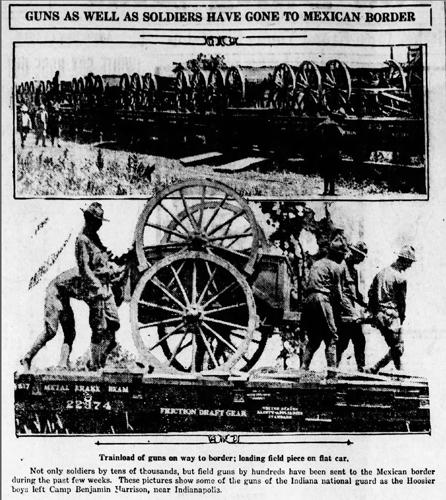
Border security and the potential for war with Mexico were also a concern, so military recruiting was stepped up.
Recruiting Station May Be Located Here
First Arizona Regiment of Reorganized Militia Needs More Men
Tucson may be chosen as a location for a recruiting station for the Reorganized Militia in case Private Cochran, of the First Arizona regiment, detailed to investigate the situation, finds that conditions warrant the establishment of the station here.
Cochran arrived in the city Friday and is looking over the ground before reporting to his superior officers. He is very much pleased over the outlook and will remain at least six days before returning to make his report at Douglas.
He will be at the armory daily from 9 o’clock in the morning until 3 o’clock in the afternoon, during which time he will be glad to meet anyone interested in joining the reorganized national guard now in the federal service.
Tucson possesses many natural advantages as a recruiting place. One of the strongest is the fact that during the fall and winter months thousands of transients pass through the city. Not a few of these are young men of good physique and habits who are temporarily down and out, but who would make first class soldiers of given a chance to enlist.
Just at present the government is making extraordinary efforts to fill up the companies of the national guard companies because of the fact that soon many of the married men and men with families dependent on them will be released from duty, according to Secretary Baker’s orders.
Mr. Cochran is a very pleasant appearing young man and has made a fine record already in recruiting in Bisbee and Douglas, and he will be ready to answer all questions relating to the army that will be asked by prospective guardsmen.
- Johanna Eubank
As soon as there were cars, there likely were car accidents. With no seatbelts, no airbags and many dirt roads, the results could be dire.
From the Arizona Daily Star, Saturday, July 22, 1916:
Car is Overturned and Occupants Injured
Machine Strikes Rock When at High Speed on Oracle Road
A Studebaker car was totally wrecked and the three occupants bruised and shaken up when the machine overturned on the Oracle road, opposite Holy Hope cemetery, yesterday afternoon.
Jesus Fimbres, of North Church street, a local automobile liveryman, was driving the car when it overturned. He stated yesterday evening that he was driving at the rate of 45 miles an hour when the machine truck a rock and overturned. He and his two companions, Polo Mendoza, 128 North Church street; and Felix Ortiz, of South Meyer street, were thrown out of the car. Timbres had his arm bruised but none of the others were injured.
The car formerly belonged to Byrd Brooks and was owned by Cruz Galvian on Convent street. Timbres was taken to the county jail and admitted to officers that he had taken a few drinks during the afternoon. Deputy Sheriff Ezekials investigated the matter and satisfied himself that none of the men were seriously injured.
The same day, the Star ran a profile of one of the candidates for Pima County Sheriff.
AS A PEACE OFFICER MILES IS A REGULAR
J. G. Miles, Candidate for Sheriff, None Other Than “Rye” Miles
“Rye” Miles, as a candidate needs to introduction to the voters of Pima county, and specially does he need none to the rural population, but for the benefit of some it may be necessary to state that J. T. Miles and “Rye” are one and the same person. He was christened J. T. by his parents but as is the custom among men who live in the wide, big open country, Miles was early given the name of “Rye” and it has stuck—as their tribute to the democracy and simplicity of character of their compadre.
Miles has a record as a peace officer which few can equal. He first came to Arizona—from Texas— back in 1897. As old timers know, Arizona’s population at that time was considered as “gross population” and Miles, as a ranger, belonged to that courageous force which reduced it to the “net population” or people that count. From that time until the present, his record has been absolutely clean and there is no man who can say that Miles has not been a practicer of good citizenship as well as a conscientious and courageous peace officer.
Miles first work as a piece officer after coming to Arizona was as a territorial ranger. That is in itself a recommendation. Next he served as a county ranger in Cochise county. While holding that position he was temporarily incapacitated for horseback riding and was forced to resign, accepting the position as constable at Benson, one of the most important peace offices in Cochise county. For several years Miles has been a cattle inspector in Pima county, which position he holds at present.
If nominated and elected sheriff of Pima county, Mr. Miles will make an efficient, painstaking, accommodating officer and he promises that he will choose deputies only on the ground of their fitness for the exacting duties as an officer of the law.
Bootleggers jeered the detectives who helped make the case against them. All we can say is, the detectives ended up on the better side of the bars.
Detectives Jeered By Prisoners Held For Running Blind Pigs
Roar of Derision Interrupts Court; Baker Guilty in two Cases
A demonstration by prisoners in the county jail against Detectives Tom and Allen Love, who have been instrumental in working up evidence against some of the defendants in Bootlegging cases on the docket of the present session of the superior court, occurred yesterday afternoon during the trial of Charles Phillips and Hannah Phillips, colored, charged with bootlegging.
The detectives were waiting in a room on the second floor of the court house, waiting to be called to the witness stand. When one of them appeared at an open window overlooking the jail court, shouts of derision went up from the prisoners assembled in the court below. The demonstration followed, it is said, when John Baker, who had just been convicted in the second case against him charging bootlegging, called attention to the detective in the window.
The windows in the back of the court room were open and the chorus of jeers that came up from below came near disturbing the procedure of the Phillips case. Several person rushed to the window to learn the cause of the disturbance, some thinking that a free-for-all fight had been started in the jail.
The two detectives were employed by the board of supervisors to ferret out blind tigers. They were assigned by the Thiele Detective Agency, of Los Angeles, and spent about two weeks in the city in the early part of June. They are brothers and near enough alike to be twins. They are young, well-dressed and nice appearing.
Baker was convicted in the second case against him about noon yesterday. He will be sentenced by Judge Frank Baxter, presiding, this afternoon at 2 o’clock and the four remaining cases against Baker will be tried next week, beginning Monday. Interruption of the trial of the remaining cases was caused by lack of a sufficient number of veniremen to form a jury and an extra venire of twenty was called.
The case of the state against Charles and Hannah Phillips, charged with violating the prohibition law, was taken up. The state put on the stand three witnesses who testified to having purchased whiskey from a club operated by Phillips and his wife on South Main street. The case will be resumed this morning when court meets.
A sensational moment came on the second Baker trial yesterday morning when the defendant, John Baker, being cross-examined by Judge John Campbell as to what Gay Alley was, answered that the judge should know as he once, with Benton Dick as once district attorney in Arizona. Judge Campbell declared that was an imputation on his honesty while serving as federal judge in Arizona and hotly demanded what Baker meant and who told him.
Baker responded that someone, he did not know who, told him that Judge Campbell had received #400 for “keeping the alley open.”
He stated that he did not know the man’s name but could identify him. Judge Campbell denounced the imputation as a lie and declared that as soon as he got off the bench he had brought injunction proceedings to close the alley. In his address to the jury he asked them if they could believe such an imputation and several audibly answered “no.”
- Johanna Eubank
A trade union declared that all city officials were crooks and should be ousted so the local government could begin anew. They weren't too happy with county officials either, but weren't proposing a clean sweep there.
From the Arizona Daily Star, Friday, July 21, 1916:
ALL CITY OFFICIALS CROOKS SAY UNIONS, DECLARING WAR
Trades Council to Rescue city From Disgrace—Aftermath of Row Over City Hall Contract—“Vice Versa” Threat Is Recalled
Charging that all city officials are crooks, and that some of the county officials are no better, the Tucson Central Trades Council is fostering a political movement to oust all such officials, specifically, the organizers of the movement charge that city officials regard the offices which they hold as means of grafting from the city treasury.
The organization of the “Taxpayers League” follows the recent declaration of war upon members of the council for refusing to reconsider their action in awarding the contract for the construction of the city hall to Crowell, a Los Angeles contractor, the lowest bidder by several thousand dollars. The alleged refusal of the contractor to employ union labor is the basis of the trades council’s enmity toward the council.
In one of the communications to the city council, the trades council said: “We remember our friends and VICE VERSA.” Apparently, the trades council is now getting ready to turn on the “vice versa.”
IN ROLL OF RESCUERS
The avowed object of the “Taxpayers’ League” is to rescue the city from the disgrace into which it has fallen. this condition of affairs, say the crusaders, arose while the citizens of the city have not been looking. While good people generally were absorbed in private pursuits, the city administration has been left to the “tender mercies of the professional politicians” whose apparent object is only to benefit themselves and those who have helped them into office.
Until the trades council jumped into the breech, “clean and decent citizens have felt a repugnance to enter into the kind of politics that generally prevail,” say the resolutions, announcing a local Armageddon. And so it happened, they say, that the administration of public affairs has been turned over to men who seem to look upon public office as a means “for private gain and aggrandizement.” The resolutions stop short of naming the guilty officials and the amount of the graft.
PLAY ALL PARTIES
The organization, the “Taxpayers’ League” will play all parties. The object of the league, in a word, is to purify politics. It proposes to oust the professionals and install the amateurs, or rather citizens chosen for their ability instead of professional cleverness in political manipulation, and after the league has elected them it will keep an eye on them to see that they do not do anything they should not do—if a mistake should be made and the wrong man elected.
A new “movement” was born Thursday night and a committee is now conducting an active campaign for members. Anyone who is politically pure in heart is qualified to join. The field of activity of the organization will be local, it is announced.
We are not so sure about local governments, but there are times we would advocate a clean sweep of both houses of Congress in Washington, D.C.
In other news, that newfangled machine, the automobile, was gaining attention and a count was made.
7318 Automobiles In Arizona; 2785 Fords
A complete list of motor vehicle statistics is contained in the recent report of Secretary of State Osborn just made public. The total number of vehicles registered in 1915 is 7318 an increase of more than 2200 over the previous year. Of this humber 6851 are gasoline motor cars, 22 are electric cars, 435 are trucks, and 405 motorcycles.
Fees for automobile licenses aggregate $40,909.50 the total fees received being $45,579.00. In the motor registration Ford cars lead with a total of 2785. Studebakers are next with a total of 702, Overlands are third with a total of 627, and Buicks are fourth at 540. Maxwells total 304 and Hupmobiles 259. there are 117 Chalmers and 122 Hudsons. Cadillacs number 237.
Maricopa county has the most motor vehicles, 2571; Cochise is second with 1216, and Pima is third with 754.

- Johanna Eubank
- Updated
The first accusation was against a Deacon, accused of stealing jewelry from a woman who managed to hold him for police in an innovative fashion.
From the Arizona Daily Star, Thursday, July 20, 1916:
Lured into Palace of Sweets By Dusty Siren Deacon Harris Trapped
Woman Phones for Police Who Arrest Church Pillar for Stealing Jewelry
“Won’t you all treat me to some ice cream,” is what Mrs. Annie Williams, who resides at 635 North Ninth street, said to Deacon Charles L. Harris, of the African Methodist church, when she met him at the corner of Stone and Congress yesterday evening.
“Shuah, ah will, Missus Williams,” Harris replied, and he made good his word by piloting her into the “Palace of Sweets,” where they ordered some of the cold stuff.
Mrs. Williams didn’t seem much interested in the ice cream but instead went to the telephone and called up a number. Pretty soon Desk Sergeant O’Donnell arrived on the scene and took Deacon Harris into custody on suspicion that he had stolen jewelry from Mrs. Williams. He was taken to the city jail and kept there all evening.
Harris strenuously denies the charge that he took any jewelry from Mrs. Williams. He says it is all framed up. The woman, however, insists that Harris is the guilty party and the matter will be thoroughly investigated by the police today.
The following day a small item ran in the Star saying that Harris had been released as there was no evidence found against him.
The next accusation led to the shooting of a chef by his brother-in-law, who accused his victim of hitting his wife, the shooter's sister.
SANTA RITA CHEF IS SHOT BY RELATIVE
Fritz Morris Wounded by W. D. Pearce Following Family Row
Following an argument in the Santa Rita hotel kitchen early yesterday morning, Fritz Morris, colored chef of the hotel, was shot and seriously wounded by his brother-in-law, W. D. Pearce, also colored. the latter was arrested and placed in the county jail, while Morris was sent to the Arizona Hospital.
The trouble between the two men is said to have arisen over the fact that Morris beat his wife, Pearce’s sister, Tuesday evening. The woman went to Pearce about the matter and the latter sought Morris at the hotel kitchen while he was preparing breakfast. According to witnesses, the two men talked to each other for several minutes. Pearce then fired at Morris and hurried from the hotel. He went to his home on Convent street where he was arrested later by Deputy Sheriff Louie Ezekials. He confessed the shooting and gave his gun up without any trouble.
Morris was sent to the Arizona hospital, where an examination disclosed the fact that the ball, which was from a 45 automatic had struck him in the left side below the ribs, penetrating his abdomen, and striking upward through his liver, found exit at the back of the lung. The condition of Morris was reported to be favorable at the hospital yesterday and there is a good chance for his recovery.
Pearce is a barber and he and Morris married sisters. A third sister is Mrs. Bragg, whose husband is serving a term at Florence for bootlegging, it is said.
Morris has been employed at the Santa Rita for about two years.
We certainly don't condone spousal abuse, nor do we condone shooting the suspected abuser.
The last accusation was made by some Mexicans who accused a railroad brakeman of assaulting them and breaking the arm of one of them when they wouldn't pay more bribery money to the brakeman for allowing them to ride without a ticket. Unfortunately, they could not give the name of the brakeman in question.
Beaten by Brakeman Story Mexicans Tell
Enrico Pacheco in Hospital With Left Arm Broken in Two Places
Two Mexicans were brought to the county jail yesterday afternoon suffering from painful wounds and bruises which they said were inflicted by a Southern Pacific brakeman at Vail station. They gave their names as Enrico Pacheco, whose left arm is said to have been broken in two places and who was otherwise injured, and Aurelia Pacheco. The latter suffered no broken bones as did Enrico, who was taken to St. Mary’s hospital for treatment after he had been examined at the county jail by Dr. Pratt, county physician.
The story told officers by the Mexicans was that they got on a Southern Pacific freight train at Benson and paid a brakeman a sum of money for permission to ride to Tucson but that the brakeman became angered at Vail when they refused to pay more money and he threw them from the train. The Mexicans did not give the brakeman’s name and no complaint was issued as a result of their story.
- Johanna Eubank
- Updated
Because women in the east wanted to wear ornamental June bugs in their hair, an enterprising boy in Tucson made a killing by selling the bugs.
From the Arizona Daily Star, Wednesday, July 19, 1916:
Tucson Boy Gets Order For 25,600 June Bugs From An Eastern Firm
Insects Will Be Used as Ornaments for Coiffures of New York’s “400”
Did you ever hear of June bugs being used for hat pins and other ornaments?
Probably not, and neither did Willis Downing, of 433 East Second street, until last week, when he received an order from an eastern jewelry firm for one hundred pounds of dried bronze June bugs.
The firm from which the order came converts the bugs into ornaments. In the process used the dried bugs are treated with a chemical that petrifies them, at the same time preserving their color and peculiar lustre. Then they are dipped in a cold and silver solution, the original bronze green tints still showing through.
Although the bugs when finished by this process, can be used for all sorts of articles, it is mainly for hair ornaments and hat pins that they are utilized.
Willis is quite enthusiastic over his new “business” and is making preparations for trapping the elusive bugs with just as much care and forethought as hunters employ in getting animals for menageries and zoological exhibits.
He expects to catch the bugs on grape vines and fig trees. In the June bug season the insects seek the fig trees and perhaps as many as four may be found on one fig. He will catch them either in a net or else by shaking them into a pail of water. Then he will dry them and ship them east in tin boxes containing about two pounds each.
As the average June bug weighs about one-sixteenth of an ounce, he will have to gather approximately 25,600 of the insects.
The eastern firm pays at the rate of 50 cents per pound, which is the present market rate on dried June bugs.
Well, people will buy almost anything!
Meanwhile, the Star reported on militiamen by printing a letter from one to his parents in Connecticut.
Typical Letter From Militiaman to Folks
Tells of Reception Given by Members of Tucson Red Cross
Tucson is getting some splendid advertising and publicity from the entertainment of national guardsmen passing through, although that was not the purpose, of course, of the local Red Cross and other who have aided in the work.
The following, from the Waterbury (Conn.) American is a sample of press notices that are appearing all over the United States.
Private Shaw’s home is at 94 Woodside avenue. He wrote as follows to his parents:
“We have just reached Nogales, and at this writing we are waiting on board train for orders. We were given tourist cars the day before yesterday, and believe me, they are moving palaces in comparison to this eon which we made the biggest part of the trip.
“Yesterday morning when we awoke we found ourselves in El Paso, Tex., one of the finest places we have struck since leaving Chicago. We have seen some real western life the last few days—regular cowboys greeting you at little stations that boast of three or four saloons and a general store. One rides for miles and miles without seeing a soul. Arizona is certainly the nearest to a desert that you can imagine.
“Last night about 8 o’clock we hit the town of Tucson which is the largest and richest in the Southwest. Here we were tendered quite a reception by the townspeople, getting all we wanted of coffee, milk, cookies, and cigars. We have quite a few good singers among us, and the people listened to our ‘concert’ with some delight.
“Trains are pulling in here (Nogales) every hour, from all points of the country with troops. They tell us the climate in this town is very healthy, being some distance above sea level. We are all in good condition and outside of the lack of exercise we can hardly realize that we have been riding for nearly a week.
“We haven’t heard any alarming [unreadable word] of the natives here are telling is of things that might happen. But we have heard so many different opinions as to the feeling of the people, we don’t know just what conditions are.”

- Johanna Eubank
- Updated
When the sheriff did a good turn for a laborer, the man decided to help the sheriff by giving up the bootlegger that supplied him.
From the Arizona Daily Star, Tuesday, July 18, 1916:
FATE SENDS SHERIFF BOOTLEGGER’S FOIL
Mexican Laborer, Done Good Turn, Gives Tip That Results in Raid
When Sheriff Forbes left Ajo Saturday he brought with him the complaining witness in a case against a man who has long been suspected by officers of conducting a blind tiger. Moreover, the sheriff, as an accommodation, cashed a pay check for the complaining witness with which he bought the booze from the bootlegger, he says.
When the sheriff was leaving the mining camp Saturday, after attending the arraignment of Jack Ellison on the charge of shooting L. L. Buck, he was accosted by C. Valenzuela, a Mexican laborer, who asked him for a ride to Gila Bend. The sheriff invited him to accompany him in an automobile and at Gila Bend he cashed a check for Valenzuela so the latter might buy a railroad ticket.
Arriving in Tucson, Valenzuela says he went to a soft drink stand at the corner of Broadway and St. Augustine Plaza operated by Jesus Provencio and bought a drink of whiskey. The drink was so good that he bought another.
He recovered consciousness early Sunday morning and found that he had been robbed of $20, his hat and his shoes. He reported the matter to Sheriff Forbes, who arranged a trip into which it is said Provencio walked unsuspectingly. Yesterday morning the sheriff’s officers raided Provencio’s place and seized a large quantity of booze and a number of barrels full of empty bottles. Province was arrested, charged with violating the probation law.
In other news, a youth stole a car and was surprised when the owner pressed charges.
YOUTH IS CHARGES WITH STEALING AUTO
Lopez Denies Car Was Taken to Expedite Elopement With Girl
Charged with the theft of an automobile, Jesus Lopez, a Mexican youth 18 years of age, was arrested by the police and turned over to the county officers yesterday. It is alleged that Lopez took an automobile belonging to Shad Bowyer. It was recovered at the time of his arrest.
Lopez was greatly surprised that his “friend” Bowyer resented his taking the automobile to take a joy ride with three other “friends” whose names Lopez professed not to know. When interviewed by County Attorney Hilzinger yesterday afternoon, Lopez readily agreed when the officials proposed to send for Bowyer, believing that his “friend” Bowyer would straighten out the matter and that he would be given liberty. Bowyer’s answer was to sign a complaint charging he youth with the theft of the automobile.
The story that was first told to the officers was that Lopez had taken the car for the purpose of expediting an elopement with his sweetheart, but this Lopez denied, saying that the parents of the girl had removed her to the country, forty miles from Tucson.
Lopez’ story of the joy ride in the automobile was that he was out with three friends who suggested the ride to him when they learned that he “could drive a Ford.” He told the county attorney he did not know the names of his three friends.
Lopez figured in a sensational case in justice court recently when he was charged by the parents of Miss Hortensia Lopez his first cousin, with disturbing the peace of the girl. The girl, however, completely disproved the charge by swearing on the stand that Jesus’ only disturbance of her peace was in making love to her and that her only desire was that he should disturb her peace some more. In that case Lopez was discharged with a lecture from the court that he must not wed Miss Hortensia, as it would be a violation of the law, she being his first cousin. Lopez left the court room unreconciled, vowing that he would wed the girl despite the law.
One might guess that the couple could elope to a state in which the law is not so strict.
- Johanna Eubank
- Updated
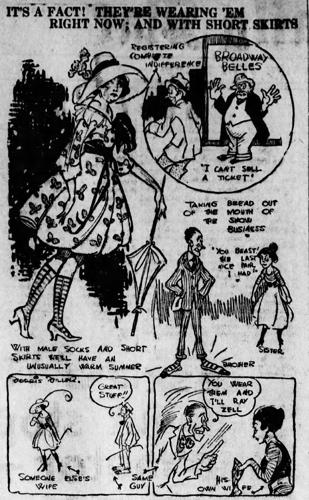
People were very concerned that women might show a couple of inches of bare leg between the bottom of a skirt and the top of the stockings. Those so concerned with a bit of skin are quite fortunate that could not see into the future and never saw the advent of mini skirts and short shorts.
From the Arizona Daily Star, Sunday, July 16, 1916:
IT’S A FACT! THEY’RE WEARING ‘EM RIGHT NOW; AND WITH SHORT SKIRTS
It may amuse, startle or enrage male readers to learn that the fashionable female young person is usurping masculine hose. There has been an advance in the price of full-length female hosiery—owing to the war or something—and the male sock has been found to be better quality, cheaper and just awfully cool and nice, declare these resourceful young women. Besides, you can almost never tell the difference.
Short skirts are shorter than ever just now. With the appearance of the make half-hose there has been apprehension felt in the more prudish circles over the alarming possibility of a gap or hiatus in the female costume. To be blunt about it, the top of the hose and the bottom of the skirt are seen to be at a remove of several inches. In this interval there is exposed to the night air and to the polite wonder of those about, a small portion of the wearer’s bicep, be it spare or plump.
It is very friendly of the women to help make the warm weather more tolerable. Men can’t walk the streets in bathing suits with any seemliness, but it will please them to see other men’s wives and sisters in relief from the heat. You go down the street any hot day and here comes a young woman with the northern exposure mentioned and you feel refreshed. You do at least if you get a good look.
In other news, a doctor in New Mexico was outraged that a Tucsonan had stolen a quart of whiskey (kept for medicinal purposes, of course) and other items from him. The whiskey seemed to bother him the most.
COMBS SOUTHWEST FOR MAN WITH QUART
Local Police Asked to Intercept Doctor Who Got Away With Booze
Righteous indignation over the loss of $5, a quart of whiskey and a pair of automobile gloves, is expressed in a letter to the Tucson police from Dr. F. M. Sexton, of Lake Arthur, N. M., in which he charges that Dr. C. K. Crawford is responsible for his loss. The letter of Dr. Sexton’s is certified by an accompanying letter from H. C. Henry, justice of the peace, who writes, “Dr. Sexton is a perfect gentleman.”
Justice Henry states that Crawford was arrested with others at the Santa Fe depot in Lake Arthur, and that he turned Crawford lose with the understanding that he was to “refund” the $5 and the quart of whiskey to Dr. Sexton.
“But he (Crawford) did not do this and ran off for parts unknown,” Justice Henry writes.
Hence the indignation of Dr. Sexton. He brands Crawford, whom he thinks may be in Tucson, with many undesirable epithets and requests the police to show him the letter, declaring that he will have Crawford “jugged” if he does not “come across.”
Dr. Sexton does not wish it understood, however, that the whiskey is for “personal use.” In a postscript he writes:
“I usually keep a little whiskey for medical use and not for my own palate. . . . I never indulge in drink. He was given but a short time to get of of this section.”
The indignation of Dr. Sexton over the loss of one quart of the bonded stuff may be understood when it is stated that Lake Arthur is one of the numerous dry towns in the prosperous Pecos valley, the only wet city being Roswell.

- Johanna Eubank
- Updated
A man found work in Ajo and left his wife behind in Tucson. Then he sent for her once he found a place for them to live; not an unusual thing to do. The response he received was cryptic to say the least.
From the Arizona Daily Star, Saturday, July 15, 1916:
Woman’s Disappearance Remains Mystery After All-Day Investigation
Strangely Worded Telegram Brings Husband Home to Find Wife Gone
George McCoy enlisted the aid of both the police department and the sheriff’s office yesterday in his search for his wife, who has disappeared under somewhat mysterious circumstances. Up to last evening their efforts had been in vain. McCoy, who also spent all of yesterday in following every available clue, had not located his wife last evening.
McCoy arrived Thursday from Ajo, where he had gone sometime ago to accept a position, and when he had prepared a home there he telegraphed his wife early this week to come to Ajo at once.
A short time later McCoy received a telegram that brought him post haste to Tucson, where he reported the matter to Sheriff Forbes and Chief of Police Cullen.
The telegram that McCoy received was signed by “Mabel Davis,” a person unknown to either the officers or to McCoy. The author of it took McCoy to task for sending for his wife to come to Ajo but was more or less cryptic to the officers.
“Brace up and be a man if you can,” it said. “Your wide is in a highly nervous condition. You should be ashamed of yourself.” The latter part of the message it is believed might have referred to McCoy’s insistence upon his wife joining him at Ajo.
After an investigation officers declared that they believed that “Mabel Davis” was a fictitious name, and further they doubt, from the wording of the telegram, that it was written by a woman. McCoy said that he knew of no reason why his wife should leave home and he suspected that she might be held under duress.
The police disposed of the theory that she might be ill at one of the local hospitals when they made an investigation at each place and found that no patient was registered under the name of McCoy.
Mrs. McCoy was formerly Mrs. Harrington, her first husband having been a railroad man of that name.
The County Attorney went to Ajo investigating when a sold clerk shot another man.
GUNMAN SHOT BY SODA CLERK IN AJO DUEL
L. L. Buck in Hospital as Result of an Encounter With Jack Ellison, Who Is Being Held; Hilzinger Is on the Scene
After receiving advices from Deputy Sheriff Keith, at Ajo, that L. L. Buck had been shot and perhaps mortally wounded in a gun encounter with Jack Ellison, proprietor of a pool hall and soft drink place, County Attorney Hilzinger, accompanied by his stenographer, Archie Connor, left for Ajo last evening. Sheriff Forbes himself will leave for the mining camp today. Buck is in a hospital and Ellison is being held.
Only the fact that Buck had been shot by an unnamed man, who was being held, was received by the sheriff, but The Star received the following from its Ajo correspondent, giving the details of the shooting:
Between 11 and 12 o’clock Thursday night L. L. Buck entered the pool hall of Ellison and Frederickson, in the building formerly occupied by the alley Lumber company, in Clarkston, accompanied by Jerry Green. He is said to have been in an intoxicated condition and demanded of Jack Ellison, in charge of the soft drink and cigar stand, a drink of whiskey.
Ellison replied that he was not selling whiskey. Buck then struck Ellison, called him a liar and various other names and dared him to come out and fight, it is said. Ellison told him he did not want to fight, as he knew Buck could lick him. Buck then asked him how he wanted to fight, and started to leave but turned around and made as if to draw a gun from inside his shirt.
Ellison at once drew a 45-caliber gun and started shooting, firing, in all, five shots. Buck jumped out of a window and staggered to a waiting auto, into which he was assisted by Jerry green and a Mexican who whom he had spent the greater part of the evening, and was taken to the New Cornelia hospital, where he was given attention by Doctor O. B. Patton.
Ellison was taken into custody by Deputy Sheriff Al Keith, in whose custody he is at present. County Attorney Hilzinger was communicated with and us expected in town tonight, accompanied by Sheriff Forbes. Ellison has retained C. T. Reddington, attorney of Ajo, as his counsel. Buck was formerly employed in the delicatessen shot of Brown & Miller at Ajo.
- Johanna Eubank
- Updated
A cowboy on his way to Tucson was struck by lightning and killed, along with his horse. This was in a time when one couldn't plan on traveling on horseback from one city to another quickly enough to avoid a storm.
From the Arizona Daily Star, Friday, July 14, 1916:
COWBOY’S HEAD IS SPLIT OPEN BY LIGHTNING BOLT
Overtaken by Storm While En Route to Tucson; Horse Also Is Killed
While driving a herd of cattle to Tucson, Manuel Bracamonte was instantly killed by a bolt of lightning yesterday morning at 9 o’clock about 31 miles southwest of Tucson. The bolt struck Bracamonte about three inches above the right eye, so death must have been instantaneous.
A horse which Bracamonte was riding was also killed.
With Bracamonte were two companions Jose Cazararo and Reyes Lovera. They were some distance from Bracamonte at the time the bolt struck and were not injured, though shocked by the lightning. In the same party was Ramon Ahumade, foreman of Kean’s ranch. The tragedy occurred about 500 yards west of the ranch.
The body was brought to the city yesterday by Ahumade, who reported the matter to Coroner Comstock. That official, after learning the circumstances, decided that an inquest was not necessary. the funeral of Bracamonte will be held today.
Bracamonte was killed during a brief ran and thunder storm that was accompanied by a vivid play of electricity.
Four men were arrested in Tucson for discharging a firearm in public. The firearm, however, wasn't found on any of the men.
FOUR MEN ARRESTED FOR DISCHARGING FIREARM
Search of Quartet, However, Reveals 2 Pocketknives; Hearing Today
Early yesterday morning Policeman Gruber, on duty on the red light reservation, saw four men conversing in earnest tones in the shadow of a building. Presently a streak of flame lit up the semidarkness and the sound of a pistol shot was heard. The officer, covering the men, marched them to the police station where each was docketed for disturbing the peace and discharging firearms in violation of the city ordinances. The men are Julius Flynn, D. F. Stenson, Albert Santacruz and G. B. Rose.
When the four men were searched upon reaching the station, not a firearm was to be found, the only weapons in the “gang” being two pocket knives. They will be tried this afternoon at 4 o’clock on the two charges stated.
The deputy marshal who had been arrested in Mexico was released and told his story.
GERMAN PLOTTER AGAINST U.S. STILL IN CUSTODY IN MEXICO
“I Saved Mexican Government $1000,” Said Schweirz Intimating Intention to Jump Bond — U.S. Deputy Marshall Duncan Tells Story of Escape
Richard Schweiz, former German soldier and alleged agent of the Carranza government, who escaped across the international line Wednesday at Nogales from the custody of Deputy United States Marshal Brad Duncan, did not make a getaway south from Nogales on a railroad motorcar, as has been persistently reported, but was captured by Mexican soldiers and has been in custody ever since, as told exclusively in The Star news story of the affair Wednesday evening. This was confirmed by Duncan, who returned yesterday evening from Nogales by automobile.
Schweiz has been confined in the court at Nogales and was not placed in jail. Up to yesterday afternoon he was still in the custody of the Mexican authorities and if any move had been made to secure his return to the American side it was not made known. As soon as he and Duncan were captured, which was about 12:30 o’clock Wednesday afternoon, they were taken to the court, and afterwards separated.
Saved Mexico $1000
“I saved the Mexican government $1000 by escaping,” is what Schweirz told Deputy Marshal Duncan after they were taken to the court.
He stated that he would have jumped his body of $1000, fixed by Commissioner O’Connor at Nogales, and gone to the Mexican side of the line. He stated that his bond would have been fixed up by Los Angeles Germans and Mexicans.
The story of Schweirz’s sensational escape was told by Duncan to a reporter at his home on East Fourth street yesterday evening shortly after his return from Nogales by automobile.
“The report that I was waiting for the train to bring Schweirz back to Tucson to jail is a misapprehension,” said Duncan, “for, as a matter of fact, his hearing had not been held and I was intending to return on the train without him. I was watching him at the office of Customs Inspector Curtis during the noon hour Wednesday while other officers were away at lunch.
“He asked me when he would have lunch, and I told him as soon as the other returned. He said that it was a little close in the office and suggested that we take a walk outside, to which I consented, as this privilege had been allowed Schweirz a number of times. So we went out of the custom house and walked west towards the arroyo.”
Left Gun at Hotel.
Duncan states that he did not have his gun on him as he did not expect Schweirz to be in his custody during the forenoon, and thought he would have no use for it, having left it at the hotel.
“I kept a close watch on Schweirz and once when he started to walk towards the line I told him not to pull anything off on me. He then asked me of the arroyo were concreted and suggested that we go and see. We walked over to the bank and just then he started to turn towards the Mexican side. We were about 50 feet from the line, I think. I caught hold of Schweirz but he slipped away from me and started to run for the line. I yelled at him that I would kill him if he did not stop but evidently he did not believe that I had my gun and kept on.
“I caught Schweirz twice just after he had crossed the line, but he got away and then the Mexican soldiers swarmed about and stopped both of us. At first they thought that Schweirz had held me up and were going to shove both of us back, but instead they took up to the court, where we were detained.”
Duncan stated that the story that he had taken Schweirz to the line to talk to a Mexican lawyer on the other side was untrue, and he declared that Schweirz was fully 50 feet from the line when he started to run.
Treated Courteously
Duncan states that he was treated courteously at the jail and that he was released at 6:30 o’clock, which was as soon as word could come from General Calles. He was then taken across the line by automobile.
Duncan went to Nogales Tuesday morning to serve papers and among them was a warrant for Schweirz from Commissioner Jones, of Tucson. Duncan turned this warrant over to Deputy United States Marshal Dumbauld of Nogales, and had no further official connection with Schweirz. As the hearing had not been held he decided to return to Tucson Wednesday afternoon, having finished his business, and, not expecting to have Schweirz in custody, left his revolver at the hotel.
It is Duncan’s theory that Schweirz finding himself alone with the officer, found out in some way that Duncan did not have his gun with him, and determined to make the attempt to get across the line.
The story that Schweirz escaped on a railroad motor car south is believed to have originated in a joke. There was no foundation for such a story, Duncan states. The two were captured together and taken to the court together.

- Johanna Eubank
- Updated
One must expect traffic rules to be rather fluid and to change frequently when drivers still referred to automobiles as “machines.” This "tongue-in-cheek" report of the new laws does take out a bit of the sting.
From the Arizona Daily Star, Thursday, July 13, 1916:
NEW “DONTS” FOR MOTORISTS IN AMENDED TRAFFIC RULES
Spot-Lights Barred and Front Lights Must Be Dimmed — Drivers Must Stop Behind Stationary Street Cars — No “Jay-Walking”
The amendment to the traffic ordinance, which is now being published in The Star, became effective upon its passage by virtue of a provision declaring that the ordinance “is urgently required for the immediate preservation of the public peace, health and safety.” Really it isn’t bad as that, but it is as legitimate a use of the emergency provision as the average use to which it has been put in Arizona, so motorists need not feel that they are felons, typhoid-carriers or lunatics at large.
Stripped of its whereases, therefores and other legal verbiage, some of the new restrictions put upon automobilists are given as the ordinance makers say, hereinafter.
The pedestrians need not display untoward signs of satisfaction at these new restrictions put upon “the enemy,” however, for the law has something to say to them also. That manner of crossing a street called “jay-walking” is absolutely prohibited so it is up to the “jay-walkers” to cultivate “city ways.”
Right of Way For “Sixes.”
Drivers of slowly moving vehicles are required by the amended ordinance to keep as close as possible to the curb on the right hand side of the street, allowing more swiftly moving vehicles free passage on the left. The driver of the machine on the left is required to sound a signal before passing the slower vehicle, which must thereupon give way to the “sixes” and other swift carriers that are not so slow or common.
Parenthetically, where the ordinance says “shall,” it apparently means just that, for failure to do what is required “in the premises” will result in arrest for committing a misdemeanor, towit, that the motorist did then and there do what is charged with doing, committing, staging or pulling off. The punishment, however, is merely nominal, the maximum being a fine of only $300 and only three months in the city jail.
Incidentally, comfortable quarters have been provided for women at the city jail. Altogether, the council could have dealt with the “emergency” much more stringently and summarily, such as hanging and burning at the stake.
Subject to police committee traffic rules, the driver approaching a street intersection shall yield the right of way to a driver approaching the intersection from the right of the first named.
Must Give Signals.
The driver of any vehicle who desired to stop his car to change its course must give a signal by raising his hand to indicate in which direction he intends turning. No turn can be made, however, other than at an intersection. The burden of determining whether or not there is sufficient room to execute any operation of the car is on the driver. In crossing a street he must turn to the left so as to head in the direction in which the traffic is moving on the side of the street toward which he is destined. Under no circumstances may a crossing be made in the middle of the block.
Between the hours of seven o’clock in the morning and six o’clock in the evening, a vehicle is not allowed to stand for a period longer than 60 minutes on the following streets:
The Forbidden Zone.
- Congress Street, between Toole Avenue and Main Street.
- Stone Avenue, between Pennington and Broadway.
- North Church Street, between Pennington and and Congress Streets.
- North Scott Street, between Pennington and Congress Streets.
- North Meyer Street, between Pennington and Congress Streets.
- North Court Street, between Pennington and Congress Streets.
- South Meyer, between Congress and McCormick Streets.
No Sidewalk Garages.
Outside of this zone, a vehicle may be allowed to stand four hours in a continuous period between 6 p. m. and 7 a. m. of the next day. This provision is aimed at those who use the sidewalks in front of their homes as an economical and convenient garage. Within a radius of thirty feet from a fire plug vehicles are absolutely prohibited and vehicles may not stop within twenty feet from the entrance to any theater or public building.
Sixteen years of age is made the minimum age limit of any automobile driver.
Drivers of vehicles are required to give an adequate warning or signal when moving from a full stop or crossing a street intersection. Drivers of power propelled vehicles are required to give an indication when approaching an intersection of what direction they will continue in.
Drivers of automobiles or other vehicles approaching a street car which has stopped to discharge or take on passengers, must stop not nearer than ten feet in the rear of the street car until the car proceeds.
Light Dimmers Required.
Light dimmers on front lights are required, the center rays to strike the ground in front of the car not further away than 45 feet from the car. Spotlights are unconditionally prohibited in the city of Tucson.
Due caution is imposed on both drivers and pedestrians at street intersections where safety zones are established and at such intersections pedestrians are prohibited from crossing the street other than at right and left angles and within the chalked lines that will mark the safety zones.
Barring these few restrictions and such others as the police committee may deem it wise to promulgate, joy riding may continue as before.
Yes, "joy riding may continue."
Women might be insulted that immediately after reporting the “nominal” fine, the Star reports that comfortable quarters have been provided for women at the jail. It would seem those at the Star, at least in 1916, may have had a certain unflattering opinion of “women drivers.”
In other news, a deputy U.S. marshal crossed the border into Mexico when his prisoner got away from him and both were arrested by Mexican authorities.
Deputy U.S. Marshal Jailed In Mexico
BRAD DUNCAN ARRESTED WHEN HE DASHES OVER LINE AFTER PRISONER
Schwierz, Plotter, Escapes From Officer When Given Near View of Mexico, But Is In Custody at Nogales; Promise Duncan’s Release
When he crossed to the Mexican side of the international line at Nogales yesterday afternoon at 2 o’clock to capture Richard Schweirz, a German charged with conducting criminal correspondence with a foreign government, who had escaped from him, Deputy United States Marshal Brad Duncan of Tucson was arrested by Mexican soldiers and thrown into jail. It was promised by Mexican authorities that he would be released at 6 o’clock. Schweirz was also thrown into jail and is still being held, according to latest reports.
Duncan was released early in the evening, according to advices received by Tucson officers. Stewart was still in jail on the Mexican side according to last reports. After crossing the line he made his way towards the railroad track, where a railroad motorcar happened to be standing, and attempted to make his escape in the car. The attempt was frustrated by Mexican soldiers, and Schweirz was thrown in jail. It is believed that the United States government will demand his return.
Schweirz, a California German, was arrested at Nogales several days ago. He was just about to enter Mexico when taken into custody.
Deputy United States Marshal Duncan went to Nogales the first of the week to bring Schweirz back to Tucson to be placed on the Pima county jail. He was to return on the afternoon “Burro,” which leaves Nogales about 2 o’clock. A little while before the train started he took Schweirz from the custom house where he had been held in custody, and walked to the railroad station.
Dashes Across Line.
Schweiz expressed a desire to look at the other side of the line at a little closer range, and Duncan consented, it is said. They walked down towards the line, and when close to the Mexican side, Schweirz, who was not “ironed,” made a sudden dash for the line.
Duncan went after him, but did not shoot, and came up to him just after Schweirz had crossed. He grappled with the German, and while they were engaged Mexican soldiers seized both of them and took them to the office of the commandante, where they were ordered held.
Promise Duncan’s Release.
The incident caused great excitement in Nogales, Arizona, and American Consul Simpich immediately applied for the release of Duncan. About 5 o’clock the Mexican military authorities sent word that they would release Duncan immediately. So far as is known, Schweirz has not been released and is still being held. No application for his return to the American side has been made thus far.
The escape of Schweirz caused great regret among the American authorities and military men who regarded his capture as a very important one, because it was believed that he was agent for a widespread plot that might have international complications.
Schweiz went to California in 1913 and tried to interest capitalists in the establishment of a German colony in Santa Barbara county, claiming that he represented a number of German noblemen. After the European war the idea was given up. Schweirz became very poor, it is said, and dropped out of sight.
Starts a Filibuster.
May 6, of the present year, he inserted advertisements in Los Angeles newspapers advertising for farm laborers. It is claimed that this was a mere pretext to get Germans and Mexicans to join him in organizing an expedition to go to Mexico and join the army.
He is said to have passed through Tucson on his way to Nogales June 26, and was arrested last week just as he was about to cross the line.
Schweirz is suspected of being in the employ of the Carranza authorities, and it is claimed that he was engaged in an attempt to smuggle an airplane from the United States into Mexico. It is intimated that prominent men higher up are implicated in the alleged Schweirz plot.
Planned Gas Squad.
It is claimed that Schweirz has admitted that he intended to go to Mexico to organize a poisonous gas corps to be used in case of war by Mexico against the United States, and that he had already made arrangements with General Calles and General Obregon.
Schweirz, so it is claimed, stated that his purpose in going to Mexico was to teach the Mexicans how to make and use poisonous gases and liquid fire against the Americans in case of hostilities.
He is said to have had a companion, Lieutenant Von Doucette, who left Holtville, Cal., July with an airplane to join the army of Calles near Agua Prieta. Whether Von Doucette had arrived was not known to Schweirz at the time if his arrest. He is said to have stated that a third companion reached the Mexican lines in safety.
When arrested Schweirz was dressed partially in the uniform of a Mexican army officer. He has been decorated with the order of the Red Eagle and the Imperial Medal of the Emperor’s twenty-fifth accession, it is reported.
“It is reported,” “it is said,” “it is claimed.” There is no mention of who has reported, said or claimed these things. One hundred years later, Arizona Daily Star reporters must give attribution to such “facts” instead of being so vague. Confirming 100-year-old facts or suppositions, however, is difficult at best and is not something the Morgue Lady has time to do with her other duties. We’ll have to accept the Star’s 100-year-old account.
- Johanna Eubank
- Updated
The Y.M.C.A. decided to establish some stations along the border for troops.
From the Arizona Daily Star, Wednesday, July 12, 1916:
“Y” Accommodations On Border for Guardsmen
Twenty Y. M. C. A. Stations Will Be Established by Association
A series of army Y. M. C. A. stations will be established along the border for the benefit of the troops called for patrol service, according to local Secretary E. Kinney Miller, who was in conference yesterday with urban Williams and W. E. Adams, International Y. M. C. A. army secretaries, who were on their way to Nogales to start an army Y. M. C. A. there.
There will be 20 in all, secretary Miller stated. They will be stationed at convenient places, and will include reading rooms, rest rooms, with facilities for billiards and pool and other accommodations needed by the soldiers.
International Army Secretary F. A. McCarl will have charge of the stations from El Paso west, while G. A. Reeder will have charge of the stations form El Paso east.
“Interstate Secretary Day, of Albuquerque, appointed a special representative at Columbus,” Secretary Miller stated yesterday evening, “and he did the very best that he could. However, in the present situation it is necessary for the international organization to take charge of the movement and I have been expecting an announcement of this kind for some time.”
In other news, the local druggist displayed live animals in his window, apparently preferring chipmunks. Our question: Was PETA around in 1916?
‘Doc.’ Shumway Looking For White Chipmunks
Will Add Rare Specimens to Collection in Show Window Zoo
A bunch of live “white chipmunks” is the main prize that “Doc” Shumway, local druggist, will seek on his lavation trip on which he starts tomorrow along the International border.
“Doc” will leave by machine today and will travel along the border from Nogales to El Paso. He is noted in Tucson and all over the southwest for his wild animal collection, particularly of rattlesnakes and chipmunks, and has achieved the distinction of being an authority on the habits of reptiles and animals that are not well known.
“I heard the other day,” Shumway said yesterday, “that there are some white chipmunks hear Calabasas, and as far as I know, they are the only ones in the country. I hope to bring back some good specimens for my show window. They re a very beautiful animal. They sprang originally from a cross between the white rat and the Arizona chipmunk.”
Chummy believes that the chipmunks such as he has in his window, are the wisest animals living. there are young chipmunks that were born in the show window and have lived all of their lives in his store. Crowds of curious people gather daily to watch the playful antics of the little animals.
- Johanna Eubank
- Updated
The reason for the forming of a rifle club may have passed, but some members wanted it to remain. It would become a semi-military, civic organization.
From the Arizona Daily Star, Tuesday, July 11, 1916:
Rifleists May Retain Their Organization
Semi-Military, Civic, Social Features Will Be Emphasized in Future
The Tucson Rifle Club battalion will not pass out of existence because the conditions which brought it into existence have passed away, very likely. At the next drill of the riflemen, Wednesday night, the members will vote on retaining their organization as a semi-military, civic organization.
There are 190 men on the rolls of the organization and many of these will drop out, now that the America-Mexico crisis has passed, but many of them, who are without family ties and who have enjoyed the drilling and social features of the organization, are in favor of keeping the organization intact, for its social benefits and for taking part in civic matters, such as Fourth of July and Memorial celebrations. On the social side, it is planned to have an annual ball and other entertainments.
In a crisis as the one which has just passed, the organization would form the skeleton of a trained military unit. The rifles that are used by the members are owned outright by the members and a planned feature of the club is a band, the nucleus of which they already have.
The plans for a new federal building were amended to allow more space for the post office at the request of the postmaster general.
Ronstadt Given Floor Space He Requested
Postoffice Will Occupy Major Part of $325,000 Federal Building
Postmaster J. M. Ronstadt was informed yesterday that the specifications for the federal building to be erected here for housing the federal departments represented in Tucson, had been amended to meet his objections.
The specifications first drawn were objected to by the postmaster as not providing enough room for the postoffice, and he took the matter up with Senator Mark Smith with the result that the floor space requested for the use of the postoffice has been provided for in the new specifications.
The space in the proposed $325,000 building assigned to the postoffice is 9700 square feet exclusive of space for the lobby, toilets and other incidentals.
The report from the committee on public buildings and grounds, made by Senator Accurst, is as follows:
“Mr. Accurst, from the committee on public buildings and grounds of the senate, to which was referred S. 889, providing for the erection of a public building in the city of Tucson, Ariz., reports the same favorably, with an amendment, and with the recommendation that it do pass.
“The treasury department, to whom the bill was referred, state that a three-story building of 13,000 square feet ground area will be required for the accommodation of the postoffice and other branches of the service at Tucson, Ariz. The estimate of space required is as follows:
- Postoffice . . . . . . . . . . . . . . . . . 9,700
- Department of justice . . . . . . . . 7,818
- Department of the interior . . . . . 1,600
- Department of labor. . . . . . . . . . 2,200
- Department of agriculture. . . . . . 2,480
- Civil service commission . . . . . . . 500
“The present rental paid for the accommodation of the above-mentioned departments is $7190 per year.
“The postal receipts for the fiscal year 1905 were $24,086.66; for the fiscal year 1915 they were $53,386.90, making an increase of $29,300.24 in 10 years. The census taken in 1910 gives the population of Tucson, Ariz., as being 13,193. The estimated population in 1915 is given at 16,177.
“A site has been acquired, and it is estimated that a building of the size required can be erected at a cost of $325,000, and the committee do recommend that the bill pass as amended.”
A man on trial for forgery turned out to have a more colorful past that was previously known.
Slayer of Eight Men, Arraigned In Court, Proud of His Prowess
Confession, However, May Help Fighting Irishman, Held for Forgery
Standing a the bar of the superior court, Judge O’Connor presiding, John Burke, charged with forgery, had it in him to make or mar his future, yesterday afternoon, for the judge was disposed toward leniency, since it was known that Burke was hampered by a physical affliction. He could not hear in one ear. He almost lost that chance when County Attorney Hilzinger, himself apparently eager to find that Burke deserved a merciful sentence, asked him:
“Have you ever killed anybody?”
Among those present in the court room there was a decided slump in Burke stock when he unblushingly replied:
“Yes.”
Burke stock hit the bottom when he added pridefully:
“I once killed eight at one time.”
Pursuing the question, however, County Attorney Hilzinger learned something that might be considered as grounds for leniency in his case. The eight men that Burke, a United States army private, killed were Moros, that tribe of Filipinos who collect human heads as trophies. When Burke had a chance to explain, there was relief pictured on the faces of the sympathetic ones in the court room. None of them blamed Burke for killing the Moros, for the Moros would doubtlessly have killed Burke had he not relied on his army Springfield rather than a bolo, with which his pursuers were armed.
The judge still has Burke’s case under advisement but he probably has a better chance for a light sentence now than just after he admitted killing eight men at one time.
Except for what appeared to be more than his share of trouble, Burke’s career might be called typically Irish. He was born of Irish parents, at Milwaukee, has been married twice, lost both wives, is the father if nine children, has been in two insane asylums, for the treatment of an aberration cased by a fall when he was a child; is a veteran of the Philippine rebellion, is now a yellow fever immune by reason of having had the disease in the islands, and has not claimed a pension until recently. Last December Burke lost his job with the Colorado Fuel and Iron company at Pueblo, Colo., six months after losong his wife. Despite his hard luck, Burke told his questioners that when he forged a check for $45 at Ajo recently, for which he was tried and bound over, it was the first time in his life that he had even stolen. And when he did that, he told the county attorney, he “felt himself slipping,” meaning that he did not appreciate fully what he was doing.
Burke’s Irish wit convulsed those in the court room several times. In recounting his misfortunes, he mentioned that he had met up with a bootlegger at Phoenix. Asked by the county attorney whether he would like to go to the asylum at Phoenix or the penitentiary at Florence, Burke replied that he preferred Phoenix.
“You might meet up with your bootlegger friend at Phoenix,” the county attorney suggested.
“I’d likelier meet him at Florence,” said Burke.
“Oh, is he at Florence now?” asked the attorney.
“No, but he soon will be,” replied Burke.
Court officials will check up Burke’s story and then will dispose of his case. The money which he obtained by forging the name of M. Curley, an official of the Cornelia Mining company, at Ajo, has been made good.

- Johanna Eubank
- Updated
It is nothing new that small business owners have hurdles on the way to making a living. One of these hurdles shared by all is that thieves may cut into profits by making off with the merchandise.
From the Arizona Daily Star Sunday, July 9, 1916:
So. Meyer Street Store Is Looted by Burglars
Thief Enters Before Place Was Closed; $400 Worth of Merchandise Is Taken
Goods to the value of more than $400 were stolen from the wholesale and retail store of Stein Brothers on South Meyer street Friday evening, according to a report made to the police and sheriff’s office yesterday morning. Up to late yesterday none of the thieves had been apprehended.
Because there was no evidence to show that the thief had entered from the outside, officers believe that he entered the store before closing and remained hidden until after closing time, when he started his work of looting the stock. The door was unlocked from the inside as the key remained in the lock as it had been left by the proprietor on leaving the store.
Among the goods taken were 20 suits, a box of gold crosses, a box of knives and other articles.
We do think the proprietor should have taken the key with him when he left, though it probably wouldn't have mattered.
- Johanna Eubank
- Updated
If you've been in Tucson for more than a few weeks, you've probably heard the name Drachman. Yes, it's a street, but it's also a family that is part of Tucson history. Harry Drachman had a plan for his shoe store in 1916.
From the Arizona Daily Star, Saturday, July 8, 1916:
Harry Drachman Buys Congress St. Property
Will Remodel Julian Store for His Shoe Business for Use January 1
One of the largest of recent deals in Congress street realty was announced yesterday, in the purchase of the store building owned and occupied by W. A. Julian and company at 118 East Congress street by Harry Drachman, local shoe merchant.
Mr. Drachman stated yesterday that he expected to remodel the building just purchased, for his own business. He expects to move from his present location, at the southeast corner of Scott and Congress, to the Julian building about January 1 next year.
The Julian company, owned by W. A. Julian and his brother. George Julian, will retire from the household goods business and will devote their attention exclusively to plumbing and allied work. They may secure a location on Broadway. W. A. Julian and wife are at present on the coast. They will return in September.
Mr. Drachman started in business in Tucson 19 years ago and has succeeded in building up one of the biggest businesses in the entire southwest. In remodeling the Julian building he will feature the very latest ideas in fixtures and store furnishings.
The Star's mess fund gave many local organizations the opportunity to help members of the local national guard.
LUNCHEON CLUB GETS BACK OF STAR MESS FUND
Committee Named to Solicit Contributions for Comfort of Tucson Boys at the Front; Ed Owen Warmly Greeted
Members of the Tucson Luncheon club unanimously endorsed the Star Mess fund for the Tucson national guard companies, and authorized the appointment of a committee to solicit funds for the mess funds of the carious Tucson military organizations at the border.
High praise was given The Star by Charles Solomon, president of the Arizona National Bank, who made the motion for the appointment of the committee. President Miller appointed J. M. McClear chairman, and he will appoint the other members of the committee.
It was brought out by a number of speakers that Tucson business men would be very glad to contribute to the mess fund for the Tucson soldiers if only their attention were called to it and given an opportunity. All the speakers highly praised the start given by The Star in the work.
Ex-President Talks.
J. E. Owen, former president of the Tucson Luncheon club, made a brief talk to the members, telling his pleasure at again being present, and touching on several points that he thought would be to the benefit of the club to follow. He mentioned the placing of posters in the carious hotels announcing the place and time of meeting of the Luncheon club, and declared that he believed the advertising department of the club should not be neglected. He deplored the action of the club in giving up the adulation in the Associated Advertising Clubs of the World, and advised that it be taken up again. He praised the work of the Red Cross in caring for the national guardsmen. His talk won great applause.
Many New Members.
Al Roshe, of the membership committee, announced that 41 regular quarterly tickets had been sold. C. A. Smith, another member of the committee, emphasized the great value of the club in getting business.
Among the guests introduced were Neri Osborn, an official of the internal revenue department; D. M. Simpson, a business man of Bisbee; E. L. Langford, of the Pima Lumber company; A. T. Hale, of Kansas City; Mr. White, of Emplame, and Mr. Bamford, of Los Angeles.
A remark of Mr. Hale caused general applause. He declared that he had been in Tucson seven years ago and had since visited all of the most important cities of the United States.
“Tucson has made 500 per cent more improvement than any of them,” he declared.
Curiosity still lingered over the flashes of light coming from the vicinity of Sentinel Peak in late June. Another possible cause was discussed.
Electric Thermostat May Have Given Signal
Scientific Explanation May Expose Mysterious Light Flashes on Hill
The electric signals seen recently on or near Sentinel Peak and thought to have been made by some person signaling to another point some miles away, may have been flashes of an electric thermostat used at the Carnegie Desert laboratory by Dr. H. A. Spochr.
This apparatus is used to control temperature of instruments at the laboratory, and gives off flashes of light at certain changes of temperature. It is thought that these might have been taken for electric signals. The only argument against this theory is that observers believed that they saw the signals on Sentinel Peak and not on the hill on which the laboratory is located.
Another explanation is that the light came from a lantern hung at the stone quarry near Sentinel Peak to give light for men who were working.
Could a thermostat have made a bright enough light and frequently enough for people to believe someone was signaling? If we find out, we'll let you know.

- Johanna Eubank
- Updated
When a raid netted 25 defendants for violating prohibitory laws (selling booze), the defendants plead not guilty. Perhaps their chances of acquittal were slim, but they would try anyway.
From the Arizona Daily Star, Friday, July 7, 1916:
25 RAID VICTIMS PLEAD NOT GUILTY
Cases Set for trial Before Judge O’Connor Week of July 19
Pleas of not guilty were entered in the superior court yesterday by the 25 persons charged with violating the prohibitory law, arrested in the recent raid by Sheriff Forbes. Their trials on more than 40 charges were set by Judge O’Connor, of Santa Cruz county, beginning July 19.
C. C. Roller, charged with gambling also pleaded not guilty and his trial was set for July 27. Several other cases for other charges were also set.
Attorney J. D. MacKay, representing one of the defendants had not yet had a preliminary hearing. The motion was overruled. The defendants were arrested on bench warrants from the superior court and their cases were not tried in justice court as usual.
The cases were set as follows: July 19: John Baker (six cases). July 20: C. and H. Phillips (four cases), Felix and Joe Mendibles (two cases). July 21: Ed Miller (two cases), Rico Sarraco, Joe Sarraco, John Green and Joe and Rico Sarraco (two cases). July 22: Pedro Juarez, Jesus Salcedo, Chas. Van Width, Jack Anderson and R. O. Nailor and W. Pearce. July 24: Tom Dorrell (two cases, Bascom Reed, Henry Meyers and Leonardo Corrella. July 25: Al Williams (three cases), A. A. and Geo. Lames (two cases). July 26: Lee Durnell, Ed McFarland, Minnie Davis (two cases, Minnie Davis and Ed McFarland. July 27: C. C. Roller (gambling), Ramon Bufando, Mariano Pacho.
Cases on charges other than violating the prohibitory law will be tried as follows: July 28: L. R. Staehle, forgery; Sylvestre Romero, grand larceny; C. K. Crawford, passing bad checks.
In the case of the State vs. Jimenez, the defendant pleaded guilty and was given a sentence of one year in the state penitentiary.
The trial jury for the trials will be drawn Monday according to an order made by Judge O’Conner yesterday.
We have a bit of trouble calling these men "victims." Prohibition might have been short-lived law, but these people were arrested for engaging in illegal activities at the time. There must have been some probable cause for the raids.
In other news, a man was assaulted with a blow to his head while sleeping. In a way, he was blamed for this because his associates said he was taking a risk for sleeping outside, but it was June in Tucson and there was no air conditioning. While the Morgue Lady would say he should exercise caution, the blame falls solely on the assailant, not the victim.
WONG’S ASSAILANT MAKES HIS ESCAPE
Unknown Man Unsuccessfully Tries to Murder Dairy Employe
After a hard day’s work yesterday Sheriff Forbes and deputies were unable to capture the would-be murderer of Wong San, Chinese laborer at the Hess dairy, in the southwest part of town on Nineteenth street. Wong was struck a terrible blow in the head while sleeping on the outside of his house, but will recover. The assailant escaped around the corner of the house and is being trailed.
The assault occurred early Thursday morning.
Wong, with another Chinese workmen, occupies an adobe shack on the opposite side of the road from the dairy. He is a devotee of the custom of sleeping outside the house, although he has been warned many times by his companion of the danger that he ran from tramps and wandering Mexicans. He still persisted, notwithstanding the repeated warnings, and Wednesday evening went to bed as usual outside while the other Chinese slept inside.
While Wong was asleep the unknown intruder crept up and delivered a terrific blow on the head with a club, believed to be stolen from the El Paso and Southwestern railroad. He was rendered unconscious by the blow, and the miscreant, evidently starting to investigate the house, found that another Chinaman was inside and then feared to continue his attempt to rob the house. It is believed to have been about 1 o’clock Thursday morning when the blow was struck.
About a half hour later the other Chinaman awoke and was attracted by the low moaning of Wong, who had now recovered consciousness. He hurried out, and finding out what had happened, rushed across the road, roused the Hess family, who phoned to the police station. Bicycle Officer Sullivan was dispatched and later Sheriff Forbes and deputies went to the scene of the outrage in an auto.
Wong was unable to tell anything about the matter. His forehead was opened up and badly lacerated. He had bled a great deal. He will recover, however, the doctor states.
Tracks of the intruder were followed and officers hope to capture the man.
- Johanna Eubank
- Updated
If you were going to get caught — at least before the days of internet, cell phone videos and twitter — it was best to get caught in a crowd, because you could also get lost in that crowd.
Once again, we feel it is necessary to define "machine" for readers. In the earlier days of the automobile, the car was often referred to as "the machine." Perhaps it was still a bit of a mystery.
From the Arizona Daily Star, Thursday, July 6, 1916:
BOOTLEGGER ESCAPES BY CLEVER RUSE
When Auto Is Spotted and Booze Seized, He Backs Through Crowd Waving Revolver; Bystanders as Screen
A sensational capture of seven suitcases of whiskey, mainly bonded goods, was made yesterday afternoon on Meyer street by Traffic Officer Arnold and Deputy Sheriff Ezekials. The owner of the booze made his getaway, it is reported, and no arrests have been made this far in the case.
The alleged bootlegger made his way through a crowd of women and children where the officers could not shoot without hurting some innocent party.
It is charged that he has been making regular trips by machine from Lordsburg.
The machine was spotted by Officer Arnold.
The capture demonstrates the claim of officers that the regular bootlegger, who is being made a scarce article by “personal use,” fears to ship by express and still continues to bring in his booze by suitcases on the train or else by auto.
The father who was alleged to have taken his children from their mother could not be arrested for kidnapping because there was no order against him to prevent it.
FATHER IS IMMUNE FROM PROSECUTION
Mother Heartbroken Over Alleged Kidnaping of Six Children
That the husband of Mrs. Margaret Chapa, of 18 West McCormick street, had taken six children of the seven in the family to Nogales in an auto, was the belief of county and city officers who investigated the report of the disappearance of the family yesterday.
It is stated that nothing can be done with Chapa if he actually did “kidnap” his own family from the care of the wife and mother, as the children were not being held in the custody of the mother on a court order, and therefore no offense was committed.
It is said that Gabriel Rendon, a neighbor, took the children uptown to buy them clothing when Chapa appeared and took them off in an auto to Nogales, where he is employed.
Friends of Chapa claim that his reason for taking his six children was that Mrs. Chapa was not taking care of them properly. She is heartbroken over the loss of the family and threatens legal measures if it is possible.
- Johanna Eubank
- Updated
An attempt to save chicks in a coop got a woman burned when a garage was destroyed by fire.
From the Arizona Daily Star, Wednesday, July 5, 1916:
Woman Burned While Trying to Save Chicks
Automobile and Garage of Paul Bengsch Are Destroyed by Fire
Damage estimated at $1000 was done to a garage and a Maxwell automobile in it at the Paul Bengsch home on South Sixth avenue yesterday morning at 10 o’clock when the building was destroyed by fire of unknown origin.
The flames got a good start and the firemen were unable to save the garage on their arrival, but they were able to prevent any damage to the house. The building was of wooden construction and was totally destroyed. The car was also destroyed, and there was not insurance on either.
Children running to turn in the alarm passed the alarm box, thus making the arrival of the department later. Mrs. Bengsch rushed into the garage to save a coop of chicks, but was forced back several times, and was severely burned. The exact cause of the fire was not known, although several causes were assigned.
In other news, what would today be called a custodial kidnapping is likely what happened when six of a woman's seven children disappeared.
Children Kidnapped Mother Tells Police
Taken Up Town by Neighbor to Buy Candy, Never Return
Yesterday morning Mrs. Margaret Chapa, 18 West McCormick street, had a happy family of seven children, but yesterday evening, as she told her pitiful story at the police station, she admitted that she had but one left, her oldest daughter. The other six had disappeared during the day and she was unable to find them.
Chap and she have had trouble, she said, and he has been working at Nogales, but yesterday he returned to Tucson. Yesterday one of the neighbors, Gabriel Rendon, wanted to take the children up town, she said, and gave each a quarter to buy candy. The children have not been seen as yet.
It is reported that they were seen in an auto driven by a strange man and Mrs. Chapa believes that they have been taken away by the husband.
The children are: Joe, 15; Aurora, 12; John, 11; Louis, 8; Bertha, 7; Esther. 5. The police will start an investigation today.

- Johanna Eubank
- Updated
National Guardsmen from Tucson were grateful for the mess fund that was already proving better food for them.
From the Arizona Daily Star, Tuesday, July 4, 1916:
MEMBERS OF COMPANY CHEER FOR CONTRIBUTORS TO MESS FUND
The Star was informed late last night that the employees of the Steinfeld Store had made up a purse of $35 to be added to The Star’s Mess Fund for the Tucson national Guardsmen at the front. This is the largest donation yet from any one source. Moreover, The Star was informed that more was coming from the same source. This boosts the Mess Fund to over $200. On behalf of the “Tucson boys,” The Star thanks these and others who are making life more pleasant for them “They also serve.”
The gratitude of members of Company E, Arizona National guard, now in the federal service at Douglas, for the efforts of the Star in raising a mess fund, is contained in a letter to The Star from Captain Robert Soto, acknowledging the receipt of the first check of $50.
In his letter Captain Soto says:
“I do not know really how to express the joy that the boys of Company E felt when they heard the news of what the Arizona Daily Star is doing for them. It is something that shows them the good intentions of the people of Tucson. It is not the gift but the intention behind the gift that will be multiplied in their hearts a thousand fold.
“The same day we received your check for $50, we received two crates of cantaloupes that were sent by one of our most distinguished citizens, Mr. B. C. Brichta. The boys had good things to eat this day, but it was a puzzle to them where all these good things were coming from. In fact, one of them remarked in a wise way, as though he knew all about it: ‘Well, I know now they are going to send is to the front, for you can see by the food they have been giving us before and the kind they are giving us today. Uncle Sam wants us to be well fed because after we cross the line it will be goodbye good things to eat, and maybe nothing to eat for many days.’
“It was quite a debate that the boys had as to why they had such good grub until the time for retreat came, when I addressed the company and explained the situation to them and the joy they displayed shows the thanks that they felt. When I told my first sergeant to dismiss the company he took the lead and they gave three cheers for the Arizona Daily Star, three cheers for B. C. Brichta, and three cheers for the people of good Old Tucson town.
“On behalf of the boys and the Hospital corps, I again ask you to mention our appreciation through the columns of your generous newspaper. Wishing it a big circulation, I am
Sincerely yours,
“ROBERT SOTO, Captain Company E, Arizona First Regiment.”
A list of contributors followed.
The arrest of a Mexican caused increased fears of an invasion. While war was on people's minds everywhere, in states that bordered Mexico, people were more concerned that a war with Mexico was imminent, so conspiracy theories were common.
CHANCE ARREST MAY REVEAL ALIEN PLOT
Map of Oro Blanco District and List of Names Found on Mexican
A sensational capture was made yesterday evening by Jailer O’Donnell and Officer Mills when they took up Herberto Zubierta on Broadway on a charge of drunkenness, only to find when they searched him that he had a map of the Oro Blanco-Arivaca district and a list of names of more than 40 Mexicans residing in that locality.
Officers of the Tucson Safety committee were much interested in the arrest of Zubierta and the disclosures, and will make a thorough investigation of the case. The map of the Oro Blanco district was faithfully made, and every place was represented in the drawing. It was done in pencil on a small piece of paper. The names of the Mexicans are believed to be men working in that district.
Zubierta refused to talk. He was very anxious to be released. He seems to be intelligent and clever, and officers are of the opinion that he may be implicated in some plot, whether directed against Tucson or against Carranza authorities on the other side it is impossible to tell at present.
While adults understood that war was to be feared, children didn't always get the message. In this case, the message was learned the hard way when children were "playing war" with a weapon that was not a toy.
Victim of Play Warfare, Henry Michaels, Age 7, Killed By Playmate
Rifle Bullet Pierces Youth’s Heart During Charge on “Mexican Army”
That the death of Henry Michaels, seven year old son of Mrs. Agnes Michaels of South Third avenue, was due to the accidental discharge of a rifle in the hands of Don Matthews, ten year old son of Mrs. and Mrs. J. D. Matthews, of the same street, was the verdict of the coroner’s jury yesterday. The shooting occurred Sunday afternoon at the Matthews home while the lads were “playing war.”
According to the evidence given by various witnesses, the lads got hold of a loaded 38-caliber rifle which had not been loaded prior to the “preparedness” preparations the present week, for 15 years. It was standing in a closet next to the room where the boys were. A football represented the Mexican army, it seems, and when the rifle was discharged young Michaels was directly in front of it.
The Matthews lad testified that it was discharged accidentally but Raymond Hubbs, the third lad present, told a somewhat different story than that of Matthews, stating that young Matthews had cocked the gun and pulled the trigger after young Michaels had told him not to.
The bullet entered the left side of the chest, piercing the heart and coming out at the back. Michaels died instantly. The rifle had been carried by an older son of Mr. Matthews for protection, in his railroad work. Mr. Matthews is division engineer and the son is also employed on the railroad.
The father of the Michaels lad committed suicide on account of ill health more than a year ago.
- Johanna Eubank
- Updated
The Society page reported on a number of children’s birthday parties, and we are sure they were all wonderful. Several reports are reprinted here. However, one at the Arizona Children’s Home warmed our hearts more than the others, simply because there are some children who never expect to have a birthday party in their circumstances.
BIRTHDAY CELEBRATED
During the week there were a number of delightful birthday parties, but none more enjoyable than that which took place at the Arizona Children’s Home Wednesday afternoon, when the eighth birthday anniversary of Lawrence Mott was made the occasion of a party. It was just by chance that Mrs. Max Koch, the recently appointed matron at the home, learned in the morning that it was the little lad’s birthday, so she made plans to celebrate it by giving all the children a party.
Several merchants in town heard of it too, and sent all sorts of things to make the day a happy one. Toys, cakes, ice cream, candies and fruit were sent to the children. In the afternoon games were played in the lovely gardens and a veritable feast of good things culminated the afternoon. The table was decorated with flowers, and the center held a large birthday cake, glowing with eight shining candles.
The children who gathered about the table were: Ollie Page, Allie Page, Mildred Felker, Carrol Page, Beulah Felker, Margaret Mott, Lupe Santa Cruz, Harry Cate, Charlie Daniels, Joe Slater, Clyde Page, Jose Delno.
Others who were visiting at the Home were: Mrs. J. S. Ebert, Mrs. J. W. Buchanan, Mrs. Ray Leach, Virginia Davenport, Tom Davenport, Harriet Ebert, Edgar Koch.
***
BIRTHDAY PARTY
Miss Katherine O’Donnell celebrated her eleventh birthday by giving an enjoyable party to a number of her young friends. The affair took place at her home, 128 West Broadway, Sunday afternoon, and was one of the most delightful parties of the week.
The house was decorated with streamers of red, white and blue bunting, together with bowls of flowers and ferns, and during the afternoon the merry company played all sorts of fascinating games and later were served with an elaborate luncheon. The table decorations carried out the patriotic color scheme, and small flags were everywhere in evidence. The center of the table held the birthday cake.
Covers were laid for Miss Mercedes McLaughlin, Miss Dorothy Sorrels, Miss Vivian Brown, Miss Ann Ryan, Miss Margaret Cordis, Miss Eva Smith, Miss Marietta McLaughlin.
***
FIVE-YEAR-OLD HAS BIRTHDAY
Little Miss Catharine Lindenwold was the winsome honor guest at a beautiful children’s party given by her aunt, Mrs. E. M. Dickerman Thursday afternoon at her home, 341 South Third avenue. During the afternoon the children were entertained with games, culminating with an “Jolla break.” A huge Jolla was suspended from one of the trees, decorated in red, white and blue.
All the children took turns in trying to break the Jolla, and finally little Louis Michels was the successful contestant receiving the prize. When the Jolla broke, quantities of American flags fluttered to the ground which were captured by the delightful children.
The birthday table was on the law and this was decorated in red, white and blue streamers. The ices further carried out the patriotic scheme. These were in the shape of miniature boats, with small flags flying. Patriotic favors were given to each small guest. The birthday cake was lit with five red candles and adorned with tiny flags.
The guests were: Helen Thorpe, Jane Thorpe, Hortense Lindenwold, Audry McCleer, Frances Pryce, Edith Ann Pryce, Margaret McAllister, Margaret Burgess, Velma Compton, Ruth Compton, Donald Mathews, Catherine Howe, Joe McAllister, Walter McAllister, Henry Michels, Louis Michels, George Ramage, Edward Howe.
Happy birthday to all of the children. Of course, if they are still alive, they are probably being asked for advice on living a long life.
- Johanna Eubank
- Updated
One may think of home invasions as a relatively recent kind of crime. It's really just a newer name for something that has been happening since people have had homes and others have wanted their stuff.
From the Arizona Daily Star, Saturday, July 1, 1916:
WOMAN BOUND AND HER HOME SEARCHED
Three Mexicans Perpetrators of Act; May Be Bootleg Plot
Why Mrs. G. H. Lerg, of East Sixth street, was tied hand and foot in her own home by three Mexicans Thursday evening, while her house was ransacked, still appears to be an insoluble mystery, although county officers worked on the case Thursday evening and all day yesterday. The most tenable theory is that Mrs. Lerg had information about some bootleggers who attempted to scare her away.
Sheriff Forbes refused to give out any information about the case yesterday, but it is known that county officers worked all day trying to discover the identity of the three Mexicans who are alleged to have visited the place Thursday evening, and also the identity of a man who has claimed that he had a prior lease on the place rented by the Lergs.
Leg himself is in Phoenix, it is said. Thursday afternoon the authorities were informed that Mrs. Lerg was being annoyed and a deputy was sent to the place to investigate. It appeared that some man had been coming to the place and annoying Mrs. Lerg, claiming that he held a lease on the house which had not expired.
Mrs. Lerg wanted the place protected, and when deputies went there Thursday evening for that purpose they were surprised to find Mrs. Lerg tied by the hands and feet. She said three Mexicans had come to the house and tied her up, but had not offered her violence in any other way. They ransacked the house but did not appear to have taken anything. Although officers refuse to discuss the affair, it is said that they theory that they are working on is that there was a party of bootleggers nearby whom Mrs. Lerg had information about and that they wanted to scare her away. To accomplish this they resorted to the expedient of tying her up. Whether the Mexicans who did this were the bootleggers themselves or whether they were hired by the bootleggers is unknown.
Mrs. Lerg is in a highly nervous state and is at the Tucsonia.
In other news, the Star's fund for better foods for National Guardsmen from Tucson was rapidly becoming a rousing success.
STAR’S APPEAL FOR GUARDSMEN STRIKES HOME
Tucsonans Respond Generously to Raise Mess Fund for Soldiers at the Front; First Contributions Already Sent
A most generous response to the Star’s mess fund appeal for the Tucson national guard companies now at the front, was received yesterday, and up to 5 o’clock Friday evening a total of $77.50 had been received by the Star.
Without waiting for the fund to reach $100, and realizing that the soldier boys from Tucson at both Nogales and Douglas were in need of comforts and delicacies immediately the business manager of The Star mailed checks for $50 each to Captain Masher of Company K at Nogales, and to Captain Soto of Company E at Douglas, with instructions that a part should be devoted to the use of the detachment of the hospital corps in each place. The hospital corps was organized in Tucson and has been divided in two equal parts, one of which is still stationed at Douglas and the other at Nogales.
From the hearty response yesterday it is evident that the donations have only started, and The Star will continue to receive donations and acknowledge them daily. Contributions can also be left with the chamber of commerce and will be acknowledged by the same.
This was followed by a list of names of those who had donated.
More like this...
- Johanna Eubank
University Extension services have long been available to help people with many little household and other duties.
In this case, an article by the University of Arizona Extension service discussed the science of baking a cake.
From the Arizona Daily Star, Sunday, July 30, 1916:
THE SCIENCE OF BAKING A CAKE
By Edith C. Salisbury, Home Economics Specialist, University of Arizona, Agricultural Extension Service and U. S. D. A.
In cake making sugar and flour are combined to make a sweet batter. The lightness is obtained by entangling air in the eggs and by the formation of a gas resulting from the union of soda and cream of tartar baking powder—with a liquid; or with soda and sour milk. Since sugar and eggs burn easily a more moderate heat is required in making cake than for bread or biscuits.
In sponge cake or cakes made without butter the lightness is often entirely obtained from the expansion of air in egg albumen and a very slow oven is necessary in baking.
UTENSILS—Those generally used in cake-making are: mixing bowl, measuring cups, mixing spoon (wooden or granite), measuring spoons table or teaspoon, cake pans (tin or aluminum), flour sifter, egg beaters (wire or Dover).
GENERAL RULES—1. The oven must be ready before mixing the cake.
2. All utensils and ingredients should be ready before mixing the cake.
3. The cake pans should be well greased and dusted with flour to prevent sticking and to produce a dry, golden-brown crust.
4. Sift flour before measuring. Once or twice sifting after measuring makes a lighter cake. Pastry or soft wheat flour is best.
5. Fine granulated sugar should be used. If powdered or brown sugar is required, roll or sift it to free from lumps.
6. Vegetable fats, as crisco and cotolene; chicken fat, a mixture of lard and butter, beef fat and butter may be substituted for butter as shortening with very good results.
7. Water, substituted for milk, makes a more delicate cake.
8. Thoroughly creaming butter and sugar together makes a fine grained cake of delicate texture.
9. Whole eggs or egg yolks may be added unbeaten, one at a time, to the creamed butter and sugar and if thoroughly beaten, will give quite as good results as when beaten in a separate bowl before adding to the butter and sugar.
10. Egg whites should be beaten on a plate or platter with a wire whisk or fork in order to entangle the greatest amount of air in them.
11. Milk and dry ingredients may be added alternately to the creamed butter and sugar.
12. Flavoring is added last.
13. If stiffly beaten egg whites are used, they should be gently folded into the batter after all mixing and beating are finished.
BAKING—The time for baking should be divided into four quarters, the first quarter for rising, second and third quarters for browning and the last quarter to finish cooking inside if the cake. This is done at a lower temperature that the browning of the cake. The oven should not be so hot during the first quarter as during the second and third. Cakes containing whites of eggs stiffly beaten should be baked in a very moderate oven. Cakes containing chocolate, molasses and fruits, require a slower oven than plain butter cakes. Average time required for a layer cake, without fruit, 40 minutes to one hour, depending on size; with fruit, molasses or chocolate, 10 to 15 minutes longer. A well baked cake shrinks from the side of the tin and springs back when pressed with the finger. The broom straw test is most reliable for loaf cakes. Pierce the cake with a clean straw, if batter clings to it when withdrawn the cake is not sufficiently baked.
FAVORITE CAKE—One third cup butter, one cup sugar, two eggs, one half-cup of milk, one and three-fourths cups of flour, two and one-half teaspoons of baking powder, one teaspoon vanilla or other flavoring.
Cream the butter and sugar together gradually, add eggs one at a time, and beat until light; then add milk, alternating with the dry ingredients sifted together. Bake in two layer or one loaf tin.
SILVER CAKE—One-third cup butter, one cup sugar, one-half cup milk, one and three-fourths cups flour, two and one-half teaspoons baking powder, whites of three eggs, one teaspoon flavoring, vanilla or a picture of vanilla and almond.
Cream the butter and sugar together; add milk gradually, alternating with dry ingredients sifted together. Add flavoring. Last fold in lightly the stiffly beaten whites. Do not beat cake after the egg whites have been added.
SUNSHINE CAKE—One-fourth cup butter, one cup sugar, yolks of three eggs, one-half cup milk, one and three-fourths cups flour, three teaspoons baking powder, one teaspoon flavoring.
Directions same as for Silver cake except egg yolks are added one at a time to the creamed butter and sugar and are beaten until very light. Both these caked make two medium sized layers.
CREAM FROSTING—One cup of granulated sugar, one teaspoon of corn starch mixed together, add three tablespoons of boiling water, set on the back of the stove until sugar is dissolved, then boil two and one-half minutes, taking time when syrup is bubbling in the center. Remove quickly from the fire and pour slowly over the stiffly beaten white of one or two eggs. Beat constantly until the right consistency to spread over the cake, that is, until the frosting will almost hold its shape when piled up. Flavor with one teaspoon of vanilla.
This frosting is easy made if water is measured exactly, if sugar is dissolved before syrup boils and if the time of boiling is carefully watched.
CHOCOLATE FROSTING—One and one-half squares of chocolate or one-third cup of cocoa, one-half cop hot milk or thin cream, few grains of salt, yolk of one egg, one-half teaspoon butter, one-half teaspoon vanilla, powdered sugar.
Melt the chocolate over hot water and add to the hot milk gradually; add the beaten egg yolk and other ingredients, and when slightly cook add sugar gradually until the right consistency to spread—about two and one-half cups.
- Johanna Eubank
How would you feel to find out that goodies, those "care packages" you sent to your deployed military service family member, were diverted to a warehouse and never given to the addressee? For starters, any food items would probably be worthless. But wouldn't that be considered mail fraud? Is the military exempt from such charges even when the contents of the mail are perfectly appropriate?
Of course, this incident was 100 years ago. Rules may have changed, but would outrage?
From the Arizona Daily Star, Saturday, July 29, 1916:
Dainties for Guardsmen Stored, Not Given Them
Chaplains Request That Public Send Gifts in Their Care to Insure Distribution
DOUGLAS, July 28.—At a meeting of chaplains of the regular army and national guard organizations stationed along the border in Arizona and New Mexico, held here today, a discussion is said to have revealed the fact that tons of supplies sent by friends of national guardsmen to the various organizations in which they are enlisted have failed to reach the guardsmen. Instead of being distributed as they should, dainties, extra clothing and other comforts, intended to make border duty more pleasant for the men, were said to be stored in warehouses.
The chaplains requested that the people of the country be advised that in sending presents to relatives or friends in the national guard, the packages should be sent in care of the chaplains attached to the particular organization of which they are members.
That’s good advice, but what about all of the gifts stored in warehouses. Were they ever distributed? What happened to these "stolen" dainties?
That same paper held the news of another suicide. It would seem self-destructive behavior is nothing new.
Young Man Ends Life Because Sweetheart Valued Love Lightly
Too Late Mercedes Regrets Faithlessness; Would Woo Life Back
Tragedy and comedy mingled in a curious manner yesterday evening in the dingy little home of Alfano Chacon, on South Meyer street. Ignacio Ruelas, a miner, crazed by the unfaithfulness of his sweetheart “Mercedes,” shot himself to death while lying on one bed in the front room, and on the other couch Jesus Bojorquez, better known to the town as “Charlie Chaplin.” a half-witted young fellow, was stretched laughing and joking, entirely unable to comprehend the terrible tragedy being enacted.
Rules shot himself twice in the mouth with a 38-caliber revolver, evidently an old weapon. He was dressed. In firing the short he had held the gun in his right hand and guided the muzzle between his lips with his left hand, which was stained and burned with powder. The shot was fired about 9:30 o’clock, soon after Ruelas came to the room.
Young Chacon lives with his mother at this place, and Jesus Bojorquez, the simple minded boy, is his brother. He took Ruelas in to stay with him out of kindness.
Rules and his sweetheart came to the city three days ago from the Old Yuma mine, where he had been working. She deserted him immediately on arriving in town, friends of Ruelas said yesterday evening, and her unfaithfulness drove him into a sort of dementia. He left no word of any kind telling the reason for his act.
While Coroner Comstock and Officer Mills were investigating the case, Mercedes herself rushed into the room sobbing and crying. The officers interposed when she was about to throw herself across the bloodstained, prostrate form of her dead lover, and she sank into a chair, screaming and crying wildly.
Later she was sent from the room to a neighbor’s house, where she moaned incoherently her grief at the sudden end to her lover.
Young Chacon was sleeping in the back room when the shot was fired and immediately ran from the house to relative’s nearby, where he fainted. He was given medical treatment and recovered.
Not much was known of Ruelas except that he was a hard working young man. His father and mother are said to reside at a mine nearby.
The shooting and subsequent excitement, with the investigations of the officers and the great throng about the house, did not have any effect on “Charlie Chaplin.” He lay on his couch and laughed and made funny gestures through the whole proceeding.
The remains were taken to the Tucson Undertaking company to be prepared for burial. Funeral arrangements will await the arrival of the father and mother.
- Johanna Eubank
The recent death at the sanitarium was ruled a suicide, but the reason was still only speculation.
From the Arizona Daily Star, Friday, July 28, 1916:
Heart Torn to Bits By Two Revolver Shots
Whether “Baron” Was Name or Title Not Shown at Eckels’ Inquest
Whether “Baron” was the first name of the youth, Baron Barnes Wadsworth Eckels, who, according to the verdict of a coroner’s jury yesterday, committed suicide Wednesday evening at a local sanitarium, or a “title” taken to enhance the adventure of a trip to South Sea Islands, was not brought out at the inquest yesterday.
the jury returned a verdict of suicide by self-inflicted gunshot wounds, the facts related by witnesses being substantially the same as published in The Star yesterday morning.
The letter found among Eckels effects, directed to a sister at St. Mary’s hospital, which it was thought might throw some light upon the cause of the young man’s self destruction, was merely a communication regarding forwarding his mail, written June 14 after he had left St. Mary’s and gone to Oracle.
Eckel’s heart was practically torn to pieces by the two 38-caliber bullets, according to the testimony of the physician. The two bullets struck the wall of the bath room in which the young man died, about 18 inches apart.
Several bootleggers saw the writing on the wall and changed their pleas to guilty.
Henry Meyer Changes Plea; Admits Guilt
Juan Matos Also Changes Plea to Guilty; ‘Knothole Case’ Today
Henry Meyer, former sergeant of the Tucson police force, plead guilty in the superior court yesterday to the charge of violating the prohibition law, and will be sentenced Saturday morning. Meyer was one of those arrested during the recent raid on soft drink establishments in the city. He at first entered a plea of not guilty but yesterday he changed his plea to guilty.
Juan Matos, of Silverbell, charged with violating the prohibition law, also changed his plea to guilty yesterday and will be sentenced Saturday, which will be sentence day for a number of convicted bootleggers, including Joe Mendibles, an order setting his time for sentence on Saturday having been entered yesterday.
The case of John Doe Richmond, the defendant in the “knothole case” will be called this morning when court convenes.
A student and employee of the University of Arizona had been electrocuted more than a year earlier. His father sued the university for negligence.
FATHER OF LEO CLOUD SUES U.A. FOR $50,000
Alleged Young Athlete’s Death Was Due to Negligence of Employers
Charging the University of Arizona and the board of regents of the university with negligence in permitting non-insulated wires to be used in connection with the light and power system on the campus, Joseph L. Cloud, father of Leo Cloud, the young tennis player and all-round athlete who was electrocuted while employed on the campus March 7, 1915, yesterday brought suit in the superior court for damages in the sum of $50,000.
Leo Cloud was one of the best known University students during his attendance at the institution, and was as efficient in his studies as he was in athletics. His death as the result of coming in contact with a live wire while painting a water tank, shocked the entire community at the time.
The complaint filed in the superior court yesterday comprises a recital of the facts, as alleged, and a request for damages in the sum of $50,000. It is alleged that the university and board of regents, by whom Cloud was employed, were negligent in permitting the use of a power wire from which the insulation had been torn away by weather and exposed for a space of from six inches to a foot at the place above which Cloud was working.
When the platform on which he was standing was lowered by the foreman of the job, it is alleged, Cloud was brought into contact with the live wire, carrying a voltage of 2400. Cloud was 22 years old at that time and damages sought are based on an earning capacity of $100 per month.
Lastly, lightning killed a woman as she sat inside her home amidst her family. No one else was injured, but the incident surely made people feel that life — and death — were fickle.
Sahuarita Woman Is Killed by Lightning
Bolt Finds Mrs. Teresa Martinez as She Sits in Her Home
The body of Mrs. Teresa Martinez, who was killed by lightning at Sahuarita Wednesday afternoon, was brought to the city yesterday and is being held at the Tucson Undertaking company until the facts regarding the woman’s death can be established. It is reported that the lightning bolt found the woman as she sat in her home in the midst of her family.
The body was viewed yesterday by Coroner Comstock and the evidences on her body that her death had been caused by being struck by lightning made it unlikely that an inquest will be held. The bolt struck the woman just above the right eye and the air was singed from the woman’s head. Profuse bleeding from the ears was another indication of death by lightning stroke.
Up to late yesterday afternoon the justice of the peace at Sahuarita had failed to report the circumstances attending the woman’s death and a deputy sheriff will go to Sahuarita this morning to make an investigation.
The body was brought in on an improvised stretcher fixed onto a Ford automobile. The woman’s husband did not accompany the body but sent word that he would come in last evening.
- Johanna Eubank
It has often been said that newspapers only print bad news. The same is now often true of television news. It's sad to say that some days good news was a rarity.
A young man at a local sanitarium took his own life and left a few mysteries behind.
From the Arizona Daily Star, Thursday, July 27, 1916:
MAKE-BELIEVE BARON ENDS LIFE AT LOCAL SANITARIUM
Correspondence Regarding Proposed South Sea Island Trip Shows Nevada, Ia., Youth Planned to Travel as Peer — Ill Health Probable Cause
No cause aside from continued ill health could be discovered for the suicide of Benjamin W. Eckels, of Nevada, Ia., who shot himself twice through the heart in his private bathroom at the Tucson-Arizona sanitarium at 10:15 yesterday evening.
Icicles appeared to be all right during the day and patients and nurses at the hospital did not notice anything peculiar about his behavior. He spent the greater part of the day reading and after 9 o’clock went to lie down on his bed on the porch onto which his room opened.
About 10:15 o’clock Miss Alice Frantz, a nurse, was awakened by the sound of a shot from the bathroom. She heard a groan and then immediately another shot. She aroused Mrs. Harrison, another nurse, and they hurried to the bathroom but found the door locked. They then went outside and looked through the window into the lighted bathroom and found Eckels lying on the floor in a pool of blood, dead. He was dressed in palm beach trousers, and shirt and had slippers on his feet.
Coroner Comstock was notified and with Sheriff Forbes went to the scene of the suicide and made a complete investigation. Icicles was about 18 to 20 years of age and had been at the sanitarium for two months, living at St. Mary’s before that time. He was a quiet fellow and never talked much, the nurses said, but always paid his bills promptly and appeared to have plenty of money.
He did the shooting with a 38-caliber special Colt’s revolver, a new weapon that had never been fired before and which he had evidently purchased for the purpose. Three shells, two of them empty, were found in the gun.
Icicles had evidently stood facing the small bathroom window and fired twice in rapid succession, falling backwards. Apparently, he died almost instantly.
There was nothing left by Eckels to indicate the cause of his act. A letter was found addressed to Siuster Annie Josephs, of St. Mary’s hospital. It is expected that this letter, when opened, will throw some light on the cause of the suicide.
Icicles had intended to go Los Angeles Friday, so he told Dr. Mead Clyne, his physician. A letter was found in his trunk from the “Where-To-Go” travel bureau addressed to Baron Benj. Wadsworth Eckels in regard to a proposed trip to Australia, Tasmania and the South Sea Islands. It was evident from the letter that Eckels intended to assume the title of “Baron” on the trip. It was stated by the company that they had communicated already with the governor of Tasmania in regard to his visit.
A report car from the Nevada high school for 1912 was found in the trunk.It was evident from articles found in the room that he had resided at Albuquerque before coming to Tucson.
His parents, Mr. and Mrs. F. J. Eckels, reside at Nevada, Ia. A postcard to him from his brother, F. J. Eckels, Jr., was found. It was mailed from Sapulpa, Oklahoma, in 1912, when he was living at Nevada.
The remains were removed to the Parker Undertaking company rooms and his father notified by wire. Although the inquest may disclose some other motive, it was believed yesterday evening that the suicide of the young man was due to ill health, heart trouble and tuberculosis.
More unhappy news from the Star of this date included an accident at a mine.
Tucson Boy is Burned By Powder Explosion
Tom Satterwhite Victim of Painful Accident at Vekol Mine
Serious burns about the head and right arm were sustained Tuesday by Tom Satterwhite, 470 North Main street, at the Vekol mine south of Casa Grande, when a charge of powder exploded prematurely while he was working with it.
Young Satterwhite was rushed to Tucson by Superintendent M. M. Carpenter yesterday morning from Casa Grande and given medical treatment first at Casa Grande and later at Tucson. His eyesight will not be affected, it is announced and his other burns are not serious. His clothing caught fire from the explosion.
- Johanna Eubank
A forest supervisor spent time assuring people that a sawmill on Mount Lemmon would not threaten the timber supply.
From the Arizona Daily Star, Wednesday, July 26, 1916:
SAWMILL NO MENACE TO TIMBER SUPPLY
No Timber for Export Will Be Cut From Local Forests, Says Johnson
That no timber would be cut in the Coronado-Chiricahua national forest for export and that only timber for domestic use would be cut, was the statement of Forest Supervisor Don P. Johnson of the local station, who returned yesterday from a visit of a week in the Catalinas.
Mr. Johnson stated that there was some apprehension among local people that an excess of timber would be cut because a new saw mill was being erected on the Webber homestead by Jim Westfall, forest ranger.
This is a saw mill of small capacity, Mr. Johnson stated yesterday, and is being erected by Westfall entirely as a private proposition. It is for the purpose of cutting timber for the erection of bungalows and houses for residents on the Webber homestead, which has been taken over by the Summerhaven company, composed of Tucson capitalists. Timber from trees on the Webber homestead will be cut, starting September 1.
Only trees that should be cut to make room for the natural growth will be sacrificed, and then the timber will be used only in the district.
There is no danger of and first “devastation,” Mr. Johnson declares, and people need not worry about this feature.
The Catalinas for climate and scenic beauty are far beyond what Mr. Johnson had expected, and he declared that with the exception of water, the mountains were fully up to the New Mexico mountains in every particular.
The trout streams in the Catalinas, he stated, were worthy of comment. He stated that Stanley [unreadable name] Jr., caught 24 trout in one day while he was there.
While in the mountains, Mr. Johnson also surveyed the land requested by the University of Arizona. Two sections on top of Mount Lemmon will be used for a biological laboratory. The altitude is approximately 9000 feet.
Another two sections in Rock Canyon will be used for a spring and fall military camp for the University cadets. The location is rather low and would be too hot for summer for camping purposes, but in the spring or fall it is just right. There is running water at the camp site and thickets of cottonwood trees.
That same supervisor told the Luncheon Club all about the new Mount Lemmon road.
Luncheon Club to Hear Of Mount Lemmon Road
Supervisor Don Johnson Will Tell Observations of Recent Trip
Forest Supervisor Don P. Johnson recently arrived in the city to assume the duties of chief of the combined Coronado-Chiricahua National forest reserve, will be the principal speaker at the Friday meeting of the Tucson Luncheon club.
Supervisor Johnson has just returned from his first visit to the Catalinas and Mount Lemmon and he is very enthusiastic over the possibilities of these nearby mountains as a summer resort. He will give information in regard to the proposed road to Mount Lemmon and will answer any questions put to him with regard to the proposed government aid for highways.
It is thought that some definite action may be started in regard to obtaining federal aid for the proposed Mount Lemmon highway, which it is believed will cost more than the estimate of $100,000.
- Johanna Eubank
It would be bad enough to be mistaken for someone who was wanted for a crime. Imagine it happening on the day you are supposed to be married. Instead you are held until your identity is confirmed.
From the Arizona Daily Star, Tuesday, July 25, 1916:
Bowie Sleuth Holds Bridegroom Because He Resembled Man Wanted
But Harold Savage Wins in Final Scene Showing Happy Wedding
A moving picture plot, perfect in every detail, even to the final happy wedding and the wedding march by the orchestra, with the scenes laid at Miami, Bowie and Tucson, was enacted by Harold C. Savage, a young business man of Miami, when he left Miami Saturday with the intention of coming to this city to wed Miss Lillian Huffman, a popular young woman of this city. To anticipate the happy denouement, Mr. Savage and Miss Huffman were married last evening at the Baptist church.
The scenario is about as follows:
Scene 1 at Miami, would picture Mr. Savage swinging merrily along the street en route to the station, where he purchases a ticket to Tucson. The ticket agent guesses the purpose of the trip by the happy manner of the young man. The train pulls in and then out, bearing the bridegroom.
Scene 2, at Bowie, reveals the train entering the station, where young Savage must change trains for Tucson. The orchestra introduces a turbulent motif in the music, for here is where the “villain” of the plot enters. He stands apart from the detraining passengers and his air of mystery identifies him as a sleuth.
“Hah,” he mutters under his breath and studiously cons a paper which he holds in his hand.
“Hah,” meaning that his suspicions are confirmed.
He must do his duty. He makes his way toward a group of passengers and lays his hand on the shoulder of Harold C. Savage. He is accused of resembling someone else, of violating some other man’s copyrighted physiogomy. The young man tries to explain. Nothing doing. “Fade away” pictures young man’s thought of girl waiting at the station in Tucson, disappointed when he did not arrive. Submits with resignation and asks detective to telephone to Tucson to ascertain his identity. He does so and learns that prisoner is none other than Harold C. Savage, brother of Ross Savage, well known business man of Tucson. Detective, disappointed, relinquishes prey, who is again pictured as happily boarding a train for Tucson.
Scene 3, pictures arrival; explanations. Shows Clerk S. A. Elrod, of the Pima superior court, issuing marriage license to Harold C. Savage and Miss Lillian Huffman. Final scene last evening at 8:30 o’clock, when marriage is performed at First Baptist church.
The title of the play? Well, how would this do: “Love Laughs at Marplots?”
The Morgue Lady didn't understand the reference for the play's title, so she looked up "marplot." It is defined as one who frustrates or ruins a plan or undertaking by meddling. Come to think of it, the meaning should have been obvious.
In other news, a young Tucsonan was training for opera roles.
Tucson Girl Training for Grand Opera Roles
Miss Trini Varela Chooses Constantino to Develop Her Voice
Down in a modest little home on Alameda street two fond parents, Mr. and Mrs. Secundino Varela, are anxiously waiting day by day for letters from their daughter, Miss Trini Varela, now in Los Angeles, that will tell the story of her battle for a position in the mimic world of grand opera.
Miss Varela left Tucson a few days ago for the coast city to begin her real musical training with Constantino, the great operatic tenor, still greater as an instructor in the Italian vocal method, and according to her first letter, received yesterday by her parents, she will begin her studies August 1.
In Tucson Miss Varela has not been well known as a singer. Her voice was first recognized by Herber Nixon, local tenor, who gave her some training and told her that she had a voice worthy of grand opera. She made her first appearance at a knight’s of Pythias social last spring with great success, and critics who heard her then were enthusiastic over the possibilities of her voice. Owing to an illness the present summer, she has been obliged to neglect her work, but now she will begin in earnest her fight to make a name for herself in the musical world.
Miss Varela is but 18 years of age and is a very attractive girl. In addition to her voice, she has everything that is necessary for success in grand opera, and her friends are very hopeful that the promise of her voice will be realized by hard work and careful instruction.
Her voice has the capacity for being a “big” voice and in addition it is sweet and flexible. Her range, already extensive, gives promise of great possibilities, and she takes high “C” very readily.
While in Los Angeles she will reside with relatives, Mr. and Mrs. G. Roletti, former residents of Tucson, who are very much interested in her.
- Johanna Eubank
It appears Prohibition caused the court to be quite busy. Trials for bootleggers appeared to be commonplace.
From the Arizona Daily Star, Sunday July 23, 1916:
John Baker’s Time Will Be Four Years in Jail
If Given Same Punishment in Remaining Cases Term Would Be 12 Years
If he should not be able to pay the fine part of his sentence, John Baker, convicted in two cases of violating the prohibition law, in the superior court, Judge Frank Baxter presiding, will have to remain in jail approximately four years to satisfy the law. In each case his sentence was 1 year in prison and a find of $300.
Baker was sentenced by Judge Baxter yesterday afternoon at 2 o’clock. He was the first of the defendants arrested as the result of the recent crusade against blind tigers, to be tried at the present term of the court. There remain four cases against Baker, and if he should be given the same punishment in each he would have to remain in jail twelve years.
When the court reconvened yesterday morning, the trial of Chas. Phillips, colored, for violating the prohibition law, was resumed. It was begin Friday afternoon. The jury returned a verdict of guilty in this case. There remain two other cases against Phillips. He will be sentenced at 2 o’clock Monday afternoon.
A jury was sworn in to try the case of the state against Joe and Felix Mendibles, charged with violating the prohibition law, but following the qualification of the jury the court recessed until Monday morning at 9 o’clock. Edwin F. Jones is associated with Attorney McKay in the Mendibles defense.
The trial of the “bootlegging cases,” as they are conventionally called, is accompanied by a great deal of public interest, the court room seating capacity being taken at each trial. T. K. Marshall, president of the Arizona Temperance Federation, is a daily attendant; and the opposite “faith” is also well represented.
After sober reflection, several defendants in cases pending in the superior court, changed their pleas from not guilty to guilty and will be sentenced Saturday July 29. They are: Charles Roller, charged with gambling; Tom Dorrell, charged in two cases with violating the prohibition law; Ed Miller, charged in two cases with violating the prohibition law.
C. K. Crawford, charged with forgery, was sentenced to a penitentiary term from 1 to 5 years; Joachin Romero, charged with assault, one to three years; Antonio Roaching, charged with resisting an officer, was sentenced to pay a fine of $25.
Border security and the potential for war with Mexico were also a concern, so military recruiting was stepped up.
Recruiting Station May Be Located Here
First Arizona Regiment of Reorganized Militia Needs More Men
Tucson may be chosen as a location for a recruiting station for the Reorganized Militia in case Private Cochran, of the First Arizona regiment, detailed to investigate the situation, finds that conditions warrant the establishment of the station here.
Cochran arrived in the city Friday and is looking over the ground before reporting to his superior officers. He is very much pleased over the outlook and will remain at least six days before returning to make his report at Douglas.
He will be at the armory daily from 9 o’clock in the morning until 3 o’clock in the afternoon, during which time he will be glad to meet anyone interested in joining the reorganized national guard now in the federal service.
Tucson possesses many natural advantages as a recruiting place. One of the strongest is the fact that during the fall and winter months thousands of transients pass through the city. Not a few of these are young men of good physique and habits who are temporarily down and out, but who would make first class soldiers of given a chance to enlist.
Just at present the government is making extraordinary efforts to fill up the companies of the national guard companies because of the fact that soon many of the married men and men with families dependent on them will be released from duty, according to Secretary Baker’s orders.
Mr. Cochran is a very pleasant appearing young man and has made a fine record already in recruiting in Bisbee and Douglas, and he will be ready to answer all questions relating to the army that will be asked by prospective guardsmen.
- Johanna Eubank
As soon as there were cars, there likely were car accidents. With no seatbelts, no airbags and many dirt roads, the results could be dire.
From the Arizona Daily Star, Saturday, July 22, 1916:
Car is Overturned and Occupants Injured
Machine Strikes Rock When at High Speed on Oracle Road
A Studebaker car was totally wrecked and the three occupants bruised and shaken up when the machine overturned on the Oracle road, opposite Holy Hope cemetery, yesterday afternoon.
Jesus Fimbres, of North Church street, a local automobile liveryman, was driving the car when it overturned. He stated yesterday evening that he was driving at the rate of 45 miles an hour when the machine truck a rock and overturned. He and his two companions, Polo Mendoza, 128 North Church street; and Felix Ortiz, of South Meyer street, were thrown out of the car. Timbres had his arm bruised but none of the others were injured.
The car formerly belonged to Byrd Brooks and was owned by Cruz Galvian on Convent street. Timbres was taken to the county jail and admitted to officers that he had taken a few drinks during the afternoon. Deputy Sheriff Ezekials investigated the matter and satisfied himself that none of the men were seriously injured.
The same day, the Star ran a profile of one of the candidates for Pima County Sheriff.
AS A PEACE OFFICER MILES IS A REGULAR
J. G. Miles, Candidate for Sheriff, None Other Than “Rye” Miles
“Rye” Miles, as a candidate needs to introduction to the voters of Pima county, and specially does he need none to the rural population, but for the benefit of some it may be necessary to state that J. T. Miles and “Rye” are one and the same person. He was christened J. T. by his parents but as is the custom among men who live in the wide, big open country, Miles was early given the name of “Rye” and it has stuck—as their tribute to the democracy and simplicity of character of their compadre.
Miles has a record as a peace officer which few can equal. He first came to Arizona—from Texas— back in 1897. As old timers know, Arizona’s population at that time was considered as “gross population” and Miles, as a ranger, belonged to that courageous force which reduced it to the “net population” or people that count. From that time until the present, his record has been absolutely clean and there is no man who can say that Miles has not been a practicer of good citizenship as well as a conscientious and courageous peace officer.
Miles first work as a piece officer after coming to Arizona was as a territorial ranger. That is in itself a recommendation. Next he served as a county ranger in Cochise county. While holding that position he was temporarily incapacitated for horseback riding and was forced to resign, accepting the position as constable at Benson, one of the most important peace offices in Cochise county. For several years Miles has been a cattle inspector in Pima county, which position he holds at present.
If nominated and elected sheriff of Pima county, Mr. Miles will make an efficient, painstaking, accommodating officer and he promises that he will choose deputies only on the ground of their fitness for the exacting duties as an officer of the law.
Bootleggers jeered the detectives who helped make the case against them. All we can say is, the detectives ended up on the better side of the bars.
Detectives Jeered By Prisoners Held For Running Blind Pigs
Roar of Derision Interrupts Court; Baker Guilty in two Cases
A demonstration by prisoners in the county jail against Detectives Tom and Allen Love, who have been instrumental in working up evidence against some of the defendants in Bootlegging cases on the docket of the present session of the superior court, occurred yesterday afternoon during the trial of Charles Phillips and Hannah Phillips, colored, charged with bootlegging.
The detectives were waiting in a room on the second floor of the court house, waiting to be called to the witness stand. When one of them appeared at an open window overlooking the jail court, shouts of derision went up from the prisoners assembled in the court below. The demonstration followed, it is said, when John Baker, who had just been convicted in the second case against him charging bootlegging, called attention to the detective in the window.
The windows in the back of the court room were open and the chorus of jeers that came up from below came near disturbing the procedure of the Phillips case. Several person rushed to the window to learn the cause of the disturbance, some thinking that a free-for-all fight had been started in the jail.
The two detectives were employed by the board of supervisors to ferret out blind tigers. They were assigned by the Thiele Detective Agency, of Los Angeles, and spent about two weeks in the city in the early part of June. They are brothers and near enough alike to be twins. They are young, well-dressed and nice appearing.
Baker was convicted in the second case against him about noon yesterday. He will be sentenced by Judge Frank Baxter, presiding, this afternoon at 2 o’clock and the four remaining cases against Baker will be tried next week, beginning Monday. Interruption of the trial of the remaining cases was caused by lack of a sufficient number of veniremen to form a jury and an extra venire of twenty was called.
The case of the state against Charles and Hannah Phillips, charged with violating the prohibition law, was taken up. The state put on the stand three witnesses who testified to having purchased whiskey from a club operated by Phillips and his wife on South Main street. The case will be resumed this morning when court meets.
A sensational moment came on the second Baker trial yesterday morning when the defendant, John Baker, being cross-examined by Judge John Campbell as to what Gay Alley was, answered that the judge should know as he once, with Benton Dick as once district attorney in Arizona. Judge Campbell declared that was an imputation on his honesty while serving as federal judge in Arizona and hotly demanded what Baker meant and who told him.
Baker responded that someone, he did not know who, told him that Judge Campbell had received #400 for “keeping the alley open.”
He stated that he did not know the man’s name but could identify him. Judge Campbell denounced the imputation as a lie and declared that as soon as he got off the bench he had brought injunction proceedings to close the alley. In his address to the jury he asked them if they could believe such an imputation and several audibly answered “no.”
- Johanna Eubank
A trade union declared that all city officials were crooks and should be ousted so the local government could begin anew. They weren't too happy with county officials either, but weren't proposing a clean sweep there.
From the Arizona Daily Star, Friday, July 21, 1916:
ALL CITY OFFICIALS CROOKS SAY UNIONS, DECLARING WAR
Trades Council to Rescue city From Disgrace—Aftermath of Row Over City Hall Contract—“Vice Versa” Threat Is Recalled
Charging that all city officials are crooks, and that some of the county officials are no better, the Tucson Central Trades Council is fostering a political movement to oust all such officials, specifically, the organizers of the movement charge that city officials regard the offices which they hold as means of grafting from the city treasury.
The organization of the “Taxpayers League” follows the recent declaration of war upon members of the council for refusing to reconsider their action in awarding the contract for the construction of the city hall to Crowell, a Los Angeles contractor, the lowest bidder by several thousand dollars. The alleged refusal of the contractor to employ union labor is the basis of the trades council’s enmity toward the council.
In one of the communications to the city council, the trades council said: “We remember our friends and VICE VERSA.” Apparently, the trades council is now getting ready to turn on the “vice versa.”
IN ROLL OF RESCUERS
The avowed object of the “Taxpayers’ League” is to rescue the city from the disgrace into which it has fallen. this condition of affairs, say the crusaders, arose while the citizens of the city have not been looking. While good people generally were absorbed in private pursuits, the city administration has been left to the “tender mercies of the professional politicians” whose apparent object is only to benefit themselves and those who have helped them into office.
Until the trades council jumped into the breech, “clean and decent citizens have felt a repugnance to enter into the kind of politics that generally prevail,” say the resolutions, announcing a local Armageddon. And so it happened, they say, that the administration of public affairs has been turned over to men who seem to look upon public office as a means “for private gain and aggrandizement.” The resolutions stop short of naming the guilty officials and the amount of the graft.
PLAY ALL PARTIES
The organization, the “Taxpayers’ League” will play all parties. The object of the league, in a word, is to purify politics. It proposes to oust the professionals and install the amateurs, or rather citizens chosen for their ability instead of professional cleverness in political manipulation, and after the league has elected them it will keep an eye on them to see that they do not do anything they should not do—if a mistake should be made and the wrong man elected.
A new “movement” was born Thursday night and a committee is now conducting an active campaign for members. Anyone who is politically pure in heart is qualified to join. The field of activity of the organization will be local, it is announced.
We are not so sure about local governments, but there are times we would advocate a clean sweep of both houses of Congress in Washington, D.C.
In other news, that newfangled machine, the automobile, was gaining attention and a count was made.
7318 Automobiles In Arizona; 2785 Fords
A complete list of motor vehicle statistics is contained in the recent report of Secretary of State Osborn just made public. The total number of vehicles registered in 1915 is 7318 an increase of more than 2200 over the previous year. Of this humber 6851 are gasoline motor cars, 22 are electric cars, 435 are trucks, and 405 motorcycles.
Fees for automobile licenses aggregate $40,909.50 the total fees received being $45,579.00. In the motor registration Ford cars lead with a total of 2785. Studebakers are next with a total of 702, Overlands are third with a total of 627, and Buicks are fourth at 540. Maxwells total 304 and Hupmobiles 259. there are 117 Chalmers and 122 Hudsons. Cadillacs number 237.
Maricopa county has the most motor vehicles, 2571; Cochise is second with 1216, and Pima is third with 754.
- Johanna Eubank
The first accusation was against a Deacon, accused of stealing jewelry from a woman who managed to hold him for police in an innovative fashion.
From the Arizona Daily Star, Thursday, July 20, 1916:
Lured into Palace of Sweets By Dusty Siren Deacon Harris Trapped
Woman Phones for Police Who Arrest Church Pillar for Stealing Jewelry
“Won’t you all treat me to some ice cream,” is what Mrs. Annie Williams, who resides at 635 North Ninth street, said to Deacon Charles L. Harris, of the African Methodist church, when she met him at the corner of Stone and Congress yesterday evening.
“Shuah, ah will, Missus Williams,” Harris replied, and he made good his word by piloting her into the “Palace of Sweets,” where they ordered some of the cold stuff.
Mrs. Williams didn’t seem much interested in the ice cream but instead went to the telephone and called up a number. Pretty soon Desk Sergeant O’Donnell arrived on the scene and took Deacon Harris into custody on suspicion that he had stolen jewelry from Mrs. Williams. He was taken to the city jail and kept there all evening.
Harris strenuously denies the charge that he took any jewelry from Mrs. Williams. He says it is all framed up. The woman, however, insists that Harris is the guilty party and the matter will be thoroughly investigated by the police today.
The following day a small item ran in the Star saying that Harris had been released as there was no evidence found against him.
The next accusation led to the shooting of a chef by his brother-in-law, who accused his victim of hitting his wife, the shooter's sister.
SANTA RITA CHEF IS SHOT BY RELATIVE
Fritz Morris Wounded by W. D. Pearce Following Family Row
Following an argument in the Santa Rita hotel kitchen early yesterday morning, Fritz Morris, colored chef of the hotel, was shot and seriously wounded by his brother-in-law, W. D. Pearce, also colored. the latter was arrested and placed in the county jail, while Morris was sent to the Arizona Hospital.
The trouble between the two men is said to have arisen over the fact that Morris beat his wife, Pearce’s sister, Tuesday evening. The woman went to Pearce about the matter and the latter sought Morris at the hotel kitchen while he was preparing breakfast. According to witnesses, the two men talked to each other for several minutes. Pearce then fired at Morris and hurried from the hotel. He went to his home on Convent street where he was arrested later by Deputy Sheriff Louie Ezekials. He confessed the shooting and gave his gun up without any trouble.
Morris was sent to the Arizona hospital, where an examination disclosed the fact that the ball, which was from a 45 automatic had struck him in the left side below the ribs, penetrating his abdomen, and striking upward through his liver, found exit at the back of the lung. The condition of Morris was reported to be favorable at the hospital yesterday and there is a good chance for his recovery.
Pearce is a barber and he and Morris married sisters. A third sister is Mrs. Bragg, whose husband is serving a term at Florence for bootlegging, it is said.
Morris has been employed at the Santa Rita for about two years.
We certainly don't condone spousal abuse, nor do we condone shooting the suspected abuser.
The last accusation was made by some Mexicans who accused a railroad brakeman of assaulting them and breaking the arm of one of them when they wouldn't pay more bribery money to the brakeman for allowing them to ride without a ticket. Unfortunately, they could not give the name of the brakeman in question.
Beaten by Brakeman Story Mexicans Tell
Enrico Pacheco in Hospital With Left Arm Broken in Two Places
Two Mexicans were brought to the county jail yesterday afternoon suffering from painful wounds and bruises which they said were inflicted by a Southern Pacific brakeman at Vail station. They gave their names as Enrico Pacheco, whose left arm is said to have been broken in two places and who was otherwise injured, and Aurelia Pacheco. The latter suffered no broken bones as did Enrico, who was taken to St. Mary’s hospital for treatment after he had been examined at the county jail by Dr. Pratt, county physician.
The story told officers by the Mexicans was that they got on a Southern Pacific freight train at Benson and paid a brakeman a sum of money for permission to ride to Tucson but that the brakeman became angered at Vail when they refused to pay more money and he threw them from the train. The Mexicans did not give the brakeman’s name and no complaint was issued as a result of their story.
- Johanna Eubank
Because women in the east wanted to wear ornamental June bugs in their hair, an enterprising boy in Tucson made a killing by selling the bugs.
From the Arizona Daily Star, Wednesday, July 19, 1916:
Tucson Boy Gets Order For 25,600 June Bugs From An Eastern Firm
Insects Will Be Used as Ornaments for Coiffures of New York’s “400”
Did you ever hear of June bugs being used for hat pins and other ornaments?
Probably not, and neither did Willis Downing, of 433 East Second street, until last week, when he received an order from an eastern jewelry firm for one hundred pounds of dried bronze June bugs.
The firm from which the order came converts the bugs into ornaments. In the process used the dried bugs are treated with a chemical that petrifies them, at the same time preserving their color and peculiar lustre. Then they are dipped in a cold and silver solution, the original bronze green tints still showing through.
Although the bugs when finished by this process, can be used for all sorts of articles, it is mainly for hair ornaments and hat pins that they are utilized.
Willis is quite enthusiastic over his new “business” and is making preparations for trapping the elusive bugs with just as much care and forethought as hunters employ in getting animals for menageries and zoological exhibits.
He expects to catch the bugs on grape vines and fig trees. In the June bug season the insects seek the fig trees and perhaps as many as four may be found on one fig. He will catch them either in a net or else by shaking them into a pail of water. Then he will dry them and ship them east in tin boxes containing about two pounds each.
As the average June bug weighs about one-sixteenth of an ounce, he will have to gather approximately 25,600 of the insects.
The eastern firm pays at the rate of 50 cents per pound, which is the present market rate on dried June bugs.
Well, people will buy almost anything!
Meanwhile, the Star reported on militiamen by printing a letter from one to his parents in Connecticut.
Typical Letter From Militiaman to Folks
Tells of Reception Given by Members of Tucson Red Cross
Tucson is getting some splendid advertising and publicity from the entertainment of national guardsmen passing through, although that was not the purpose, of course, of the local Red Cross and other who have aided in the work.
The following, from the Waterbury (Conn.) American is a sample of press notices that are appearing all over the United States.
Private Shaw’s home is at 94 Woodside avenue. He wrote as follows to his parents:
“We have just reached Nogales, and at this writing we are waiting on board train for orders. We were given tourist cars the day before yesterday, and believe me, they are moving palaces in comparison to this eon which we made the biggest part of the trip.
“Yesterday morning when we awoke we found ourselves in El Paso, Tex., one of the finest places we have struck since leaving Chicago. We have seen some real western life the last few days—regular cowboys greeting you at little stations that boast of three or four saloons and a general store. One rides for miles and miles without seeing a soul. Arizona is certainly the nearest to a desert that you can imagine.
“Last night about 8 o’clock we hit the town of Tucson which is the largest and richest in the Southwest. Here we were tendered quite a reception by the townspeople, getting all we wanted of coffee, milk, cookies, and cigars. We have quite a few good singers among us, and the people listened to our ‘concert’ with some delight.
“Trains are pulling in here (Nogales) every hour, from all points of the country with troops. They tell us the climate in this town is very healthy, being some distance above sea level. We are all in good condition and outside of the lack of exercise we can hardly realize that we have been riding for nearly a week.
“We haven’t heard any alarming [unreadable word] of the natives here are telling is of things that might happen. But we have heard so many different opinions as to the feeling of the people, we don’t know just what conditions are.”
- Johanna Eubank
When the sheriff did a good turn for a laborer, the man decided to help the sheriff by giving up the bootlegger that supplied him.
From the Arizona Daily Star, Tuesday, July 18, 1916:
FATE SENDS SHERIFF BOOTLEGGER’S FOIL
Mexican Laborer, Done Good Turn, Gives Tip That Results in Raid
When Sheriff Forbes left Ajo Saturday he brought with him the complaining witness in a case against a man who has long been suspected by officers of conducting a blind tiger. Moreover, the sheriff, as an accommodation, cashed a pay check for the complaining witness with which he bought the booze from the bootlegger, he says.
When the sheriff was leaving the mining camp Saturday, after attending the arraignment of Jack Ellison on the charge of shooting L. L. Buck, he was accosted by C. Valenzuela, a Mexican laborer, who asked him for a ride to Gila Bend. The sheriff invited him to accompany him in an automobile and at Gila Bend he cashed a check for Valenzuela so the latter might buy a railroad ticket.
Arriving in Tucson, Valenzuela says he went to a soft drink stand at the corner of Broadway and St. Augustine Plaza operated by Jesus Provencio and bought a drink of whiskey. The drink was so good that he bought another.
He recovered consciousness early Sunday morning and found that he had been robbed of $20, his hat and his shoes. He reported the matter to Sheriff Forbes, who arranged a trip into which it is said Provencio walked unsuspectingly. Yesterday morning the sheriff’s officers raided Provencio’s place and seized a large quantity of booze and a number of barrels full of empty bottles. Province was arrested, charged with violating the probation law.
In other news, a youth stole a car and was surprised when the owner pressed charges.
YOUTH IS CHARGES WITH STEALING AUTO
Lopez Denies Car Was Taken to Expedite Elopement With Girl
Charged with the theft of an automobile, Jesus Lopez, a Mexican youth 18 years of age, was arrested by the police and turned over to the county officers yesterday. It is alleged that Lopez took an automobile belonging to Shad Bowyer. It was recovered at the time of his arrest.
Lopez was greatly surprised that his “friend” Bowyer resented his taking the automobile to take a joy ride with three other “friends” whose names Lopez professed not to know. When interviewed by County Attorney Hilzinger yesterday afternoon, Lopez readily agreed when the officials proposed to send for Bowyer, believing that his “friend” Bowyer would straighten out the matter and that he would be given liberty. Bowyer’s answer was to sign a complaint charging he youth with the theft of the automobile.
The story that was first told to the officers was that Lopez had taken the car for the purpose of expediting an elopement with his sweetheart, but this Lopez denied, saying that the parents of the girl had removed her to the country, forty miles from Tucson.
Lopez’ story of the joy ride in the automobile was that he was out with three friends who suggested the ride to him when they learned that he “could drive a Ford.” He told the county attorney he did not know the names of his three friends.
Lopez figured in a sensational case in justice court recently when he was charged by the parents of Miss Hortensia Lopez his first cousin, with disturbing the peace of the girl. The girl, however, completely disproved the charge by swearing on the stand that Jesus’ only disturbance of her peace was in making love to her and that her only desire was that he should disturb her peace some more. In that case Lopez was discharged with a lecture from the court that he must not wed Miss Hortensia, as it would be a violation of the law, she being his first cousin. Lopez left the court room unreconciled, vowing that he would wed the girl despite the law.
One might guess that the couple could elope to a state in which the law is not so strict.
- Johanna Eubank
People were very concerned that women might show a couple of inches of bare leg between the bottom of a skirt and the top of the stockings. Those so concerned with a bit of skin are quite fortunate that could not see into the future and never saw the advent of mini skirts and short shorts.
From the Arizona Daily Star, Sunday, July 16, 1916:
IT’S A FACT! THEY’RE WEARING ‘EM RIGHT NOW; AND WITH SHORT SKIRTS
It may amuse, startle or enrage male readers to learn that the fashionable female young person is usurping masculine hose. There has been an advance in the price of full-length female hosiery—owing to the war or something—and the male sock has been found to be better quality, cheaper and just awfully cool and nice, declare these resourceful young women. Besides, you can almost never tell the difference.
Short skirts are shorter than ever just now. With the appearance of the make half-hose there has been apprehension felt in the more prudish circles over the alarming possibility of a gap or hiatus in the female costume. To be blunt about it, the top of the hose and the bottom of the skirt are seen to be at a remove of several inches. In this interval there is exposed to the night air and to the polite wonder of those about, a small portion of the wearer’s bicep, be it spare or plump.
It is very friendly of the women to help make the warm weather more tolerable. Men can’t walk the streets in bathing suits with any seemliness, but it will please them to see other men’s wives and sisters in relief from the heat. You go down the street any hot day and here comes a young woman with the northern exposure mentioned and you feel refreshed. You do at least if you get a good look.
In other news, a doctor in New Mexico was outraged that a Tucsonan had stolen a quart of whiskey (kept for medicinal purposes, of course) and other items from him. The whiskey seemed to bother him the most.
COMBS SOUTHWEST FOR MAN WITH QUART
Local Police Asked to Intercept Doctor Who Got Away With Booze
Righteous indignation over the loss of $5, a quart of whiskey and a pair of automobile gloves, is expressed in a letter to the Tucson police from Dr. F. M. Sexton, of Lake Arthur, N. M., in which he charges that Dr. C. K. Crawford is responsible for his loss. The letter of Dr. Sexton’s is certified by an accompanying letter from H. C. Henry, justice of the peace, who writes, “Dr. Sexton is a perfect gentleman.”
Justice Henry states that Crawford was arrested with others at the Santa Fe depot in Lake Arthur, and that he turned Crawford lose with the understanding that he was to “refund” the $5 and the quart of whiskey to Dr. Sexton.
“But he (Crawford) did not do this and ran off for parts unknown,” Justice Henry writes.
Hence the indignation of Dr. Sexton. He brands Crawford, whom he thinks may be in Tucson, with many undesirable epithets and requests the police to show him the letter, declaring that he will have Crawford “jugged” if he does not “come across.”
Dr. Sexton does not wish it understood, however, that the whiskey is for “personal use.” In a postscript he writes:
“I usually keep a little whiskey for medical use and not for my own palate. . . . I never indulge in drink. He was given but a short time to get of of this section.”
The indignation of Dr. Sexton over the loss of one quart of the bonded stuff may be understood when it is stated that Lake Arthur is one of the numerous dry towns in the prosperous Pecos valley, the only wet city being Roswell.
- Johanna Eubank
A man found work in Ajo and left his wife behind in Tucson. Then he sent for her once he found a place for them to live; not an unusual thing to do. The response he received was cryptic to say the least.
From the Arizona Daily Star, Saturday, July 15, 1916:
Woman’s Disappearance Remains Mystery After All-Day Investigation
Strangely Worded Telegram Brings Husband Home to Find Wife Gone
George McCoy enlisted the aid of both the police department and the sheriff’s office yesterday in his search for his wife, who has disappeared under somewhat mysterious circumstances. Up to last evening their efforts had been in vain. McCoy, who also spent all of yesterday in following every available clue, had not located his wife last evening.
McCoy arrived Thursday from Ajo, where he had gone sometime ago to accept a position, and when he had prepared a home there he telegraphed his wife early this week to come to Ajo at once.
A short time later McCoy received a telegram that brought him post haste to Tucson, where he reported the matter to Sheriff Forbes and Chief of Police Cullen.
The telegram that McCoy received was signed by “Mabel Davis,” a person unknown to either the officers or to McCoy. The author of it took McCoy to task for sending for his wife to come to Ajo but was more or less cryptic to the officers.
“Brace up and be a man if you can,” it said. “Your wide is in a highly nervous condition. You should be ashamed of yourself.” The latter part of the message it is believed might have referred to McCoy’s insistence upon his wife joining him at Ajo.
After an investigation officers declared that they believed that “Mabel Davis” was a fictitious name, and further they doubt, from the wording of the telegram, that it was written by a woman. McCoy said that he knew of no reason why his wife should leave home and he suspected that she might be held under duress.
The police disposed of the theory that she might be ill at one of the local hospitals when they made an investigation at each place and found that no patient was registered under the name of McCoy.
Mrs. McCoy was formerly Mrs. Harrington, her first husband having been a railroad man of that name.
The County Attorney went to Ajo investigating when a sold clerk shot another man.
GUNMAN SHOT BY SODA CLERK IN AJO DUEL
L. L. Buck in Hospital as Result of an Encounter With Jack Ellison, Who Is Being Held; Hilzinger Is on the Scene
After receiving advices from Deputy Sheriff Keith, at Ajo, that L. L. Buck had been shot and perhaps mortally wounded in a gun encounter with Jack Ellison, proprietor of a pool hall and soft drink place, County Attorney Hilzinger, accompanied by his stenographer, Archie Connor, left for Ajo last evening. Sheriff Forbes himself will leave for the mining camp today. Buck is in a hospital and Ellison is being held.
Only the fact that Buck had been shot by an unnamed man, who was being held, was received by the sheriff, but The Star received the following from its Ajo correspondent, giving the details of the shooting:
Between 11 and 12 o’clock Thursday night L. L. Buck entered the pool hall of Ellison and Frederickson, in the building formerly occupied by the alley Lumber company, in Clarkston, accompanied by Jerry Green. He is said to have been in an intoxicated condition and demanded of Jack Ellison, in charge of the soft drink and cigar stand, a drink of whiskey.
Ellison replied that he was not selling whiskey. Buck then struck Ellison, called him a liar and various other names and dared him to come out and fight, it is said. Ellison told him he did not want to fight, as he knew Buck could lick him. Buck then asked him how he wanted to fight, and started to leave but turned around and made as if to draw a gun from inside his shirt.
Ellison at once drew a 45-caliber gun and started shooting, firing, in all, five shots. Buck jumped out of a window and staggered to a waiting auto, into which he was assisted by Jerry green and a Mexican who whom he had spent the greater part of the evening, and was taken to the New Cornelia hospital, where he was given attention by Doctor O. B. Patton.
Ellison was taken into custody by Deputy Sheriff Al Keith, in whose custody he is at present. County Attorney Hilzinger was communicated with and us expected in town tonight, accompanied by Sheriff Forbes. Ellison has retained C. T. Reddington, attorney of Ajo, as his counsel. Buck was formerly employed in the delicatessen shot of Brown & Miller at Ajo.
- Johanna Eubank
A cowboy on his way to Tucson was struck by lightning and killed, along with his horse. This was in a time when one couldn't plan on traveling on horseback from one city to another quickly enough to avoid a storm.
From the Arizona Daily Star, Friday, July 14, 1916:
COWBOY’S HEAD IS SPLIT OPEN BY LIGHTNING BOLT
Overtaken by Storm While En Route to Tucson; Horse Also Is Killed
While driving a herd of cattle to Tucson, Manuel Bracamonte was instantly killed by a bolt of lightning yesterday morning at 9 o’clock about 31 miles southwest of Tucson. The bolt struck Bracamonte about three inches above the right eye, so death must have been instantaneous.
A horse which Bracamonte was riding was also killed.
With Bracamonte were two companions Jose Cazararo and Reyes Lovera. They were some distance from Bracamonte at the time the bolt struck and were not injured, though shocked by the lightning. In the same party was Ramon Ahumade, foreman of Kean’s ranch. The tragedy occurred about 500 yards west of the ranch.
The body was brought to the city yesterday by Ahumade, who reported the matter to Coroner Comstock. That official, after learning the circumstances, decided that an inquest was not necessary. the funeral of Bracamonte will be held today.
Bracamonte was killed during a brief ran and thunder storm that was accompanied by a vivid play of electricity.
Four men were arrested in Tucson for discharging a firearm in public. The firearm, however, wasn't found on any of the men.
FOUR MEN ARRESTED FOR DISCHARGING FIREARM
Search of Quartet, However, Reveals 2 Pocketknives; Hearing Today
Early yesterday morning Policeman Gruber, on duty on the red light reservation, saw four men conversing in earnest tones in the shadow of a building. Presently a streak of flame lit up the semidarkness and the sound of a pistol shot was heard. The officer, covering the men, marched them to the police station where each was docketed for disturbing the peace and discharging firearms in violation of the city ordinances. The men are Julius Flynn, D. F. Stenson, Albert Santacruz and G. B. Rose.
When the four men were searched upon reaching the station, not a firearm was to be found, the only weapons in the “gang” being two pocket knives. They will be tried this afternoon at 4 o’clock on the two charges stated.
The deputy marshal who had been arrested in Mexico was released and told his story.
GERMAN PLOTTER AGAINST U.S. STILL IN CUSTODY IN MEXICO
“I Saved Mexican Government $1000,” Said Schweirz Intimating Intention to Jump Bond — U.S. Deputy Marshall Duncan Tells Story of Escape
Richard Schweiz, former German soldier and alleged agent of the Carranza government, who escaped across the international line Wednesday at Nogales from the custody of Deputy United States Marshal Brad Duncan, did not make a getaway south from Nogales on a railroad motorcar, as has been persistently reported, but was captured by Mexican soldiers and has been in custody ever since, as told exclusively in The Star news story of the affair Wednesday evening. This was confirmed by Duncan, who returned yesterday evening from Nogales by automobile.
Schweiz has been confined in the court at Nogales and was not placed in jail. Up to yesterday afternoon he was still in the custody of the Mexican authorities and if any move had been made to secure his return to the American side it was not made known. As soon as he and Duncan were captured, which was about 12:30 o’clock Wednesday afternoon, they were taken to the court, and afterwards separated.
Saved Mexico $1000
“I saved the Mexican government $1000 by escaping,” is what Schweirz told Deputy Marshal Duncan after they were taken to the court.
He stated that he would have jumped his body of $1000, fixed by Commissioner O’Connor at Nogales, and gone to the Mexican side of the line. He stated that his bond would have been fixed up by Los Angeles Germans and Mexicans.
The story of Schweirz’s sensational escape was told by Duncan to a reporter at his home on East Fourth street yesterday evening shortly after his return from Nogales by automobile.
“The report that I was waiting for the train to bring Schweirz back to Tucson to jail is a misapprehension,” said Duncan, “for, as a matter of fact, his hearing had not been held and I was intending to return on the train without him. I was watching him at the office of Customs Inspector Curtis during the noon hour Wednesday while other officers were away at lunch.
“He asked me when he would have lunch, and I told him as soon as the other returned. He said that it was a little close in the office and suggested that we take a walk outside, to which I consented, as this privilege had been allowed Schweirz a number of times. So we went out of the custom house and walked west towards the arroyo.”
Left Gun at Hotel.
Duncan states that he did not have his gun on him as he did not expect Schweirz to be in his custody during the forenoon, and thought he would have no use for it, having left it at the hotel.
“I kept a close watch on Schweirz and once when he started to walk towards the line I told him not to pull anything off on me. He then asked me of the arroyo were concreted and suggested that we go and see. We walked over to the bank and just then he started to turn towards the Mexican side. We were about 50 feet from the line, I think. I caught hold of Schweirz but he slipped away from me and started to run for the line. I yelled at him that I would kill him if he did not stop but evidently he did not believe that I had my gun and kept on.
“I caught Schweirz twice just after he had crossed the line, but he got away and then the Mexican soldiers swarmed about and stopped both of us. At first they thought that Schweirz had held me up and were going to shove both of us back, but instead they took up to the court, where we were detained.”
Duncan stated that the story that he had taken Schweirz to the line to talk to a Mexican lawyer on the other side was untrue, and he declared that Schweirz was fully 50 feet from the line when he started to run.
Treated Courteously
Duncan states that he was treated courteously at the jail and that he was released at 6:30 o’clock, which was as soon as word could come from General Calles. He was then taken across the line by automobile.
Duncan went to Nogales Tuesday morning to serve papers and among them was a warrant for Schweirz from Commissioner Jones, of Tucson. Duncan turned this warrant over to Deputy United States Marshal Dumbauld of Nogales, and had no further official connection with Schweirz. As the hearing had not been held he decided to return to Tucson Wednesday afternoon, having finished his business, and, not expecting to have Schweirz in custody, left his revolver at the hotel.
It is Duncan’s theory that Schweirz finding himself alone with the officer, found out in some way that Duncan did not have his gun with him, and determined to make the attempt to get across the line.
The story that Schweirz escaped on a railroad motor car south is believed to have originated in a joke. There was no foundation for such a story, Duncan states. The two were captured together and taken to the court together.
- Johanna Eubank
One must expect traffic rules to be rather fluid and to change frequently when drivers still referred to automobiles as “machines.” This "tongue-in-cheek" report of the new laws does take out a bit of the sting.
From the Arizona Daily Star, Thursday, July 13, 1916:
NEW “DONTS” FOR MOTORISTS IN AMENDED TRAFFIC RULES
Spot-Lights Barred and Front Lights Must Be Dimmed — Drivers Must Stop Behind Stationary Street Cars — No “Jay-Walking”
The amendment to the traffic ordinance, which is now being published in The Star, became effective upon its passage by virtue of a provision declaring that the ordinance “is urgently required for the immediate preservation of the public peace, health and safety.” Really it isn’t bad as that, but it is as legitimate a use of the emergency provision as the average use to which it has been put in Arizona, so motorists need not feel that they are felons, typhoid-carriers or lunatics at large.
Stripped of its whereases, therefores and other legal verbiage, some of the new restrictions put upon automobilists are given as the ordinance makers say, hereinafter.
The pedestrians need not display untoward signs of satisfaction at these new restrictions put upon “the enemy,” however, for the law has something to say to them also. That manner of crossing a street called “jay-walking” is absolutely prohibited so it is up to the “jay-walkers” to cultivate “city ways.”
Right of Way For “Sixes.”
Drivers of slowly moving vehicles are required by the amended ordinance to keep as close as possible to the curb on the right hand side of the street, allowing more swiftly moving vehicles free passage on the left. The driver of the machine on the left is required to sound a signal before passing the slower vehicle, which must thereupon give way to the “sixes” and other swift carriers that are not so slow or common.
Parenthetically, where the ordinance says “shall,” it apparently means just that, for failure to do what is required “in the premises” will result in arrest for committing a misdemeanor, towit, that the motorist did then and there do what is charged with doing, committing, staging or pulling off. The punishment, however, is merely nominal, the maximum being a fine of only $300 and only three months in the city jail.
Incidentally, comfortable quarters have been provided for women at the city jail. Altogether, the council could have dealt with the “emergency” much more stringently and summarily, such as hanging and burning at the stake.
Subject to police committee traffic rules, the driver approaching a street intersection shall yield the right of way to a driver approaching the intersection from the right of the first named.
Must Give Signals.
The driver of any vehicle who desired to stop his car to change its course must give a signal by raising his hand to indicate in which direction he intends turning. No turn can be made, however, other than at an intersection. The burden of determining whether or not there is sufficient room to execute any operation of the car is on the driver. In crossing a street he must turn to the left so as to head in the direction in which the traffic is moving on the side of the street toward which he is destined. Under no circumstances may a crossing be made in the middle of the block.
Between the hours of seven o’clock in the morning and six o’clock in the evening, a vehicle is not allowed to stand for a period longer than 60 minutes on the following streets:
The Forbidden Zone.
- Congress Street, between Toole Avenue and Main Street.
- Stone Avenue, between Pennington and Broadway.
- North Church Street, between Pennington and and Congress Streets.
- North Scott Street, between Pennington and Congress Streets.
- North Meyer Street, between Pennington and Congress Streets.
- North Court Street, between Pennington and Congress Streets.
- South Meyer, between Congress and McCormick Streets.
No Sidewalk Garages.
Outside of this zone, a vehicle may be allowed to stand four hours in a continuous period between 6 p. m. and 7 a. m. of the next day. This provision is aimed at those who use the sidewalks in front of their homes as an economical and convenient garage. Within a radius of thirty feet from a fire plug vehicles are absolutely prohibited and vehicles may not stop within twenty feet from the entrance to any theater or public building.
Sixteen years of age is made the minimum age limit of any automobile driver.
Drivers of vehicles are required to give an adequate warning or signal when moving from a full stop or crossing a street intersection. Drivers of power propelled vehicles are required to give an indication when approaching an intersection of what direction they will continue in.
Drivers of automobiles or other vehicles approaching a street car which has stopped to discharge or take on passengers, must stop not nearer than ten feet in the rear of the street car until the car proceeds.
Light Dimmers Required.
Light dimmers on front lights are required, the center rays to strike the ground in front of the car not further away than 45 feet from the car. Spotlights are unconditionally prohibited in the city of Tucson.
Due caution is imposed on both drivers and pedestrians at street intersections where safety zones are established and at such intersections pedestrians are prohibited from crossing the street other than at right and left angles and within the chalked lines that will mark the safety zones.
Barring these few restrictions and such others as the police committee may deem it wise to promulgate, joy riding may continue as before.
Yes, "joy riding may continue."
Women might be insulted that immediately after reporting the “nominal” fine, the Star reports that comfortable quarters have been provided for women at the jail. It would seem those at the Star, at least in 1916, may have had a certain unflattering opinion of “women drivers.”
In other news, a deputy U.S. marshal crossed the border into Mexico when his prisoner got away from him and both were arrested by Mexican authorities.
Deputy U.S. Marshal Jailed In Mexico
BRAD DUNCAN ARRESTED WHEN HE DASHES OVER LINE AFTER PRISONER
Schwierz, Plotter, Escapes From Officer When Given Near View of Mexico, But Is In Custody at Nogales; Promise Duncan’s Release
When he crossed to the Mexican side of the international line at Nogales yesterday afternoon at 2 o’clock to capture Richard Schweirz, a German charged with conducting criminal correspondence with a foreign government, who had escaped from him, Deputy United States Marshal Brad Duncan of Tucson was arrested by Mexican soldiers and thrown into jail. It was promised by Mexican authorities that he would be released at 6 o’clock. Schweirz was also thrown into jail and is still being held, according to latest reports.
Duncan was released early in the evening, according to advices received by Tucson officers. Stewart was still in jail on the Mexican side according to last reports. After crossing the line he made his way towards the railroad track, where a railroad motorcar happened to be standing, and attempted to make his escape in the car. The attempt was frustrated by Mexican soldiers, and Schweirz was thrown in jail. It is believed that the United States government will demand his return.
Schweirz, a California German, was arrested at Nogales several days ago. He was just about to enter Mexico when taken into custody.
Deputy United States Marshal Duncan went to Nogales the first of the week to bring Schweirz back to Tucson to be placed on the Pima county jail. He was to return on the afternoon “Burro,” which leaves Nogales about 2 o’clock. A little while before the train started he took Schweirz from the custom house where he had been held in custody, and walked to the railroad station.
Dashes Across Line.
Schweiz expressed a desire to look at the other side of the line at a little closer range, and Duncan consented, it is said. They walked down towards the line, and when close to the Mexican side, Schweirz, who was not “ironed,” made a sudden dash for the line.
Duncan went after him, but did not shoot, and came up to him just after Schweirz had crossed. He grappled with the German, and while they were engaged Mexican soldiers seized both of them and took them to the office of the commandante, where they were ordered held.
Promise Duncan’s Release.
The incident caused great excitement in Nogales, Arizona, and American Consul Simpich immediately applied for the release of Duncan. About 5 o’clock the Mexican military authorities sent word that they would release Duncan immediately. So far as is known, Schweirz has not been released and is still being held. No application for his return to the American side has been made thus far.
The escape of Schweirz caused great regret among the American authorities and military men who regarded his capture as a very important one, because it was believed that he was agent for a widespread plot that might have international complications.
Schweiz went to California in 1913 and tried to interest capitalists in the establishment of a German colony in Santa Barbara county, claiming that he represented a number of German noblemen. After the European war the idea was given up. Schweirz became very poor, it is said, and dropped out of sight.
Starts a Filibuster.
May 6, of the present year, he inserted advertisements in Los Angeles newspapers advertising for farm laborers. It is claimed that this was a mere pretext to get Germans and Mexicans to join him in organizing an expedition to go to Mexico and join the army.
He is said to have passed through Tucson on his way to Nogales June 26, and was arrested last week just as he was about to cross the line.
Schweirz is suspected of being in the employ of the Carranza authorities, and it is claimed that he was engaged in an attempt to smuggle an airplane from the United States into Mexico. It is intimated that prominent men higher up are implicated in the alleged Schweirz plot.
Planned Gas Squad.
It is claimed that Schweirz has admitted that he intended to go to Mexico to organize a poisonous gas corps to be used in case of war by Mexico against the United States, and that he had already made arrangements with General Calles and General Obregon.
Schweirz, so it is claimed, stated that his purpose in going to Mexico was to teach the Mexicans how to make and use poisonous gases and liquid fire against the Americans in case of hostilities.
He is said to have had a companion, Lieutenant Von Doucette, who left Holtville, Cal., July with an airplane to join the army of Calles near Agua Prieta. Whether Von Doucette had arrived was not known to Schweirz at the time if his arrest. He is said to have stated that a third companion reached the Mexican lines in safety.
When arrested Schweirz was dressed partially in the uniform of a Mexican army officer. He has been decorated with the order of the Red Eagle and the Imperial Medal of the Emperor’s twenty-fifth accession, it is reported.
“It is reported,” “it is said,” “it is claimed.” There is no mention of who has reported, said or claimed these things. One hundred years later, Arizona Daily Star reporters must give attribution to such “facts” instead of being so vague. Confirming 100-year-old facts or suppositions, however, is difficult at best and is not something the Morgue Lady has time to do with her other duties. We’ll have to accept the Star’s 100-year-old account.
- Johanna Eubank
The Y.M.C.A. decided to establish some stations along the border for troops.
From the Arizona Daily Star, Wednesday, July 12, 1916:
“Y” Accommodations On Border for Guardsmen
Twenty Y. M. C. A. Stations Will Be Established by Association
A series of army Y. M. C. A. stations will be established along the border for the benefit of the troops called for patrol service, according to local Secretary E. Kinney Miller, who was in conference yesterday with urban Williams and W. E. Adams, International Y. M. C. A. army secretaries, who were on their way to Nogales to start an army Y. M. C. A. there.
There will be 20 in all, secretary Miller stated. They will be stationed at convenient places, and will include reading rooms, rest rooms, with facilities for billiards and pool and other accommodations needed by the soldiers.
International Army Secretary F. A. McCarl will have charge of the stations from El Paso west, while G. A. Reeder will have charge of the stations form El Paso east.
“Interstate Secretary Day, of Albuquerque, appointed a special representative at Columbus,” Secretary Miller stated yesterday evening, “and he did the very best that he could. However, in the present situation it is necessary for the international organization to take charge of the movement and I have been expecting an announcement of this kind for some time.”
In other news, the local druggist displayed live animals in his window, apparently preferring chipmunks. Our question: Was PETA around in 1916?
‘Doc.’ Shumway Looking For White Chipmunks
Will Add Rare Specimens to Collection in Show Window Zoo
A bunch of live “white chipmunks” is the main prize that “Doc” Shumway, local druggist, will seek on his lavation trip on which he starts tomorrow along the International border.
“Doc” will leave by machine today and will travel along the border from Nogales to El Paso. He is noted in Tucson and all over the southwest for his wild animal collection, particularly of rattlesnakes and chipmunks, and has achieved the distinction of being an authority on the habits of reptiles and animals that are not well known.
“I heard the other day,” Shumway said yesterday, “that there are some white chipmunks hear Calabasas, and as far as I know, they are the only ones in the country. I hope to bring back some good specimens for my show window. They re a very beautiful animal. They sprang originally from a cross between the white rat and the Arizona chipmunk.”
Chummy believes that the chipmunks such as he has in his window, are the wisest animals living. there are young chipmunks that were born in the show window and have lived all of their lives in his store. Crowds of curious people gather daily to watch the playful antics of the little animals.
- Johanna Eubank
The reason for the forming of a rifle club may have passed, but some members wanted it to remain. It would become a semi-military, civic organization.
From the Arizona Daily Star, Tuesday, July 11, 1916:
Rifleists May Retain Their Organization
Semi-Military, Civic, Social Features Will Be Emphasized in Future
The Tucson Rifle Club battalion will not pass out of existence because the conditions which brought it into existence have passed away, very likely. At the next drill of the riflemen, Wednesday night, the members will vote on retaining their organization as a semi-military, civic organization.
There are 190 men on the rolls of the organization and many of these will drop out, now that the America-Mexico crisis has passed, but many of them, who are without family ties and who have enjoyed the drilling and social features of the organization, are in favor of keeping the organization intact, for its social benefits and for taking part in civic matters, such as Fourth of July and Memorial celebrations. On the social side, it is planned to have an annual ball and other entertainments.
In a crisis as the one which has just passed, the organization would form the skeleton of a trained military unit. The rifles that are used by the members are owned outright by the members and a planned feature of the club is a band, the nucleus of which they already have.
The plans for a new federal building were amended to allow more space for the post office at the request of the postmaster general.
Ronstadt Given Floor Space He Requested
Postoffice Will Occupy Major Part of $325,000 Federal Building
Postmaster J. M. Ronstadt was informed yesterday that the specifications for the federal building to be erected here for housing the federal departments represented in Tucson, had been amended to meet his objections.
The specifications first drawn were objected to by the postmaster as not providing enough room for the postoffice, and he took the matter up with Senator Mark Smith with the result that the floor space requested for the use of the postoffice has been provided for in the new specifications.
The space in the proposed $325,000 building assigned to the postoffice is 9700 square feet exclusive of space for the lobby, toilets and other incidentals.
The report from the committee on public buildings and grounds, made by Senator Accurst, is as follows:
“Mr. Accurst, from the committee on public buildings and grounds of the senate, to which was referred S. 889, providing for the erection of a public building in the city of Tucson, Ariz., reports the same favorably, with an amendment, and with the recommendation that it do pass.
“The treasury department, to whom the bill was referred, state that a three-story building of 13,000 square feet ground area will be required for the accommodation of the postoffice and other branches of the service at Tucson, Ariz. The estimate of space required is as follows:
- Postoffice . . . . . . . . . . . . . . . . . 9,700
- Department of justice . . . . . . . . 7,818
- Department of the interior . . . . . 1,600
- Department of labor. . . . . . . . . . 2,200
- Department of agriculture. . . . . . 2,480
- Civil service commission . . . . . . . 500
“The present rental paid for the accommodation of the above-mentioned departments is $7190 per year.
“The postal receipts for the fiscal year 1905 were $24,086.66; for the fiscal year 1915 they were $53,386.90, making an increase of $29,300.24 in 10 years. The census taken in 1910 gives the population of Tucson, Ariz., as being 13,193. The estimated population in 1915 is given at 16,177.
“A site has been acquired, and it is estimated that a building of the size required can be erected at a cost of $325,000, and the committee do recommend that the bill pass as amended.”
A man on trial for forgery turned out to have a more colorful past that was previously known.
Slayer of Eight Men, Arraigned In Court, Proud of His Prowess
Confession, However, May Help Fighting Irishman, Held for Forgery
Standing a the bar of the superior court, Judge O’Connor presiding, John Burke, charged with forgery, had it in him to make or mar his future, yesterday afternoon, for the judge was disposed toward leniency, since it was known that Burke was hampered by a physical affliction. He could not hear in one ear. He almost lost that chance when County Attorney Hilzinger, himself apparently eager to find that Burke deserved a merciful sentence, asked him:
“Have you ever killed anybody?”
Among those present in the court room there was a decided slump in Burke stock when he unblushingly replied:
“Yes.”
Burke stock hit the bottom when he added pridefully:
“I once killed eight at one time.”
Pursuing the question, however, County Attorney Hilzinger learned something that might be considered as grounds for leniency in his case. The eight men that Burke, a United States army private, killed were Moros, that tribe of Filipinos who collect human heads as trophies. When Burke had a chance to explain, there was relief pictured on the faces of the sympathetic ones in the court room. None of them blamed Burke for killing the Moros, for the Moros would doubtlessly have killed Burke had he not relied on his army Springfield rather than a bolo, with which his pursuers were armed.
The judge still has Burke’s case under advisement but he probably has a better chance for a light sentence now than just after he admitted killing eight men at one time.
Except for what appeared to be more than his share of trouble, Burke’s career might be called typically Irish. He was born of Irish parents, at Milwaukee, has been married twice, lost both wives, is the father if nine children, has been in two insane asylums, for the treatment of an aberration cased by a fall when he was a child; is a veteran of the Philippine rebellion, is now a yellow fever immune by reason of having had the disease in the islands, and has not claimed a pension until recently. Last December Burke lost his job with the Colorado Fuel and Iron company at Pueblo, Colo., six months after losong his wife. Despite his hard luck, Burke told his questioners that when he forged a check for $45 at Ajo recently, for which he was tried and bound over, it was the first time in his life that he had even stolen. And when he did that, he told the county attorney, he “felt himself slipping,” meaning that he did not appreciate fully what he was doing.
Burke’s Irish wit convulsed those in the court room several times. In recounting his misfortunes, he mentioned that he had met up with a bootlegger at Phoenix. Asked by the county attorney whether he would like to go to the asylum at Phoenix or the penitentiary at Florence, Burke replied that he preferred Phoenix.
“You might meet up with your bootlegger friend at Phoenix,” the county attorney suggested.
“I’d likelier meet him at Florence,” said Burke.
“Oh, is he at Florence now?” asked the attorney.
“No, but he soon will be,” replied Burke.
Court officials will check up Burke’s story and then will dispose of his case. The money which he obtained by forging the name of M. Curley, an official of the Cornelia Mining company, at Ajo, has been made good.
- Johanna Eubank
It is nothing new that small business owners have hurdles on the way to making a living. One of these hurdles shared by all is that thieves may cut into profits by making off with the merchandise.
From the Arizona Daily Star Sunday, July 9, 1916:
So. Meyer Street Store Is Looted by Burglars
Thief Enters Before Place Was Closed; $400 Worth of Merchandise Is Taken
Goods to the value of more than $400 were stolen from the wholesale and retail store of Stein Brothers on South Meyer street Friday evening, according to a report made to the police and sheriff’s office yesterday morning. Up to late yesterday none of the thieves had been apprehended.
Because there was no evidence to show that the thief had entered from the outside, officers believe that he entered the store before closing and remained hidden until after closing time, when he started his work of looting the stock. The door was unlocked from the inside as the key remained in the lock as it had been left by the proprietor on leaving the store.
Among the goods taken were 20 suits, a box of gold crosses, a box of knives and other articles.
We do think the proprietor should have taken the key with him when he left, though it probably wouldn't have mattered.
- Johanna Eubank
If you've been in Tucson for more than a few weeks, you've probably heard the name Drachman. Yes, it's a street, but it's also a family that is part of Tucson history. Harry Drachman had a plan for his shoe store in 1916.
From the Arizona Daily Star, Saturday, July 8, 1916:
Harry Drachman Buys Congress St. Property
Will Remodel Julian Store for His Shoe Business for Use January 1
One of the largest of recent deals in Congress street realty was announced yesterday, in the purchase of the store building owned and occupied by W. A. Julian and company at 118 East Congress street by Harry Drachman, local shoe merchant.
Mr. Drachman stated yesterday that he expected to remodel the building just purchased, for his own business. He expects to move from his present location, at the southeast corner of Scott and Congress, to the Julian building about January 1 next year.
The Julian company, owned by W. A. Julian and his brother. George Julian, will retire from the household goods business and will devote their attention exclusively to plumbing and allied work. They may secure a location on Broadway. W. A. Julian and wife are at present on the coast. They will return in September.
Mr. Drachman started in business in Tucson 19 years ago and has succeeded in building up one of the biggest businesses in the entire southwest. In remodeling the Julian building he will feature the very latest ideas in fixtures and store furnishings.
The Star's mess fund gave many local organizations the opportunity to help members of the local national guard.
LUNCHEON CLUB GETS BACK OF STAR MESS FUND
Committee Named to Solicit Contributions for Comfort of Tucson Boys at the Front; Ed Owen Warmly Greeted
Members of the Tucson Luncheon club unanimously endorsed the Star Mess fund for the Tucson national guard companies, and authorized the appointment of a committee to solicit funds for the mess funds of the carious Tucson military organizations at the border.
High praise was given The Star by Charles Solomon, president of the Arizona National Bank, who made the motion for the appointment of the committee. President Miller appointed J. M. McClear chairman, and he will appoint the other members of the committee.
It was brought out by a number of speakers that Tucson business men would be very glad to contribute to the mess fund for the Tucson soldiers if only their attention were called to it and given an opportunity. All the speakers highly praised the start given by The Star in the work.
Ex-President Talks.
J. E. Owen, former president of the Tucson Luncheon club, made a brief talk to the members, telling his pleasure at again being present, and touching on several points that he thought would be to the benefit of the club to follow. He mentioned the placing of posters in the carious hotels announcing the place and time of meeting of the Luncheon club, and declared that he believed the advertising department of the club should not be neglected. He deplored the action of the club in giving up the adulation in the Associated Advertising Clubs of the World, and advised that it be taken up again. He praised the work of the Red Cross in caring for the national guardsmen. His talk won great applause.
Many New Members.
Al Roshe, of the membership committee, announced that 41 regular quarterly tickets had been sold. C. A. Smith, another member of the committee, emphasized the great value of the club in getting business.
Among the guests introduced were Neri Osborn, an official of the internal revenue department; D. M. Simpson, a business man of Bisbee; E. L. Langford, of the Pima Lumber company; A. T. Hale, of Kansas City; Mr. White, of Emplame, and Mr. Bamford, of Los Angeles.
A remark of Mr. Hale caused general applause. He declared that he had been in Tucson seven years ago and had since visited all of the most important cities of the United States.
“Tucson has made 500 per cent more improvement than any of them,” he declared.
Curiosity still lingered over the flashes of light coming from the vicinity of Sentinel Peak in late June. Another possible cause was discussed.
Electric Thermostat May Have Given Signal
Scientific Explanation May Expose Mysterious Light Flashes on Hill
The electric signals seen recently on or near Sentinel Peak and thought to have been made by some person signaling to another point some miles away, may have been flashes of an electric thermostat used at the Carnegie Desert laboratory by Dr. H. A. Spochr.
This apparatus is used to control temperature of instruments at the laboratory, and gives off flashes of light at certain changes of temperature. It is thought that these might have been taken for electric signals. The only argument against this theory is that observers believed that they saw the signals on Sentinel Peak and not on the hill on which the laboratory is located.
Another explanation is that the light came from a lantern hung at the stone quarry near Sentinel Peak to give light for men who were working.
Could a thermostat have made a bright enough light and frequently enough for people to believe someone was signaling? If we find out, we'll let you know.
- Johanna Eubank
When a raid netted 25 defendants for violating prohibitory laws (selling booze), the defendants plead not guilty. Perhaps their chances of acquittal were slim, but they would try anyway.
From the Arizona Daily Star, Friday, July 7, 1916:
25 RAID VICTIMS PLEAD NOT GUILTY
Cases Set for trial Before Judge O’Connor Week of July 19
Pleas of not guilty were entered in the superior court yesterday by the 25 persons charged with violating the prohibitory law, arrested in the recent raid by Sheriff Forbes. Their trials on more than 40 charges were set by Judge O’Connor, of Santa Cruz county, beginning July 19.
C. C. Roller, charged with gambling also pleaded not guilty and his trial was set for July 27. Several other cases for other charges were also set.
Attorney J. D. MacKay, representing one of the defendants had not yet had a preliminary hearing. The motion was overruled. The defendants were arrested on bench warrants from the superior court and their cases were not tried in justice court as usual.
The cases were set as follows: July 19: John Baker (six cases). July 20: C. and H. Phillips (four cases), Felix and Joe Mendibles (two cases). July 21: Ed Miller (two cases), Rico Sarraco, Joe Sarraco, John Green and Joe and Rico Sarraco (two cases). July 22: Pedro Juarez, Jesus Salcedo, Chas. Van Width, Jack Anderson and R. O. Nailor and W. Pearce. July 24: Tom Dorrell (two cases, Bascom Reed, Henry Meyers and Leonardo Corrella. July 25: Al Williams (three cases), A. A. and Geo. Lames (two cases). July 26: Lee Durnell, Ed McFarland, Minnie Davis (two cases, Minnie Davis and Ed McFarland. July 27: C. C. Roller (gambling), Ramon Bufando, Mariano Pacho.
Cases on charges other than violating the prohibitory law will be tried as follows: July 28: L. R. Staehle, forgery; Sylvestre Romero, grand larceny; C. K. Crawford, passing bad checks.
In the case of the State vs. Jimenez, the defendant pleaded guilty and was given a sentence of one year in the state penitentiary.
The trial jury for the trials will be drawn Monday according to an order made by Judge O’Conner yesterday.
We have a bit of trouble calling these men "victims." Prohibition might have been short-lived law, but these people were arrested for engaging in illegal activities at the time. There must have been some probable cause for the raids.
In other news, a man was assaulted with a blow to his head while sleeping. In a way, he was blamed for this because his associates said he was taking a risk for sleeping outside, but it was June in Tucson and there was no air conditioning. While the Morgue Lady would say he should exercise caution, the blame falls solely on the assailant, not the victim.
WONG’S ASSAILANT MAKES HIS ESCAPE
Unknown Man Unsuccessfully Tries to Murder Dairy Employe
After a hard day’s work yesterday Sheriff Forbes and deputies were unable to capture the would-be murderer of Wong San, Chinese laborer at the Hess dairy, in the southwest part of town on Nineteenth street. Wong was struck a terrible blow in the head while sleeping on the outside of his house, but will recover. The assailant escaped around the corner of the house and is being trailed.
The assault occurred early Thursday morning.
Wong, with another Chinese workmen, occupies an adobe shack on the opposite side of the road from the dairy. He is a devotee of the custom of sleeping outside the house, although he has been warned many times by his companion of the danger that he ran from tramps and wandering Mexicans. He still persisted, notwithstanding the repeated warnings, and Wednesday evening went to bed as usual outside while the other Chinese slept inside.
While Wong was asleep the unknown intruder crept up and delivered a terrific blow on the head with a club, believed to be stolen from the El Paso and Southwestern railroad. He was rendered unconscious by the blow, and the miscreant, evidently starting to investigate the house, found that another Chinaman was inside and then feared to continue his attempt to rob the house. It is believed to have been about 1 o’clock Thursday morning when the blow was struck.
About a half hour later the other Chinaman awoke and was attracted by the low moaning of Wong, who had now recovered consciousness. He hurried out, and finding out what had happened, rushed across the road, roused the Hess family, who phoned to the police station. Bicycle Officer Sullivan was dispatched and later Sheriff Forbes and deputies went to the scene of the outrage in an auto.
Wong was unable to tell anything about the matter. His forehead was opened up and badly lacerated. He had bled a great deal. He will recover, however, the doctor states.
Tracks of the intruder were followed and officers hope to capture the man.
- Johanna Eubank
If you were going to get caught — at least before the days of internet, cell phone videos and twitter — it was best to get caught in a crowd, because you could also get lost in that crowd.
Once again, we feel it is necessary to define "machine" for readers. In the earlier days of the automobile, the car was often referred to as "the machine." Perhaps it was still a bit of a mystery.
From the Arizona Daily Star, Thursday, July 6, 1916:
BOOTLEGGER ESCAPES BY CLEVER RUSE
When Auto Is Spotted and Booze Seized, He Backs Through Crowd Waving Revolver; Bystanders as Screen
A sensational capture of seven suitcases of whiskey, mainly bonded goods, was made yesterday afternoon on Meyer street by Traffic Officer Arnold and Deputy Sheriff Ezekials. The owner of the booze made his getaway, it is reported, and no arrests have been made this far in the case.
The alleged bootlegger made his way through a crowd of women and children where the officers could not shoot without hurting some innocent party.
It is charged that he has been making regular trips by machine from Lordsburg.
The machine was spotted by Officer Arnold.
The capture demonstrates the claim of officers that the regular bootlegger, who is being made a scarce article by “personal use,” fears to ship by express and still continues to bring in his booze by suitcases on the train or else by auto.
The father who was alleged to have taken his children from their mother could not be arrested for kidnapping because there was no order against him to prevent it.
FATHER IS IMMUNE FROM PROSECUTION
Mother Heartbroken Over Alleged Kidnaping of Six Children
That the husband of Mrs. Margaret Chapa, of 18 West McCormick street, had taken six children of the seven in the family to Nogales in an auto, was the belief of county and city officers who investigated the report of the disappearance of the family yesterday.
It is stated that nothing can be done with Chapa if he actually did “kidnap” his own family from the care of the wife and mother, as the children were not being held in the custody of the mother on a court order, and therefore no offense was committed.
It is said that Gabriel Rendon, a neighbor, took the children uptown to buy them clothing when Chapa appeared and took them off in an auto to Nogales, where he is employed.
Friends of Chapa claim that his reason for taking his six children was that Mrs. Chapa was not taking care of them properly. She is heartbroken over the loss of the family and threatens legal measures if it is possible.
- Johanna Eubank
An attempt to save chicks in a coop got a woman burned when a garage was destroyed by fire.
From the Arizona Daily Star, Wednesday, July 5, 1916:
Woman Burned While Trying to Save Chicks
Automobile and Garage of Paul Bengsch Are Destroyed by Fire
Damage estimated at $1000 was done to a garage and a Maxwell automobile in it at the Paul Bengsch home on South Sixth avenue yesterday morning at 10 o’clock when the building was destroyed by fire of unknown origin.
The flames got a good start and the firemen were unable to save the garage on their arrival, but they were able to prevent any damage to the house. The building was of wooden construction and was totally destroyed. The car was also destroyed, and there was not insurance on either.
Children running to turn in the alarm passed the alarm box, thus making the arrival of the department later. Mrs. Bengsch rushed into the garage to save a coop of chicks, but was forced back several times, and was severely burned. The exact cause of the fire was not known, although several causes were assigned.
In other news, what would today be called a custodial kidnapping is likely what happened when six of a woman's seven children disappeared.
Children Kidnapped Mother Tells Police
Taken Up Town by Neighbor to Buy Candy, Never Return
Yesterday morning Mrs. Margaret Chapa, 18 West McCormick street, had a happy family of seven children, but yesterday evening, as she told her pitiful story at the police station, she admitted that she had but one left, her oldest daughter. The other six had disappeared during the day and she was unable to find them.
Chap and she have had trouble, she said, and he has been working at Nogales, but yesterday he returned to Tucson. Yesterday one of the neighbors, Gabriel Rendon, wanted to take the children up town, she said, and gave each a quarter to buy candy. The children have not been seen as yet.
It is reported that they were seen in an auto driven by a strange man and Mrs. Chapa believes that they have been taken away by the husband.
The children are: Joe, 15; Aurora, 12; John, 11; Louis, 8; Bertha, 7; Esther. 5. The police will start an investigation today.
- Johanna Eubank
National Guardsmen from Tucson were grateful for the mess fund that was already proving better food for them.
From the Arizona Daily Star, Tuesday, July 4, 1916:
MEMBERS OF COMPANY CHEER FOR CONTRIBUTORS TO MESS FUND
The Star was informed late last night that the employees of the Steinfeld Store had made up a purse of $35 to be added to The Star’s Mess Fund for the Tucson national Guardsmen at the front. This is the largest donation yet from any one source. Moreover, The Star was informed that more was coming from the same source. This boosts the Mess Fund to over $200. On behalf of the “Tucson boys,” The Star thanks these and others who are making life more pleasant for them “They also serve.”
The gratitude of members of Company E, Arizona National guard, now in the federal service at Douglas, for the efforts of the Star in raising a mess fund, is contained in a letter to The Star from Captain Robert Soto, acknowledging the receipt of the first check of $50.
In his letter Captain Soto says:
“I do not know really how to express the joy that the boys of Company E felt when they heard the news of what the Arizona Daily Star is doing for them. It is something that shows them the good intentions of the people of Tucson. It is not the gift but the intention behind the gift that will be multiplied in their hearts a thousand fold.
“The same day we received your check for $50, we received two crates of cantaloupes that were sent by one of our most distinguished citizens, Mr. B. C. Brichta. The boys had good things to eat this day, but it was a puzzle to them where all these good things were coming from. In fact, one of them remarked in a wise way, as though he knew all about it: ‘Well, I know now they are going to send is to the front, for you can see by the food they have been giving us before and the kind they are giving us today. Uncle Sam wants us to be well fed because after we cross the line it will be goodbye good things to eat, and maybe nothing to eat for many days.’
“It was quite a debate that the boys had as to why they had such good grub until the time for retreat came, when I addressed the company and explained the situation to them and the joy they displayed shows the thanks that they felt. When I told my first sergeant to dismiss the company he took the lead and they gave three cheers for the Arizona Daily Star, three cheers for B. C. Brichta, and three cheers for the people of good Old Tucson town.
“On behalf of the boys and the Hospital corps, I again ask you to mention our appreciation through the columns of your generous newspaper. Wishing it a big circulation, I am
Sincerely yours,
“ROBERT SOTO, Captain Company E, Arizona First Regiment.”
A list of contributors followed.
The arrest of a Mexican caused increased fears of an invasion. While war was on people's minds everywhere, in states that bordered Mexico, people were more concerned that a war with Mexico was imminent, so conspiracy theories were common.
CHANCE ARREST MAY REVEAL ALIEN PLOT
Map of Oro Blanco District and List of Names Found on Mexican
A sensational capture was made yesterday evening by Jailer O’Donnell and Officer Mills when they took up Herberto Zubierta on Broadway on a charge of drunkenness, only to find when they searched him that he had a map of the Oro Blanco-Arivaca district and a list of names of more than 40 Mexicans residing in that locality.
Officers of the Tucson Safety committee were much interested in the arrest of Zubierta and the disclosures, and will make a thorough investigation of the case. The map of the Oro Blanco district was faithfully made, and every place was represented in the drawing. It was done in pencil on a small piece of paper. The names of the Mexicans are believed to be men working in that district.
Zubierta refused to talk. He was very anxious to be released. He seems to be intelligent and clever, and officers are of the opinion that he may be implicated in some plot, whether directed against Tucson or against Carranza authorities on the other side it is impossible to tell at present.
While adults understood that war was to be feared, children didn't always get the message. In this case, the message was learned the hard way when children were "playing war" with a weapon that was not a toy.
Victim of Play Warfare, Henry Michaels, Age 7, Killed By Playmate
Rifle Bullet Pierces Youth’s Heart During Charge on “Mexican Army”
That the death of Henry Michaels, seven year old son of Mrs. Agnes Michaels of South Third avenue, was due to the accidental discharge of a rifle in the hands of Don Matthews, ten year old son of Mrs. and Mrs. J. D. Matthews, of the same street, was the verdict of the coroner’s jury yesterday. The shooting occurred Sunday afternoon at the Matthews home while the lads were “playing war.”
According to the evidence given by various witnesses, the lads got hold of a loaded 38-caliber rifle which had not been loaded prior to the “preparedness” preparations the present week, for 15 years. It was standing in a closet next to the room where the boys were. A football represented the Mexican army, it seems, and when the rifle was discharged young Michaels was directly in front of it.
The Matthews lad testified that it was discharged accidentally but Raymond Hubbs, the third lad present, told a somewhat different story than that of Matthews, stating that young Matthews had cocked the gun and pulled the trigger after young Michaels had told him not to.
The bullet entered the left side of the chest, piercing the heart and coming out at the back. Michaels died instantly. The rifle had been carried by an older son of Mr. Matthews for protection, in his railroad work. Mr. Matthews is division engineer and the son is also employed on the railroad.
The father of the Michaels lad committed suicide on account of ill health more than a year ago.
- Johanna Eubank
The Society page reported on a number of children’s birthday parties, and we are sure they were all wonderful. Several reports are reprinted here. However, one at the Arizona Children’s Home warmed our hearts more than the others, simply because there are some children who never expect to have a birthday party in their circumstances.
BIRTHDAY CELEBRATED
During the week there were a number of delightful birthday parties, but none more enjoyable than that which took place at the Arizona Children’s Home Wednesday afternoon, when the eighth birthday anniversary of Lawrence Mott was made the occasion of a party. It was just by chance that Mrs. Max Koch, the recently appointed matron at the home, learned in the morning that it was the little lad’s birthday, so she made plans to celebrate it by giving all the children a party.
Several merchants in town heard of it too, and sent all sorts of things to make the day a happy one. Toys, cakes, ice cream, candies and fruit were sent to the children. In the afternoon games were played in the lovely gardens and a veritable feast of good things culminated the afternoon. The table was decorated with flowers, and the center held a large birthday cake, glowing with eight shining candles.
The children who gathered about the table were: Ollie Page, Allie Page, Mildred Felker, Carrol Page, Beulah Felker, Margaret Mott, Lupe Santa Cruz, Harry Cate, Charlie Daniels, Joe Slater, Clyde Page, Jose Delno.
Others who were visiting at the Home were: Mrs. J. S. Ebert, Mrs. J. W. Buchanan, Mrs. Ray Leach, Virginia Davenport, Tom Davenport, Harriet Ebert, Edgar Koch.
***
BIRTHDAY PARTY
Miss Katherine O’Donnell celebrated her eleventh birthday by giving an enjoyable party to a number of her young friends. The affair took place at her home, 128 West Broadway, Sunday afternoon, and was one of the most delightful parties of the week.
The house was decorated with streamers of red, white and blue bunting, together with bowls of flowers and ferns, and during the afternoon the merry company played all sorts of fascinating games and later were served with an elaborate luncheon. The table decorations carried out the patriotic color scheme, and small flags were everywhere in evidence. The center of the table held the birthday cake.
Covers were laid for Miss Mercedes McLaughlin, Miss Dorothy Sorrels, Miss Vivian Brown, Miss Ann Ryan, Miss Margaret Cordis, Miss Eva Smith, Miss Marietta McLaughlin.
***
FIVE-YEAR-OLD HAS BIRTHDAY
Little Miss Catharine Lindenwold was the winsome honor guest at a beautiful children’s party given by her aunt, Mrs. E. M. Dickerman Thursday afternoon at her home, 341 South Third avenue. During the afternoon the children were entertained with games, culminating with an “Jolla break.” A huge Jolla was suspended from one of the trees, decorated in red, white and blue.
All the children took turns in trying to break the Jolla, and finally little Louis Michels was the successful contestant receiving the prize. When the Jolla broke, quantities of American flags fluttered to the ground which were captured by the delightful children.
The birthday table was on the law and this was decorated in red, white and blue streamers. The ices further carried out the patriotic scheme. These were in the shape of miniature boats, with small flags flying. Patriotic favors were given to each small guest. The birthday cake was lit with five red candles and adorned with tiny flags.
The guests were: Helen Thorpe, Jane Thorpe, Hortense Lindenwold, Audry McCleer, Frances Pryce, Edith Ann Pryce, Margaret McAllister, Margaret Burgess, Velma Compton, Ruth Compton, Donald Mathews, Catherine Howe, Joe McAllister, Walter McAllister, Henry Michels, Louis Michels, George Ramage, Edward Howe.
Happy birthday to all of the children. Of course, if they are still alive, they are probably being asked for advice on living a long life.
- Johanna Eubank
One may think of home invasions as a relatively recent kind of crime. It's really just a newer name for something that has been happening since people have had homes and others have wanted their stuff.
From the Arizona Daily Star, Saturday, July 1, 1916:
WOMAN BOUND AND HER HOME SEARCHED
Three Mexicans Perpetrators of Act; May Be Bootleg Plot
Why Mrs. G. H. Lerg, of East Sixth street, was tied hand and foot in her own home by three Mexicans Thursday evening, while her house was ransacked, still appears to be an insoluble mystery, although county officers worked on the case Thursday evening and all day yesterday. The most tenable theory is that Mrs. Lerg had information about some bootleggers who attempted to scare her away.
Sheriff Forbes refused to give out any information about the case yesterday, but it is known that county officers worked all day trying to discover the identity of the three Mexicans who are alleged to have visited the place Thursday evening, and also the identity of a man who has claimed that he had a prior lease on the place rented by the Lergs.
Leg himself is in Phoenix, it is said. Thursday afternoon the authorities were informed that Mrs. Lerg was being annoyed and a deputy was sent to the place to investigate. It appeared that some man had been coming to the place and annoying Mrs. Lerg, claiming that he held a lease on the house which had not expired.
Mrs. Lerg wanted the place protected, and when deputies went there Thursday evening for that purpose they were surprised to find Mrs. Lerg tied by the hands and feet. She said three Mexicans had come to the house and tied her up, but had not offered her violence in any other way. They ransacked the house but did not appear to have taken anything. Although officers refuse to discuss the affair, it is said that they theory that they are working on is that there was a party of bootleggers nearby whom Mrs. Lerg had information about and that they wanted to scare her away. To accomplish this they resorted to the expedient of tying her up. Whether the Mexicans who did this were the bootleggers themselves or whether they were hired by the bootleggers is unknown.
Mrs. Lerg is in a highly nervous state and is at the Tucsonia.
In other news, the Star's fund for better foods for National Guardsmen from Tucson was rapidly becoming a rousing success.
STAR’S APPEAL FOR GUARDSMEN STRIKES HOME
Tucsonans Respond Generously to Raise Mess Fund for Soldiers at the Front; First Contributions Already Sent
A most generous response to the Star’s mess fund appeal for the Tucson national guard companies now at the front, was received yesterday, and up to 5 o’clock Friday evening a total of $77.50 had been received by the Star.
Without waiting for the fund to reach $100, and realizing that the soldier boys from Tucson at both Nogales and Douglas were in need of comforts and delicacies immediately the business manager of The Star mailed checks for $50 each to Captain Masher of Company K at Nogales, and to Captain Soto of Company E at Douglas, with instructions that a part should be devoted to the use of the detachment of the hospital corps in each place. The hospital corps was organized in Tucson and has been divided in two equal parts, one of which is still stationed at Douglas and the other at Nogales.
From the hearty response yesterday it is evident that the donations have only started, and The Star will continue to receive donations and acknowledge them daily. Contributions can also be left with the chamber of commerce and will be acknowledged by the same.
This was followed by a list of names of those who had donated.
More like this...
Tags
More information
- 100 years ago in Tucson series: June 1916
- 100 years ago in Tucson August 1: Grieving father and missing boys
- 100 years ago in Tucson August 2: Burglars, missing man and body parts
- 100 years ago in Tucson August 3: Hand's owner identified
- 100 years ago in Tucson August 4: Praise for jury and cars get a lift
- 100 years ago in Tucson August 5: Missing wife found
- 100 years ago in Tucson August 9: Storm damage and desert tragedy
- 100 years ago in Tucson August 10: Census of newsmen
- 100 years ago in Tucson August 11: City charter, a fair and Laborites
- 100 years ago in Tucson August 12: Sand saves man from jail
- 100 years ago in Tucson August 13: Cruel fate, ambush, freaky verdict
- 100 years ago in Tucson Aug. 15: Burglar caught and partners in crime
Most Popular
-
15 popular movies filmed in Arizona to add to your watch list
-
Arizona expected to take a 31% cut in Colorado River supplies
-
Colorado River's two big lakes drop to lowest water levels on record
-
Tucson church employee accused of embezzling $335K
-
Ex-governor does about-face, endorses Biggs for AZ gov after criticisms

