

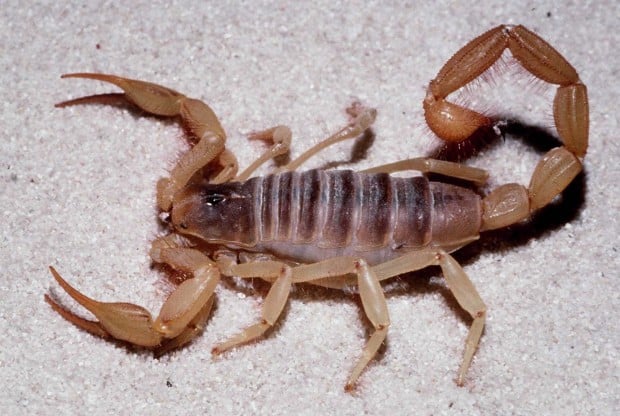
Warmer nighttime temperatures are bringing out one of Arizona's most feared creatures: scorpions.
As the weather warms, and evening temperatures stay at 70 or higher, the scorpions get more active, said Craig Levy, program manager of the vector-borne-disease program at the Arizona Department of Health Services.
"Usually around May and throughout the summer, you start to see more scorpion activity," Levy said.
More than 8,000 people are stung by scorpions each year in Arizona, according to a press release from Gilbert Hospital. The hospital is taking part in an antivenin study. It's the sixth year of the study, being conducted by the University of Arizona's Venom Immunochemistry, Pharmacology, and Emergency Response (VIPER) Institute.
The antivenin is given to patients who show the signs and symptoms of toxicity, said Dr. Kimberly Warren, hospital pharmacy director.
People are also reading…
"Most of the adults don't have the symptoms like the children generally do. But it can be fatal. It depends on the severity of the sting or if there are multiple stings," Warren said.
The signs of trouble for someone stung by a scorpion include eye rolling, limb twitching or thrashing, increased secretions or respiratory distress, she said.
"With the antivenin, generally within 30 minutes of having it administered the symptoms start to resolve," Warren said.
Dr. Imad Haddad, medical director of the pediatric intensive care unit at Mesa's Cardon Children's Medical Center, said the emergency room started seeing an increase in scorpion stings about a month ago. Many of the patients are less than 2 years old.
"Because of their size, the venom attacks them the most," Haddad said.
In the past, the hospital would give patients medication to sedate them. In some cases, children were put on a respirator because they were unable to handle the secretions created by the scorpion's toxins.
"However, since we've started the antivenin, we discharge them two to three hours after entering the ER," Haddad said.
Several Banner Health locations are also participating in the UA antivenin study, he said.
Scorpions tend to hide during the day in cracks and crevices around a house, DHS' Levy said. They may find refuge in decorative rock, behind vines, in brick retaining walls or in a pile of wood.
They come out at night to feast on crickets and cockroaches. Most scorpions seen near urban areas are bark scorpions, Levy said.
"They are not easy to control through pesticides, mainly because their outer shell is impermeable," Levy said. If you choose to use a pesticide, make sure it's clearly marked for scorpion use, he said.
Levy prefers the "black light method." He said he goes out at night and hunts for them around his house with a black light, which causes scorpions to glow. They can then picked up with a grilling tong and destroyed.
The best thing to do is try to remove the habitats they like, such as the lumber piles or large riverbed rocks.
The antivenin study is being conducted at 27 Arizona hospitals, said Dr. Leslie Boyer, director of the UA's VIPER institute and an associate professor of pathology at the University of Arizona. More than 1,200 young people have received the antivenin during the study.


