Jennifer Seeley was glued to her phone, safe at home but terrified nonetheless.
There was an active shooter at the Texas mall where she works as an assistant store manager. And she was searching desperately for information, praying. Was the gunman dead? Were her coworkers dead? What was happening?

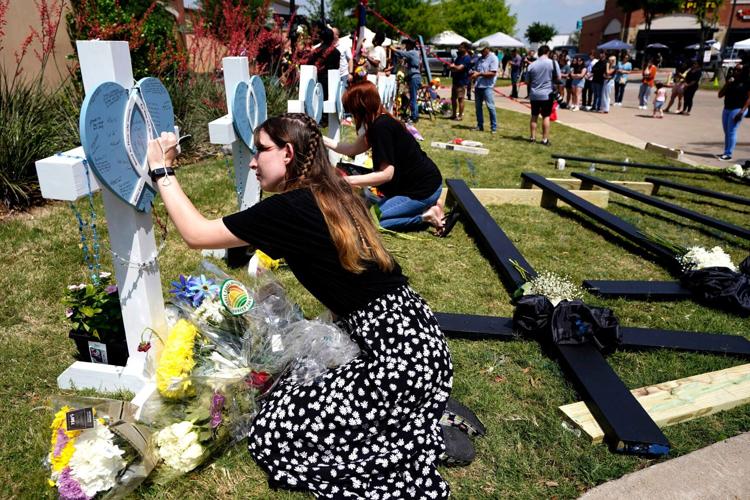
Jennifer Seeley leaves a message on a cross that has the name of security guard Christian LaCour, written on it on May 8 at a makeshift memorial in Allen, Texas.
So with law enforcement in the Dallas area town of Allen releasing information slowly on that horrible May 6 afternoon, she turned to social media for answers, stumbling across videos showing the bodies of some of the eight who were slain. Desperately she texted her coworkers.
“That’s where all of my information came from was what I saw on Twitter. And, you know, nobody was really releasing any information on what actually happened,” she said.
The shooting at the Allen Premium Outlets earlier this month has law enforcement public information officers from around the country talking. Social media, they say, has accelerated everything. Now everyone can post images from their phone. That means if police don’t talk, reporters and the public will simply go online, as happened in Allen.
People are also reading…
And that presents a major problem, says Katie Nelson, social media and public relations coordinator for the Mountain View Police Department in northern California. Nelson teaches about crisis management and social media best practices. And these days, she says, when it comes to responding, “The luxury of time does not exist.”

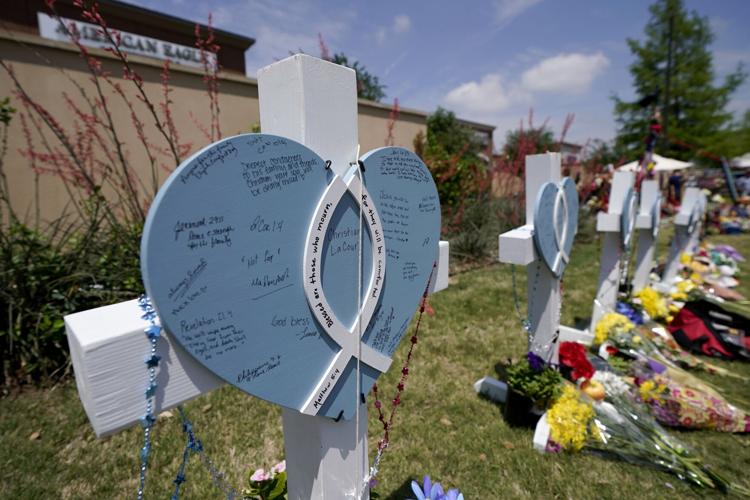
A cross bearing the name Christian LaCour stands near others representing each of the victims of a mass shooting at a makeshift memorial in Allen, Texas, on May 8.
Police began to harness social media a decade ago, most famously after the Boston Marathon bombing in 2013. The four-day manhunt ended with police tweeting: “CAPTURED!!! The hunt is over. The search is done. The terror is over. And justice has won. Suspect in custody.”
It was groundbreaking at the time, says Yael Bar Tur, a police communication consultant and former director of social media for the New York City police department. Now, she says, that it is the basic level expected of law enforcement.
“It’s not enough just to be on social media, you have to be good at it,” she says. “At the end of the day, you know, we have to use this tool because if you don’t, it is going to be used against you.”
In Allen, the mall shooting happened around 3:30 p.m. Allen police sent their first tweet around 4:20 p.m., announcing simply that police were at the mall and that an active investigation was underway. At nearly 7 p.m., police in Allen said an officer had “neutralized the threat.” That meant he was dead. But the often-used term can be confusing to the public, says Julie Parker, a former broadcast journalist and law enforcement public information officer who now advises government agencies on how to respond to critical incidents.

Adding to the situation, the initial news conferences were brief and infrequent. One lasted less than two minutes, and police took no questions.
Eventually Seeley learned that her co-workers had survived, but a security guard she knew was among the dead. Twenty-year-old Christian LaCour had helped jump start a customer’s car just a few days earlier.
“Very anxiety-inducing,” she said of the whole experience.
How to harness social media in the best ways — and quickly — was on everyone’s mind recently as public information officers gathered at a midyear conference of the International Association of Chiefs of Police.
“You had a little more time to get information out five or six years ago. The expectation wasn’t there that it would be immediate, and I think it is now,” says Sarah Boyd, public relations manager at the Clay County, Missouri, Sheriff’s Office.
She says her colleagues often text each other to discuss how communications are handled after tragedies. The responsibility weighs on her; she is well aware that the messages police tweet in the midst of a mass shooting might be read by someone hiding from the shooter.
“All they’ve got is their phone, and that tweet is their lifeline,” Boyd said.

It can be challenging, though, with police nationally struggling to regain the public’s trust in the wake of George Floyd’s killing in 2020 and the protests that followed. Many factors — for example is the suspect still on the loose? — play a role in what can be released. And even if the suspect is killed, the investigation isn’t over; law enforcement still must determine whether the shooter acted alone, says Alex del Carmen, an associate dean of the school of criminology at Tarleton State University in Texas.
Missteps after the mass shooting at Uvalde, when law enforcement released shifting and at times contradictory information, show the importance of getting details right.
The bulk of the nation’s police forces are small, and there are vast differences in what each state allows them to release. The public itself has no such restrictions, though.
After a man killed 10 people at a supermarket in Boulder, Colorado, in March 2021, an independent, part-time journalist began livestreaming on his YouTube channel before officers even arrived. The effect can be instantaneous — and, for authorities, quite dizzying.
“We’re putting out information quicker than I’ve ever seen before,” says Boulder police public information officer Dionne Waugh. Given the speed of social media, she says, there’s simply no choice.
How to take a break from social media
Be easy on yourself and ask for help about social media use

"If you're reading this article, kudos to you for thinking about reevaluating social media," Agarwal said Trying to meet your goals is all about celebrating the small wins.
At the least, set small benchmarks for yourself like spending 10 minutes less on social media than the day before. The right amount of social media time is different for everyone since some people actually use these apps to brand and help market themselves. Find your own social media sweet spot, and remember, even if you scroll too much on social media one day, you can try and meet your goal tomorrow.
Another way to keep you on track is to share your goal with someone you trust. A friend or loved one who can kindly nudge you when they notice you've been on social media for awhile.
Helpful exercise to remind you what you're missing by scrolling

Scrolling through social media while hanging out with friends isn't uncommon nowadays, but when you think about how unengaged you are in those moments, it can put social media use into perspective.
Agarwal suggests the next time you're in a room with others at a family or friends gathering and you see yourself scrolling through social media instead of engaging with others, take a minute to physically remove yourself from the room and isolate in another room. Listen and feel how much you may be missing out on.
"What that does is it gives your brain a signal. If you force yourself to leave the room, you realize how much you're using that app and missing out on other people," Agarwal said. "It's a good physical reminder of being present in the moment and not on your on your phone and scrolling through social media."
Use your phone's screen-time tracking feature and limit social media use

Most smart phones nowadays track your screen-time and usage already. It's a good idea to figure out your average screen time per day so you have a benchmark that you can work on.
On iPhone, you can go into your "Screen Time" settings, which displays the amount of time you spend on each app and allows you to put timers on specific apps to limit how long you're on them. Android phones have similar features in the "Digital Wellbeing" settings. Additionally, Facebook, Instagram and TikTok offer the same features within the app settings themselves.
Physically distance yourself from your phone and apps

When you're at home and have free time, put your phone in a drawer or somewhere you can't see it. Oftentimes limiting the ability to quickly and easily pick up your phone is enough to keep you off of social media, said Agarwal. If your phone is what keeps your hands from fidgeting, try to have some objects around the house that relieve stress, like a stress ball, fidget toy or yarn and crochet hooks.
Hide your social media apps on your phone by placing the app on the second or third page of your home screen or bury the app inside an "app folder" with a bunch of others. When you're waiting in line or have a free five minutes, instead of grabbing your phone — take in the view, practice some breathing exercises or read a book.
Benefits of taking a social media break

Ever hear of "text neck?" It's the result of looking down at our phones when scrolling or texting, straining the neck muscles over a long period of time. Taking a break from social media helps relieve neck pain and gives your eyes a break from bright screens.
People may also be more connected than ever through social media, but a 2018 University of Pennsylvania study found that people who limit their time on social media experience less depression and feelings of loneliness.
Taking a break from social media will give you better sleep, too. Research suggests that nighttime use of social media is driven by FOMO (fear of missing out), and keeps people scrolling longer at night instead of going to sleep.
Reevaluate what you want out of social media

What is the reason that brought you onto social media? This is the question Agarwal said to ask yourself when trying to figure out if it's time to take a social media break. If you're not getting the same satisfaction from the reason you use social media, it may be time to look for alternatives.
If you joined social media to...
1. Find community: Look for clubs and groups in your neighborhood where you can meet and interact with others IRL (in real life).
2. Be inspired: Consume other forms of media like magazines, books, podcasts, movies or live events.
3. Buy and sell things: Try using other apps, like OfferUp or NextDoor, or visiting local events and marketplaces in person.
Two and a half hours.

Two and a half hours — that's the average amount of time people spend on social media each day.
It may not sound like a lot, but that time can really add up — and at what cost? Social media has proven negative effects on mental health (especially for teens), self-image and for some is a huge time-waster.
University of Penn's Anish Agarwal, an emergency physician, researcher, and deputy director for the Center for Digital Health, said it's important to constantly be reevaluating the role social media plays in daily life.
The bottom line: taking a break from social media is healthy for you. Read on for guidance and tools to help you limit screen time on these apps.