WHEATON, Ill. — The most noticeable part of the cicada invasion blanketing the central United States is the sound — an eerie, amazingly loud song that gets in a person's ears and won't let much else in.

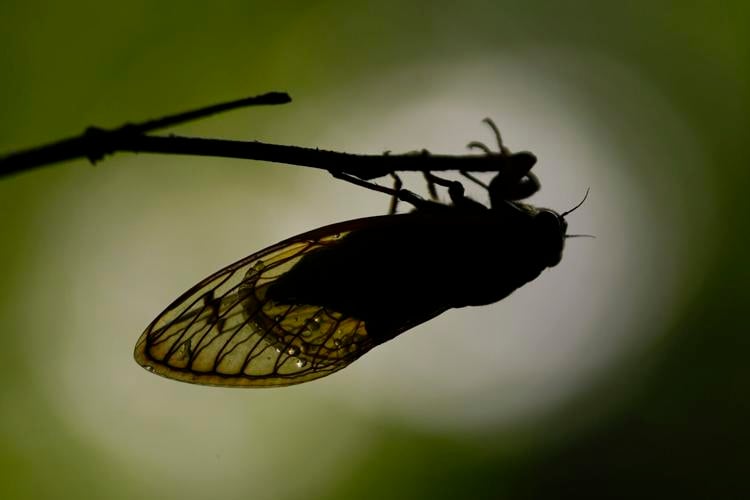
Water droplets cling to the wings of an adult periodical cicada June 4 at Lincoln Memorial Garden and Nature Center in Springfield, Ill. The most noticeable part of the cicada invasion blanketing the central United States is the sound.
“It’s beautiful chaos,” said Rebecca Schmidt, a U.S. Department of Agriculture research entomologist. “It does make this kind of symphony.”
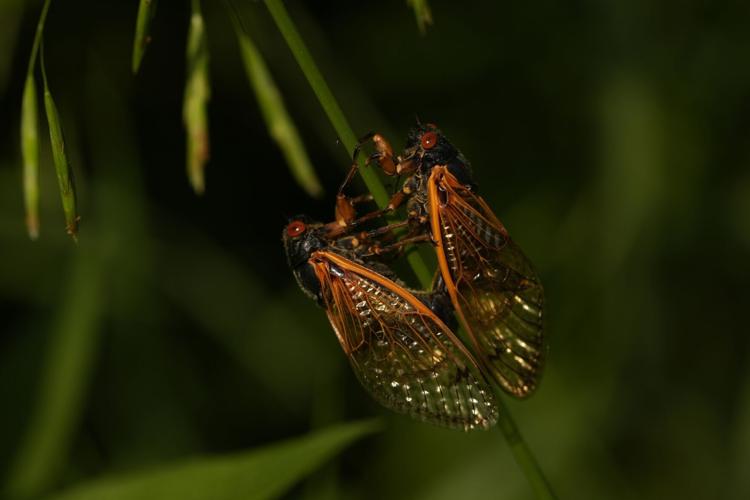
The songs — only from males — are mating calls. Each periodical cicada species has its own distinct song, but two stand out: those of the orange-striped decims or pharaoh cicadas, and the cassini cicada, which is smaller and has no orange stripes on its belly.
People are also reading…
“The one we’re hearing the most is the cassini, a buzzy trail that goes up in a wave and is coming back down,” Jennifer Rydzewski, an insect ecologist at DuPage County Forest Preserve, said as she spoke in a clearing near a grove of trees.
“And every time it goes up in a wave and comes back down, you’ll see in the treetops a bunch of them start flying out, so they’ll make a call and then jump to a new branch and make the call again. So it’s actually like different groups that are coming in waves.”

Two adult periodical cicadas mate June 4 at Lincoln Memorial Garden and Nature Center in Springfield, Ill. The songs they sing — only from males — are mating calls.

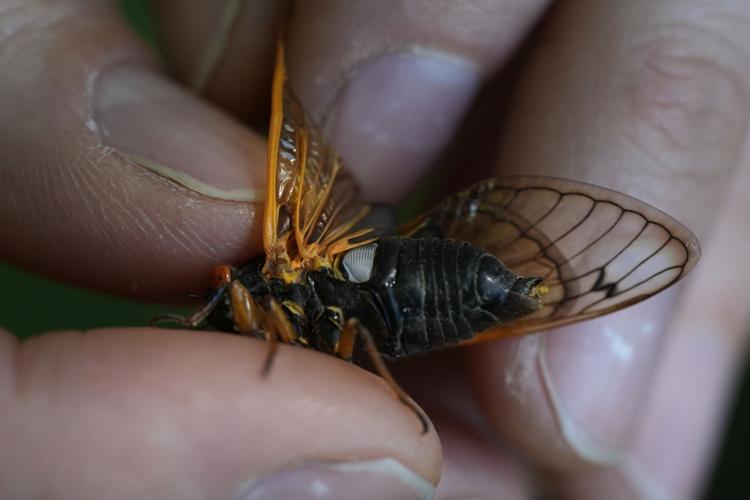
The tymbal, a white membrane on a periodical cicada male's midsection used to create sound, is displayed June 5 by Jennifer Rydzewski, an insect ecologist for the DuPage Forest Preserve, in Wheaton, Ill.
The other one is a “constant whirring hum, which is the pharaoh's staccato,” and every now and then an individual call that sounds like “eee-ooo” can be heard, she said. Others have said the sound is more like “fffaaaro, fffaaaro.”
The sound comes from a white membrane on the male's midsection that is made to vibrate, Schmidt and Rydzewski said. The area beneath it acts like an echo chamber.

“It’s a lot of the same sort of physics as an instrument,” Schmidt said. “So if you think about like a drum, you can have a pretty small drum that is being hit by somebody that’s not hitting it that hard, and it still makes quite a lot of noise."
Everything you need to know about this year's emergence of two broods of cicadas
Are you ready for the 'Cicadapocalypse'? The last time this emergence happened was in 1803, when Thomas Jefferson was president and busy finalizing the Louisiana Purchase.

For the first time in 221 years — back when Thomas Jefferson was president — two particular periodical cicada broods are set to surface this spring.

For the first time in 221 years, more than a trillion of two particular periodical cicada broods are set to surface this spring.

Arm yourself with the 10 most essential fun facts as cicadas prepare to take the Midwest and part of the U.S. south by storm.

Every 221 years, two major cicada broods, XIII and XIX, emerge together. The last time this happened, Thomas Jefferson was president of the Un…

Periodical cicadas enthusiast Roger McMullan, who is the author and illustrator of the graphic novel "Cicadapocalypse," aims to educate young, curious minds about the mysterious and fascinating insect.

More than 2 billion people eat insects on a daily basis around the world. But entomophagy, or the intentional consumption of insects as food, remains rare in the U.S.

Explore unique recipes featuring cicadas with Emergence Cookies and Southern Cicada Tartlets.