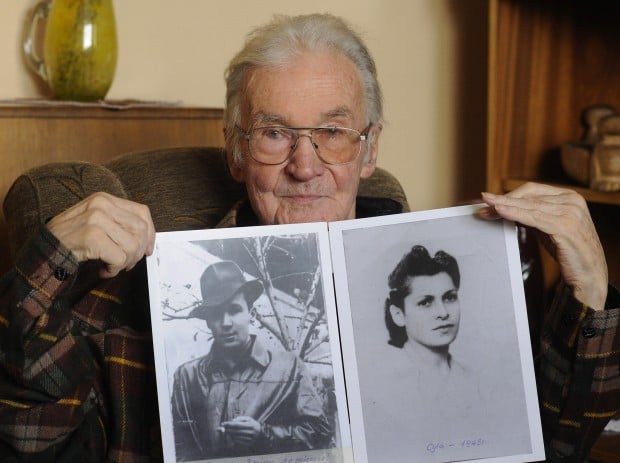
NOWY TARG, Poland - With every step toward the gate, Jerzy Bielecki was certain he would be shot.
The day was July 21, 1944. Bielecki was walking in broad daylight down a pathway at Auschwitz, wearing a stolen SS uniform with his Jewish sweetheart Cyla Cybulska by his side.
He tried to keep a stern bearing on the long stretch of gravel to the sentry post.
The German guard frowned at his forged pass and eyed the two for a period that seemed like an eternity - then uttered the miraculous words: "Ja, danke" - yes, thank you - and let Jerzy and Cyla out of the death camp.
It was a common saying among Auschwitz inmates that the only way out was through the crematorium chimneys. These were among the few ever to escape.
Bielecki, 23, used his relatively privileged position as a German-speaking Catholic Pole to orchestrate the daring rescue of his Jewish girlfriend, who was doomed to die.
People are also reading…
"It was great love," Bielecki, now 89, recalled in an interview at his home 55 miles from Auschwitz.
"We were making plans that we would get married and would live together forever."
Bielecki was 19 when the Germans seized him on the false suspicion he was a Polish resistance fighter, and took him to the camp in April 1940.
He was sent to work in warehouses.
It was two years before the first Jews started arriving. Most were taken straight to the gas chambers of neighboring Birkenau, while a few became forced laborers amid horrific conditions.
In September 1943 Bielecki was assigned to a grain storage warehouse. Suddenly a door opened and a group of girls walked in.
"It seemed to me that one of them, a pretty dark-haired one, winked at me," Bielecki said as he recalled the scene. It was Cyla - who had been assigned to repair grain sacks.
Their friendship grew into love.
In a report she wrote for the Auschwitz memorial in 1983, Cybulska recalled that during the meetings they told each other their life stories.
Cybulska, her parents, two brothers and a younger sister were rounded up in January 1943 in the Lomza ghetto in northern Poland and taken to Auschwitz-Birkenau. Her parents and sister were immediately killed in the gas chambers, but she and her brothers were put to work.
By September, Cybulska, 22, was the only one left alive.
As their love blossomed, Bielecki planned an escape.
From a fellow Polish inmate at a uniform warehouse, he got a complete SS uniform and a pass. Using an eraser and pencil, he changed the officer's name in the pass from Rottenfuehrer Helmut Stehler to Steiner just in case the guard knew the real Stehler, and wrote that an inmate was being led out of the camp for police interrogation.
He briefed her on his plan: "Tomorrow an SS-man will come to take you for an interrogation. The SS-man will be me."
The next day, Bielecki, in the stolen uniform, came to the laundry barrack where Cybulska had been moved for work duty. Sweating with fear, he demanded her release.
Bielecki led her out of the barrack and onto a long path leading to a side gate guarded by the sleepy SS-man.
"I was expecting to be shot," Bielecki said.
But when he looked back, the guard was in his booth. They walked to a road, then into fields where they hid in dense bushes until dark, when they started to march.
"Marching across fields and woods was very exhausting, especially for me, not used to such intensive walks," Cybulska said in her report to Auschwitz as quoted in a book Bielecki has written, "He Who Saves One Life ..."
For nine nights they moved under the cover of darkness toward Bielecki's uncle's home not far from Krakow.
His mother was overjoyed to see him alive.
To keep her away from possible Nazi patrols, Cybulska was hidden on a nearby farm. Bielecki decided to go into hiding in Krakow. The couple spent their last night together under a pear tree in an orchard, making plans to meet right after the war.
After the Soviet army rolled through Krakow in January 1945, Bielecki left the city where he had been hiding and walked 25 miles in snow to meet Cybulska.
He was four days too late.
Cybulska, not aware that the area where she had been hiding had been liberated three weeks before, gave up waiting for him, concluding her "Juracek" either was dead or had abandoned their plans.
She got on a train to Warsaw, planning to find an uncle in the United States. On the train she met a Jewish man, David Zacharowitz, and the two began a relationship and eventually married. They headed to Sweden, then to Cybulska's uncle in New York, who helped them start a jewelry business. Zacharowitz died in 1975.
In Poland, Bielecki eventually started a family of his own and worked as the director of a school for car mechanics. He had no news of Cybulska and had no way of finding her.
Cybulska was haunted in the years after she left Poland by a wish to find Jurek.
Sheer chance made her wish come true.
While talking to her Polish cleaning woman in 1982, Cybulska related her Auschwitz escape story.
"I know the story, I saw a man on Polish TV saying he had led his Jewish girlfriend out of Auschwitz," the cleaning lady told Cybulska, according to Bielecki.
Early one morning in May 1983, the phone rang in Bielecki's home in Nowy Targ.
"A female voice said 'Juracku, this is me, your little Cyla,' " Bielecki recalls.
A few weeks later they met at Krakow airport. He brought her 39 red roses, one for each year they spent apart.
"Cyla was telling me: leave your wife, come with me to America," Bielecki recalls. "She cried a lot when I told her: Look, I have such fine children, I have a son, how could I do that?"
She returned to New York. They never met again.
Cybulska died a few years later in New York.
"I was very much in love with Cyla, very much," Bielecki said recently. "Sometimes I cried after the war, that she was not with me. I dreamed of her at night and woke up crying."
"Fate decided for us, but I would do the same again."

 Lake Mead's drops raise prospect of unaffordable Hoover Dam electricity