

The Missouri Department of Elementary and Secondary Education has named a transition team of educators, reformers, alumni and parents to help determine the future of the Normandy School District.
The 10-member committee is tasked with developing a transition plan for the unaccredited school system that could take effect as early as July 1.
On Feb. 21, Education Commissioner Chris Nicastro wrote a letter to prospective members and said the plan should include recommendations on district organization and school governance, recruiting high-quality teachers and principals, and other operational issues.
The Missouri Board of Education authorized the task force on Feb. 18, the same day it also took control of the district’s finances.
“If the district lapses, our task is to say what happens next,” said Carole Basile, chairman of the committee and dean of the College of Education at the University of Missouri-St. Louis. “We understand this is precedent setting. Everything is on the table.”
People are also reading…
Members include Maxine Clark — the founder of Build-A-Bear Workshop who serves on the boards of Teach For America, Beyond Housing and KIPP: St. Louis, the high-peforming charter school south of downtown. Former state Sen. Wayne Goode, who lived in the Normandy district for 70 years, is on the task force, as is Monica Huddleston, the mayor of Greendale, and Connie Holtrop, a parent.
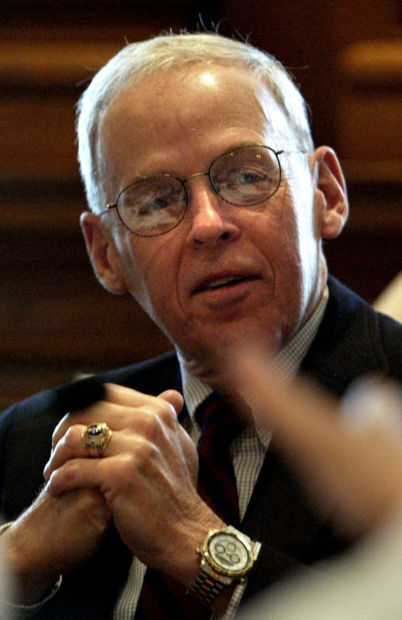
Gary Cunningham, a member of the task force and 1962 Normandy grad who went on to serve on the Missouri Board of Education, said it’s difficult to see Normandy in such turmoil. He’s hoping to develop a plan that focuses on the best interests of students. “This isn’t exactly about a district. It isn’t about administration. It isn’t about teachers so much. It’s about kids and what’s best for kids in this situation,” he said.
Normandy is at the epicenter of the school transfer situation, which has resulted in about 2,200 students transferring from its schools and those in unaccredited Riverview Gardens to higher-performing schools across the region.
By law, the unaccredited districts must cover tuition and transportation costs of those students. Those costs are resulting in a financial drain that exceeds the per-student revenue both districts receive. Normandy officials are hoping for $5 million from the Legislature to get through the end of the school year.
Though the House Appropriations Committee approved the funding last week, members of the Senate Appropriations Commission on Tuesday approved just $1.5 million for Normandy. Lawmakers had previously voiced concern that offering up money to keep Normandy’s doors open would set a precedent.
The amount should allow the district keep schools open through the end of the school year, but wouldn’t allow for any reserve fund, said Ron Lankford, a deputy commissioner of education. The lack of any reserve fund makes a district lapse all the more likely this summer.
Members of the task force must consider changes taking shape in Jefferson City, where lawmakers are debating proposals that could curtail the cost and number of school transfers. The task force’s first report will be due in May.
“It’s not going to be easy,” Goode said. “There’s a lot to be answered, to be sure. There are a number of things, including legal issues, that no one’s ever gone through before, at least not in this manner.”
In her letter, Nicastro said that no one with a financial interest or contractual relationship with Normandy could serve on the transition task force.
Other members include Sharon Thompson, a grandmother in the district; Steven Cousins, a partner at the St. Louis law firm Armstrong Teasdale; William Douthit, managing director of Education Equity; and Charles Pearson, a former educator and Normandy administrator.
They will be meeting with Normandy Superintendent Ty McNichols, school board members, and others as they develop the plan.
Normandy School Board President William Humphrey did not return a phone call seeking comment.
Alex Stuckey of the Post-Dispatch contributed to this report.


