

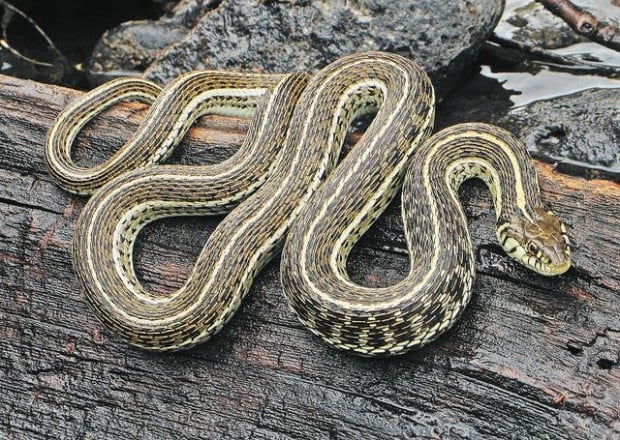
A yellow-and-olive striped garter snake subspecies that once frequented Southern Arizona rivers and streams is in bad enough shape that it could disappear from the United States within a quarter-century, federal officials say.
But the U.S. Fish and Wildlife Service decided this week not to list the northern Mexican garter snake as threatened or endangered because too many other imperiled animals and plants around the country are in worse shape and have higher priority for protection. The snake has gone to its list of about 280 candidate species and subspecies that are waiting their turn for protection.
Wildlife Service officials don't know how long it might be before the snake is listed, largely because it is a subspecies. They typically fall lower on the federal pecking order for protection than full-fledged species, a Wildlife Service spokesman said this week.
People are also reading…
Yet the northern Mexican garter snake is important, Wildlife Service officials said, because it is an "indicator species." It indicates the broader health of riverfront riparian areas and other aquatic areas where it lives.
The snake is one of 39 species or subspecies in Arizona that are federally protected or are candidates for protection and that depend on riparian areas. That number of species is evidence of the precarious state of water-based Southwestern ecosystems, the Wildlife Service said.
"It looks very close" to disappearing from this country, Phil Rosen, a University of Arizona reptile specialist, said of the snake. "We really don't know of any place where it seems to be thriving and well-established in a healthy environment."
The northern Mexican garter snake is a victim of non-native frogs, fish and crayfish that eat the snake or live off its prey.
"You're talking about starvation of snakes and direct predation of snakes themselves," said Jeff Servoss, a Wildlife Service biologist in Phoenix.
Also, livestock grazing, groundwater pumping and many other activities have eliminated the snake from at least 90 percent of its range in the Southwest, Wildlife Service officials said.
"The northern Mexican garter snake faces significant threats in the United States and Mexico," said Steve Spangle, the Wildlife Service's Arizona field supervisor. "However, we don't have the resources at this time to engage in the listing process" for it and other imperiled species across the United States.
A Tucson-based environmental group that has petitioned and sued to get the snake listed since 2003 blasted the Wildlife Service's decision.
"This is classic delay by the Bush administration," said Noah Greenwald, biodiversity program director at the Center for Biological Diversity.
The snake will be folded into a Center for Biological Diversity lawsuit that argues that continued delays in listing candidate species are illegal.
The northern Mexican garter snake, a subspecies of the Mexican garter snake, is found in the United States only in a handful of places in Arizona. It used to live throughout Southern Arizona, extreme western New Mexico and the Sierra Madre range area in northern Mexico. Its total population is unknown. It is listed as a threatened species in Mexico and hasn't been seen in New Mexico since 2002.
An example of the snake's precarious status comes from Las Cienegas National Conservation Area, a federally protected desert grassland area southeast of Tucson.
In 2002 and 2003, biologists captured and released 29 northern Mexican garter snakes in an in-depth search for the snake there. At the time, scientists considered the northern Mexican garter snake to be "widely distributed" in that area, the Wildlife Service said. But in 2007 and 2008, searches found only one northern Mexican garter snake in that area.
The snake also is known or presumed to live in the Santa Cruz River near the San Rafael Valley in Southeastern Arizona, Tonto Creek in the Salt River Basin near Phoenix, along the Verde River Valley of Yavapai County and at state fish hatcheries near Oak Creek.
Dwelling places
Where the northern Mexican garter snake used to live:
• The Santa Cruz River north of Nogales.
• The San Pedro River.
• Tanque Verde Creek in Tucson.
• The Rillito River in Tucson.
• Agua Caliente Spring in Tucson.
• The Rio San Bernardino near the U.S.-Mexico border.
• The Gila River.
• The Lower Colorado River from Davis Dam to the U.S.-Mexico border.
Source: U.S. Fish and Wildlife Service


