

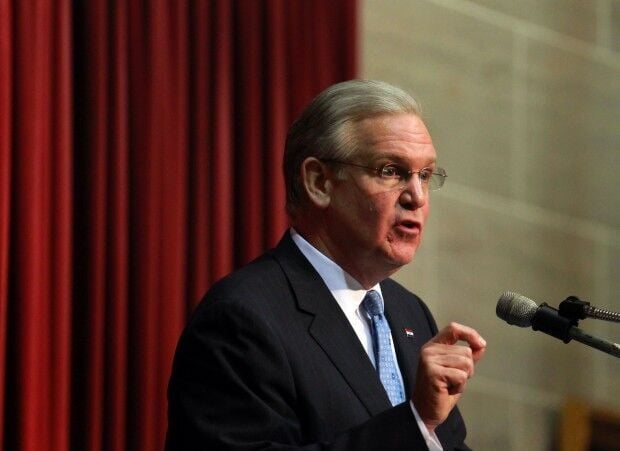
Gov. Jay Nixon struck back at claims today that the state Department of Revenue is using Missouri’s new drivers’ license system to send information to the federal government and aid the implementation of the federal REAL ID Act.
“This Department of Revenue and this state of Missouri is not collecting a bunch of unusual data to send to some sort of magical database someplace to mess with people. It’s not happening,” he said in a meeting with reporters.
The state Legislature passed a law in 2009 to block implementation of the 2005 federal anti-terrorism effort that calls for standardized state forms of identification.
“No we’re not moving forward in trying to implement REAL ID,” Nixon repeated today. “We’re following the law that I signed.”
Speculation over the state’s handling of private information under the new license system has swirled in recent weeks, fueled by advocacy groups and elected officials, including Republican Lt. Gov. Peter Kinder and state Sen. Kurt Schaefer, R-Columbia. In the ongoing debate, House and Senate Republicans have called DOR’s funding into question – on top of asking for more information on the new licensing program.
People are also reading…
Earlier this week, United for Missouri, a conservative advocacy group, launched an ad campaign targeting Nixon and the state Department of Revenue, repeating allegations that the state has been sharing private drivers’ license data with the federal government.
Despite multiple denials from Revenue Department heads and a judge’s order last week that said claims in a related lawsuit have relied only on hearsay, the group asserts in its video ad that DOR is “collecting personal information on gun owners and sending it to the Obama administration.”
“Sounds like Gov. Nixon isn’t doing his job to protect us from Obama’s reach,” the video claims, seeking to tie Missouri’s Democrat governor to President Barack Obama.
In a radio version, United for Missouri tells listeners that if they have obtained drivers’ licenses or concealed carry endorsements in the past four years “chances are your personal information has been provided to the Obama administration as part of a federal database.”
Leaders in the Department of Revenue repeatedly have denied claims that the state is sharing personal information with the federal government through the new enhanced drivers’ license system. No evidence has been shown that the information is being shared with the federal government.
During a recent House committee hearing, deputy director John Mollenkamp said copies of “source documents” — birth certificates, concealed carry permits, marriage licenses and other credentials scanned for the state’s new enhanced drivers licenses — are sent only to the state data center in Jefferson City. “It stops there — the scanned documents go no further,” he told lawmakers.
Senate Republicans have subpoenaed the department for more information and received several boxes of information in response.
“We’re going to go through the documents,” Schaefer said Tuesday.
Last week, Stoddard County Circuit Judge Rob Mayer, denied a request for a preliminary injunction in a lawsuit related to the claims and said the case relied only on hearsay.
Mayer, a Republican who served in the state Legislature from 2000 to last year, said in his order that attorneys did not provide any evidence that shows DOR is sending license information to the federal government.
Stoddard County Prosecutor Russ Oliver, who is working privately as an attorney for Griffin, told House members during the committee hearing that Griffin’s lawsuit is more about the collection and saving of data, which Mollenkamp and other agency heads have admitted to. Still, the lawsuit drew most attention over its allegations that the info is also being disseminated to the federal government and a private company.
Nixon said that critics who are claiming that the new drivers’ licenses are being used to implement REAL ID are trying to “play into folks concerns about this and that.”
He said that the enhanced drivers’ licenses provide a layer of security for the state.
“You want the drivers’ license to be a document that’s correct and there are a lot of reasons for that,” he said.
United for Missouri’s ads direct listeners and viewers to wrongwayjay.com, a website that clarifies that questions remain on the issue. The website calls for an audit of the Revenue Department to determine what information – if any – is being shared and with whom.
DOR leaders have said that Missourians’ private records are scanned and saved in Jefferson City with a summary file going to a third party that makes the licenses. That data is then destroyed, according to state officials and the company.
Despite most of the focus being on whether the information is being sent to the federal government (including such allegations in the United for Missouri ads), some lawmakers say they also are concerned about the scanning and retention of documents here in Missouri.
Schaefer, who has repeatedly raised questions about the licensing system in recent weeks, told the AP Tuesday that he didn’t realize that would be part of the new licensing procedure because of the 2009 state law that prohibits the implementation of the federal REAL ID Act here.
He has also suggested that the state could start its own licensing, rather than contract out to a third-party.
The REAL ID Act, an anti-terrorism law that Congress approved, following recommendations of the 9/11 Commission, creates minimum security standards for license issuance, and it prohibits federal agencies from accepting documents that don’t meet the minimum standards. For example, drivers’ licenses from states that don’t implement REAL ID may not be accepted for boarding planes.
The U.S. Department of Homeland Security website lists Missouri among several states that have submitted real ID "package and status updates."
DHS reports that as of February, 19 states (Alabama, Colorado, Connecticut, Delaware, Florida, Georgia, Iowa, Indiana, Kansas, Maryland, Nebraska, Ohio, South Dakota, Tennessee, Utah, Vermont, Wisconsin, West Virginia and Wyoming) have implemented the full provisions of the federal law.
Despite much of the accusations here coming from Republicans, conservatives elsewhere have had the opposite reaction. They have criticized the Obama administration for pushing back implementation of a program that is supposed to thwart acts of terrorism.
Elizabeth Crisp covers Missouri politics and state government for the Post-Dispatch. Follow her on Twitter at @elizabethcrisp.


