

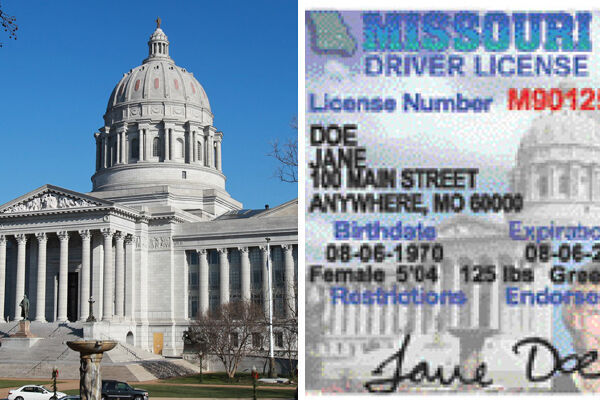
JEFFERSON CITY • Documents that drivers are now required to submit to obtain Missouri drivers licenses are not being shared with the federal government or a private company, according to testimony during a House committee hearing Monday.
Missouri Department of Revenue deputy director John Mollenkamp said copies of the documents — birth certificates, concealed carry permits, marriage licenses and other credentials scanned for the state’s new enhanced drivers licenses — are sent only to the state data center in Jefferson City.
“It stops there — the scanned documents go no further,” he said, echoing comments he made to lawmakers late last week.
Speculation over the state’s handling of private information under the new license system has swirled for several days, fueled by advocacy groups and state officials, including Republican Lt. Gov. Peter Kinder.
People are also reading…
Representatives from the Department of Revenue, the company printing Missouri licenses and those who have been lodging claims of improper data collection spoke on the issue in a three-hour hearing Monday.
At the end, the Republican lawmakers who called the hearing appeared to agree that some claims have been overblown.
“I don’t think there’s any evidence at this point that any information has been shared with the federal government,” Rep. Todd Richardson, R-Poplar Bluff, said after the hearing.
But he plans to continue working on a bill that he has filed that would block the Revenue Department from keeping copies of certain documents.
“Whether the information is being shared with anyone or not, I have deep concerns about the state collecting and holding that much data,” Richardson said.
Rep. Jay Barnes, R-Jefferson City, said the state is creating a “treasure-trove” of documents that contain personal information.
“I think it’s a very dangerous situation,” he said.
The Revenue Department recently rolled out the new drivers licenses in an effort to curb identity theft and fraud. Because of the new security features, which include ghost images, laser etching and microprinting, the licenses are mailed to recipients from a third-party vendor that prints them.
The state processes about 4,000 licenses per day, Mollenkamp said. Basic information for each one is transferred from the state data center to the Atlanta-based printer in a file called a “folio.” No images of original documents ever leave the state, officials said.
Several gun advocates have questioned the department’s collection of concealed carry documents, but Mollenkamp said the Department of Revenue already was a middleman in Missouri’s concealed carry permits. The Department of Revenue is the agency notified when concealed carry holders are convicted of felonies or have any other issues that make them ineligible to continue to carry legally. The change is then noted in the drivers license system, he said.
But Russell Oliver, attorney for a Stoddard County man who has filed a lawsuit over the new process, said the Department of Revenue can’t place additional requirements on people to obtain concealed carry permits.
His client, Eric Griffin, couldn’t get his concealed carry status added to his license without allowing his documents to be scanned.
“They’re placing a new restriction and hurdle that’s not authorized by statute,” Oliver said. “This new procedure is specifically barred (under state law).”
In the lawsuit, which was filed against the local fee office agent, Griffin claims the scanned documents are “being collected, retained and disseminated to a third-party entity and/or the federal government … in order for a person to obtain their concealed carry endorsement or renew or obtain their drivers license.” The lawsuit, which was announced March 4 with a news conference, gave a boost to claims already circulating that private documents were being transferred out of the state.
Many who have spoken against the new process have sought to tie the system to the U.S. Department of Homeland Security, the United Nations and the federal REAL ID Act of 2005, anti-terrorism legislation that the state Legislature has struck back against.
The Missouri Family Network sent an alert to its followers this month, claiming that photos and source documents scanned for new drivers licenses are being sent to a federal database — a claim the Department of Revenue repeatedly has denied. The network, a conservative activist organization, also claimed that license photos are enhanced with “biometric data,” such as retinal scans or traceable facial patterns. The Department of Revenue also denies it is collecting such data.
Kerry Messer, a lobbyist and president of Missouri Family Network, told the committee he got his information from private conversations with fee office employees, whom he would not identify.
“We’re in a big mess right now,” he said. “We need to get some protection for the citizens of the state of Missouri.”
Brent Stafford of O’Fallon said he has been following the issue through the Missouri Family Network alerts. He told committee members he is concerned the parent company of the printer has ties to the United Nations. He also said he worries the state could use scanned phone bills, used as proof of residency, to track phone calls.
“A lot of my concerns were put to rest if, in fact, the testimony is accurate,” Stafford said.
Department of Revenue director Brian Long said scanning documents helps the state deter, detect and prosecute identity theft.
“I’ve heard law enforcement say before that it’s the fastest-growing crime in Missouri,” he said.
According to federal authorities, thousands of illegal immigrants were able to obtain Missouri drivers licenses from the contracted fee office in St. Joseph by using fake birth certificates and Social Security cards. More than a dozen people were indicted last year on federal conspiracy charges related to those claims.
Long said that contracting the service out was the least-expensive option for the state. The computers and scanners used to create the new licenses are owned by the private company that prints them.
The state has been able to save about $1 million a year by going to the new system. Printing licenses on its own could cost $4 million more a year.
During the hearing, Barnes suggested the state could purchase its own printer that could be operated in Jefferson City. But it’s unclear how much that would cost.
Richard McIntosh, a Missouri-based lobbyist who is representing the printer company, MorphoTrust USA, said the state taking over its own printing would be costly.
“The cost was an extreme factor in why they went the route they did,” he said. “It was presented as a cash-saving opportunity for taxpayers in this state.”
McIntosh also said the company isn’t capturing information from the documents that are scanned. “It would be very expensive to write an interface to capture that data,” he said. “It’s not being done.”
Elizabeth Crisp covers Missouri politics and state government for the Post-Dispatch. Follow her on Twitter at @elizabethcrisp.


