

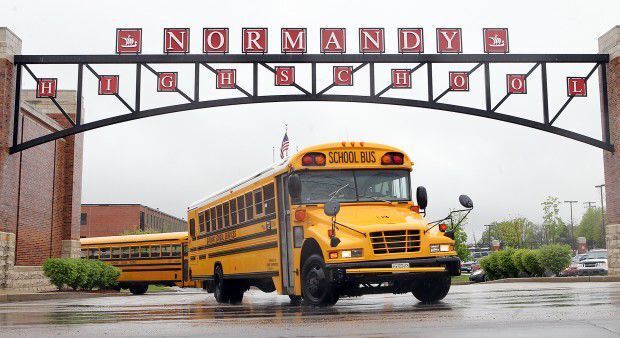
PINE LAWN • Several rows of chairs at the elementary school Saturday caught the small crowd’s attention.
Not because they were purple, but because so many seats were empty at a time when perhaps the Normandy School District needs them filled the most.
The event at Barack Obama Elementary was supposed to be a “community conversation” about school safety. About 20 people showed up, and only a few of them were parents.
In 2012, Normandy High School reported 285 discipline incidents — such as assaults, drugs and weapons — that resulted in out-of-school suspension, a rate of more than one for every four students, the highest among high schools in the region.
At the start of the gathering, Superintendent Stanton Lawrence, who is leaving at the end of the school year to go home to Texas, said there should have been a standing-room-only crowd. Then, he launched into a presentation about how a quarter of students caused 100 percent of the 1,729 suspensions so far this school year. He said most of the problems start as troubling seeds planted outside school walls.
People are also reading…
“It’s not the responsibility of the school alone, but of the community,” Lawrence said.
He said the community is fragmented like no other he has heard of in more than two decades of working in public education, including rough areas of Dallas and Houston. Normandy draws its 4,000 students from 24 municipalities. They live under 15 police departments and mayors. On top of that, nearly all of the students receive free or reduced lunch and over half of the student body moves at least once each year.
“We have to find a way to get around the table and work as one,” Lawrence said.
There are added stresses, Lawrence said in an interview after the meeting. He’d never heard of a struggling school district merging with a failed school district, as Normandy did in 2000 with Wellston. He compared it to throwing an anchor to somebody barely treading water. In 2012, Normandy lost its accreditation.
“If we switched kids with Ladue, we’d turn it around tomorrow,” he said.
Multiple breakout sessions were scheduled Saturday to talk about things such as conflict resolution and preventing bullying. But since the group was so small, they merged it all into one. A meeting at another school Saturday drew a similar crowd.
They talked about kids taking over homes and classrooms and if that wasn’t stopped what those children would be like as adults. They talked about fights being recorded and amplified over and over through social media outlets like Facebook and Twitter. They talked about how parents don’t show up for meetings like this because they are tired of talk and no action.
Eventually, two young teachers who are leaving the district spoke, saying the main problems weren’t fragmented homes and communities, rather an administration that doesn’t hold students accountable for their actions. They believe the community will improve when the students are educated.
“We don’t have systems in place to deal with conflict resolutions,” said Brittany Kelleher, 23, an English teacher at Normandy High.
“Teachers need to be backed up,” said Elyse Schultz, 23, a math teacher. “It’s not the kids, it’s the adult problems.”
Schultz is going to medical school. Kelleher plans to explore public policy in Boston.
“You come in and throw a bomb and you walk away. You can’t do that,” Yvonne Claywhite, a substitute teacher, told them after she found out the two teachers were leaving after just one year. “Don’t you want to see this come to fruition?”
Kelleher said there are good students and teachers at Normandy, and that poor discipline is a fixable problem, but they’ve decided to try and help in other ways, in other cities.


