Summers are famously humid in New York State, but life in the Maioli household has gotten more comfortable since the couple installed a new heating and cooling system — one that isn’t well known yet in the U.S.
“My wife is pretty happy because in the summer we can keep it to as cold as we like,” typically 69 or 70 degrees, Joe Maioli said. In 2021, the Ontario, New York, couple installed a geothermal — or ground source — heat pump.
The units you see that look like box fans outside homes and businesses are the more common air-source heat pumps. They wring energy out of outdoor air for heat and soak up excess heat indoors and move it out when they’re cooling. Geothermal heat pumps use underground temperatures, instead of outdoor air.

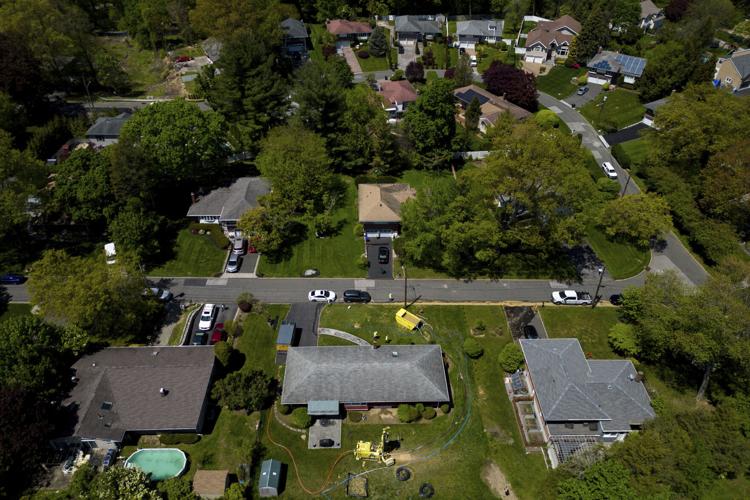
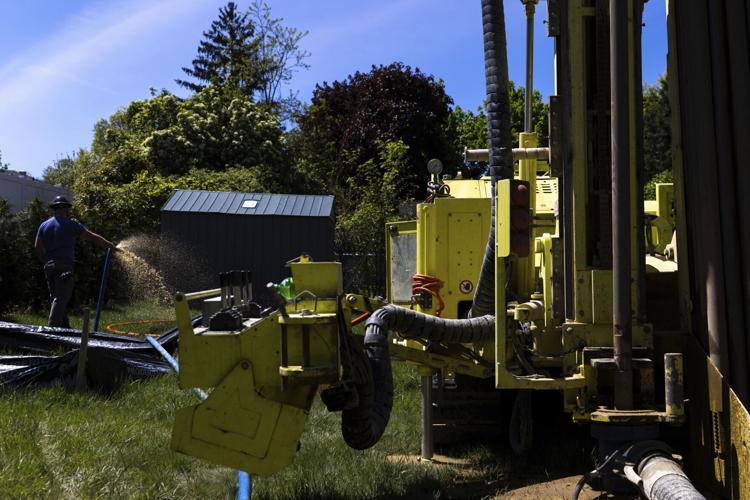
A Dandelion Energy employee sprays excess groundwater back on the lawn during installation of a geothermal heat pump system May 8, 2023, at a home in White Plains, N.Y. A water-filled loop is installed several hundred feet deep in the yard to either carry heat away from or into the house depending on season.
A major push is now underway to get people to consider ground-source heat pumps because they use far less electricity than other heating and cooling methods. “Ground-source heat pumps average about 30 percent less electricity use than air-source heat pumps over the course of the heating season,” said Michael Waite, senior manager in the buildings program at the American Council for an Energy Efficient Economy.
People are also reading…
“Cooling the house for a month is maybe $10 worth of electricity, and this is the most efficient way to do it,” Maioli said. During the coldest winter months, their highest heating bill was around $70, he said.
To install ground-source systems, contractors bring in heavy equipment and drill to bury a loop of flexible piping several hundred feet deep in your yard. Water flowing through the loop takes advantage of the underground temperature, a fairly stable 55 degrees.

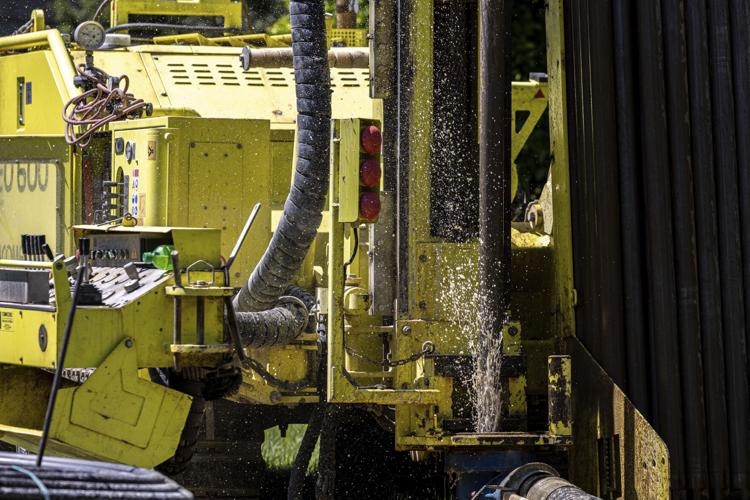
Groundwater squirts up during drilling for a geothermal heating and cooling system May 8, 2023, at a home in White Plains, N.Y.
Indoors, often in the basement, a unit contains refrigerant — a fluid that can easily absorb a lot of heat. In summer, the water in the loop dumps heat into the ground. In winter, it pulls heat from the earth with amazing efficiency and moves it indoors.
“We really feel like we’re on the right side of a megatrend,” said Tim Litton, director of marketing communications for WaterFurnace, a geothermal manufacturer in Fort Wayne, Indiana.
With the better known air-source heat pumps, Litton said, outdoor parts can ice over in winter. Then the system has to pull heat from indoors to thaw them. There’s also dirt, animals and debris.
WaterFurnace systems can be put in yards as small as 15 by 15 feet, he said. But the drilling rigs can’t get in where homes are really close together.
There is “a lot of demand for geothermal right now,” Mark Schultz, president of Earth River Geothermal in Maryland said, and the interest in reducing carbon emissions is a big motivator for customers. “They have electric vehicles in the driveway and solar panels on the roof,” he said of the sites he goes out to bid.

Groundwater empties into a dumpster May 8, 2023, while workers drill a hole for a geothermal heat pump system at a home in White Plains, N.Y. Industry experts see the technology becoming increasingly popular in the coming years.
In the Midwest, Litton sees a broad range of buyers. “We kind of span the entire political spectrum — whether you’re a progressive environmentalist or a fiscal conservative,” he said. “It’s kind of nice in these divisive times to have something to agree on,” he said.
The sticker prices for ground-source are higher than traditional systems. But last year’s Inflation Reduction Act highly incentivizes them with a 30% tax credit. So a customer purchasing a $30,000 system would end up paying $21,000. If someone doesn’t owe enough taxes in one year to benefit from that, they can carry it over to the next year. Nor is there any dollar limit on the credit, unlike for air-source units, which are capped at a $2,000.
Some states offer credits on top of that. In South Carolina, residents get another 25% credit, meaning a homeowner there could end up with a 55% discount off the initial cost. Some utilities offer incentives, too.
People who live in places with cold winters and hot summers reap the biggest savings. Still, leaders at three companies interviewed cited initial cost as a barrier.
Corey Roberts lives on Long Island, New York, and installed a geothermal system made by Dandelion Energy last July. He was renovating and needed a new heater and AC. He was also interested in sustainability. He opted for Dandelion after comparing the costs with a natural gas system.

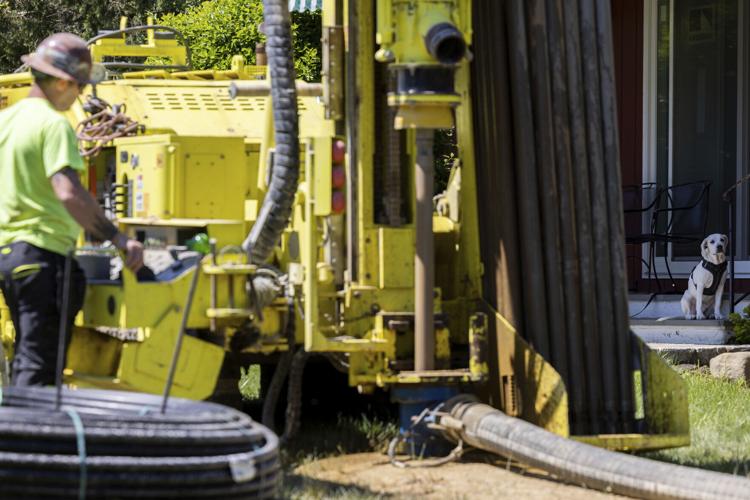
A dog looks on as a Dandelion Energy employee drills a hole for a geothermal heat pump system May 8, 2023, at a home in White Plains, N.Y.
“I can tell you the house is the coolest it’s ever been and the heating is the steadiest we’ve ever had since we’ve been living here. We are very happy,” Roberts said.
The upfront cost was an eye-popping $63,500, far more than the $27,000 natural gas option. But after the 30% federal tax credit plus a $5,000 state tax credit for geothermal plus a rebate from his electric company, it was about $32,000.
“Dandelion was only a $5,000 difference to a conventional system. If you think about how long it takes to recover the costs in savings, it’s quite quick,” Roberts said.
The new system has attracted the interest of friends and neighbors.
“We have a lot of people on the street asking us how it works and we say it’s just like magic. Water moves around a pipe in the ground and voilà, here we are heating and cooling. It’s amazing,” he said.
Dandelion, born out of a Google innovation lab in 2017, designs, installs, and maintains its own systems in New York, Connecticut, and Massachusetts. CEO Michael Sachse said the inspiration for the company was finding an affordable way to control temperature in the home without contributing to climate change.