
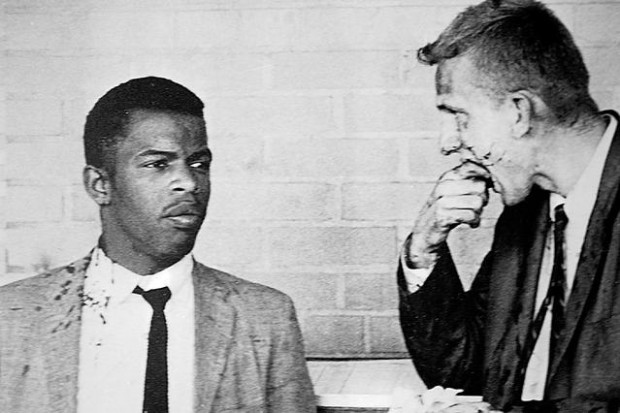

On May 20, 1961, Jim Zwerg and 21 others boarded a Greyhound bus in Birmingham, Ala., bound for Montgomery, and ultimately, New Orleans.
Some on the bus were white, like Zwerg. Most were black. All were Freedom Riders, testing interstate bus segregation in the Deep South, which had long ignored a 1946 Supreme Court decision outlawing the practice.
Arriving from Nashville, then arrested and let go in Birmingham without incident, they were now about to feel the full fury of hate bearing down on them in Montgomery.
Out of nowhere, the howling mob descended — men, women, children — carrying bricks, hammers, baseball bats.
"They were screaming, 'Kill the niggers. Get 'em. Get 'em.' Then they started screaming, 'Get the nigger lover.' I knew they were coming after me," says Zwerg.
People are also reading…
"The police had given them a half-hour to beat us up. As they came nearer, we sang hymns and said prayers. I bowed my head, closed my eyes. I asked God to be with me. To help me be nonviolent and to forgive them," he says.
"He was there. I felt his presence and a calm come over me. I knew in that instant whether I lived or died, it would be all right."
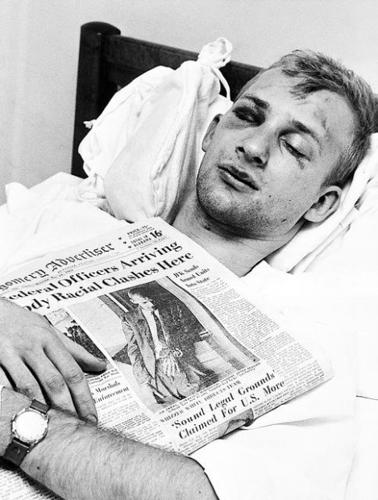
Severely beaten, Zwerg would spend five days in a Montgomery hospital. Pictures of his bloody face were flashed around the world in newspapers and on television, along with his words:
"Segregation must be stopped. It must be broken down. We're going on to New Orleans no matter what. We're dedicated to this. We'll take hitting. We'll take beating. We're willing to accept death."
Those words galvanized the Freedom Rider movement, sending a cross section of Americans rolling toward the South.
By the end of 1962, "white" and "colored" sections no longer existed in bus stations in the South, nor in the buses serving them.
Still healing from his injuries, Zwerg, along with nine other Riders, including future Georgia Congressman John Lewis, would receive a Freedom Award from the Rev. Dr. Martin Luther King Jr., and the Southern Christian Leadership Conference in the fall of 1961.
"Dr. King encouraged me to finish my education and pursue the ministry," says Zwerg, who moved to Tucson in 1970 and became pastor of Casas Adobes Congregational Church.
A big bear of a man, Zwerg, 66, sits this day in the living room of his Midtown home, reflecting on the improbable journey that delivered him from his "lily-white" childhood in Appleton, Wis., into the flailing arms of that mob in Montgomery.
The '50s
An Eagle Scout, Zwerg sang in the church choir and entertained thoughts of becoming a minister. In 1958, he arrived at Beloit College, a small liberal arts school in Wisconsin.
He had two roommates. One was the white quarterback of the football team. The other was Bob Carter, a classics major. "He was short and wiry and black, and he was not involved in the civil-rights movement," says Zwerg.
Sometimes when the two took a table at the college cafeteria, whites would get up and leave.
"He didn't get upset," he says. "That's what bothered me."
Finally, Zwerg confronted his roommate. "He pulled out a paperback of Dr. King's book, 'Stride Toward Freedom,' about the Montgomery bus boycott," says Zwerg. "He said, 'Read this.' He was bright enough to realize violence was not the answer."
In the second semester of his junior year, Zwerg transferred to Fisk University in Nashville, Tenn. "I was majoring in sociology and they had an exchange program. They had 10 white students in the whole school and all but one was an exchange student."
He soon learned about the movement to integrate Nash-ville's movie houses and went to see the students standing peacefully in front of the theaters. That's where he met John Lewis, then a 21-year-old student at Nashville's American Baptist Theological Seminary.
"He invited me to go to church with him after the stand-ins," says Zwerg.
After the stand-ins, everyone marched to the First Colored Baptist Church. As Lewis and Zwerg talked, Zwerg realized, "Here was a young man, younger than I was, with a deep and profound faith. He was the rock of the national movement."
In a phone interview from his office in Washington, D.C., Lewis says he, too, felt an instant kinship.
"Jim had a growing interest with the movement, with the philosophy of nonviolence," says Lewis.
He invited Zwerg to come to a workshop on nonviolence the next day, put on by the Nash-ville Student Movement.
"I was the only white," says Zwerg, describing the group of about 150. Zwerg began working behind the scenes, passing out fliers and working on a newsletter.
Still, he wanted to do more. "These kids were putting their faith on the line and I was just intellectualizing."
After several workshops, Zwerg was deemed ready to join the push to integrate Nash-ville's theaters. "My early test was to go to the theaters and buy two tickets. I could buy them because I was white."
Getting inside with a black friend was another matter. "One time we made it inside the lobby. We got hit on the head with a monkey wrench."
In April 1961, Nashville's theaters agreed to integrate. But the Nashville students were not yet done. "The movement was so much more than sitting down with a hamburger," says Zwerg. "Ultimately, we wanted to change society."
On May 4, 1961, about a dozen Freedom Riders boarded a bus in Washington, D.C., aimed at New Orleans. Ten days later, May 14, the Riders split their ranks into two buses, one Greyhound, the other Trailways.
The Greyhound bus got as far as Anniston, Ala., where it was set on fire. Meanwhile, white attackers took over the Trailways bus, beating its passengers as it headed from Anniston toward a waiting mob in Birmingham.
News soon reached Nashville.
"We were having a celebration for the integration of the movie theaters when we got word of the bus-burning," says Zwerg.
There was no hesitation.
"Eighteen of us volunteered. That was culled to 10."
Martin Luther King and other leaders urged them not to go, says Zwerg. "They called it a suicide mission. We said it was something we were willing to die for."
The night before, each of them wrote a farewell note to loved ones. Zwerg called his mother.
"I explained how important this was to me," says Zwerg, whose father had earlier suffered a heart attack.
"I told my mother, 'I love you but I have to do this.' My mother said, 'You've killed your father,' and hung up."
On May 17, they pulled out of Nashville, Freedom Riders as well as regular passengers. Zwerg sat up front, next to black student Paul Brooks.
A white man sitting behind them asked, "Where y'all going?"
"We said we were heading to New Orleans," says Zwerg. "He just smiled and said, 'You'll never make it.' "
The man was right. Just outside Birmingham, Police Chief Eugene "Bull" Connor had his men haul the Freedom Riders off to jail. Zwerg was thrown into the drunk tank by a jailer who announced, "Here's a goddamn nigger-loving Freedom Rider."
Noticing how filthy the place was, Zwerg got a trusty to get him some mops and pails. "We got a work crew together and all the while we're talking."
Over the next two days, he talked to the men about discrimination. Hoping their voices might be heard by Freedom Riders in nearby cells, Zwerg also led the men in singing, "Paul and Silas bound in jail, got no money for to go their bail. Keep your eyes on the prize. Hold on."
"That day I had groups in various levels of inebriation singing 'Eyes on the Prize,' " says Zwerg.
On May 19, charges were suspended against Zwerg and Brooks.
"By this time another group of kids had come down from Nashville," says Zwerg. "So 22 of us spent the night in the Birmingham bus station with the Klan marching around outside."
The next day, they boarded another Greyhound heading for Montgomery. This time Lewis sat next to Zwerg up front.
"We had police protection all the way to Montgomery. The police plane was overhead. John was so relaxed he fell asleep," says Zwerg.
But when they hit the Montgomery city limits, the support vanished. "There was not a sign of the police until we got to the bus station, where we saw a squad car disappear around the corner."
Reporters were waiting for them.
"John was prepared to address the press. He had barely opened his mouth when this stocky white man with a cigar in his mouth started going after the press," says Zwerg. "He grabbed a camera and threw it on the ground."
Next, the mob turned on them. Some managed to escape, including five black women Riders. But their black cabbie was afraid to transport the two white female Freedom Riders.
"They were beaten," says Zwerg, who as the lone white male Rider seemed to particularly incense the crowd.
"I got yanked over a railing, thrown on the ground. I got up on all fours. I got kicked in the spine, I heard the curses and fell on my back. A foot came down on my face. That's the last thing I remember."
Meanwhile, Lewis was knocked out with a wooden crate. Although photographs show Lewis and Zwerg standing together after the attack, Zwerg does not recall it.
He does remember waking up in a moving vehicle. "I heard Southern voices. I thought I was going to be lynched."
One of those voices belonged to Alabama Public Safety Director Floyd Mann, who had finally stopped the mayhem by threatening to shoot the rioters.
Zwerg was on his way to the hospital. He had three cracked vertebrae, a severe concussion and a broken nose. He also learned that his father had suffered a mild heart attack.
He returned to Nashville two weeks later to take his final exams, then spent the rest of the summer recuperating at home.
That fall, he returned to Beloit, which had canceled its exchange program with Fisk. That same fall, Lewis enrolled at Fisk.
Heeding Martin Luther King's advice, Zwerg did go to seminary school. He also married and started a family that now includes three children, five grandchildren.
After five years behind the pulpit here in Tucson, Zwerg went to work for a variety of organizations, most of them non-profits. He's now retired.
For years, he suffered from what he calls white guilt. "I'm sure I got more press because I was white."
Five years ago, he attended the 40th reunion of the Freedom Riders, which included a stop at the Civil Rights Institute in Birmingham.
Inside was a timeline exhibit of various years in the civil- rights movement. "For 1961 there was a picture of me in the hospital," says Zwerg. "So many people had gone through so much more. I started crying. I shouldn't be up there."
But then Jim Davis, another Freedom Rider, reminded him: "Jim, don't you realize that your words from that hospital bed were the call to action for everyone that followed?"
Adds Lewis: "Jim made a lasting and profound contribution to the cause of civil rights."
Still shunning any tag of "hero," Zwerg says, "It was not a matter of white versus black. It was just right versus wrong."
In a ruling tougher than the original Supreme Court mandate, the Interstate Commerce Commission outlawed segregation in interstate bus travel in September 1961.
Within months, segregated travel became a thing of the past.
● National Geographic published "Freedom Riders: John Lewis and Jim Zwerg on the Front Lines of the Civil Rights Movement," by Ann Bausum, in December 2005 ($18.95). The book is written for readers age 9 to 12.


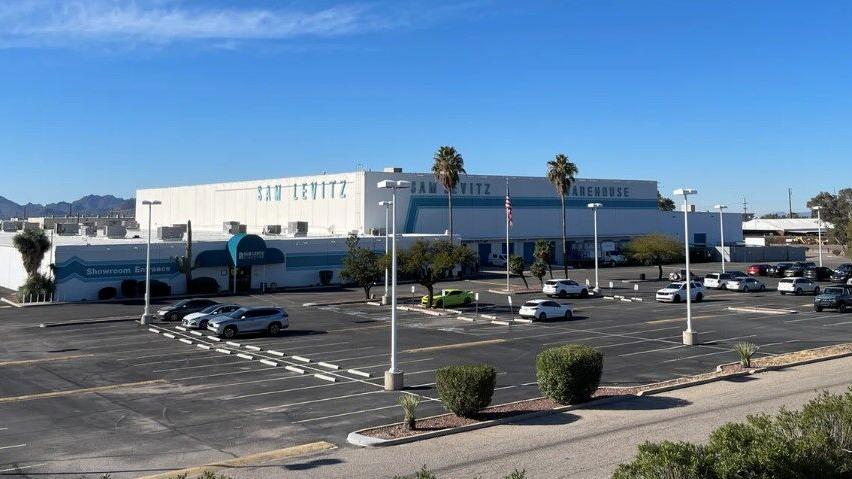
 Former Sam Levitz building sells for $8.6 million