

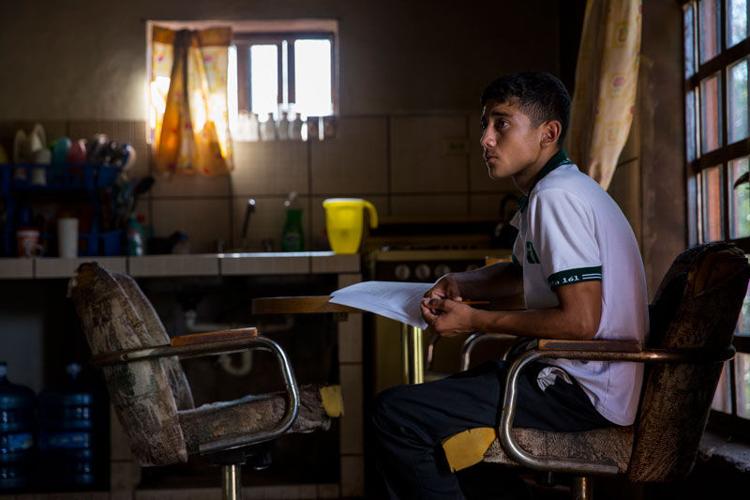
SONORA, MEXICO — A small fan clicks and hums as Jonathan Cosillos focuses on a chemistry book at his kitchen table. He’s working on his daily homework, but the light breeze isn’t enough to keep the flies from interrupting his concentration.
It’s late summer in the rural farming community, and Cosillos is still getting used to his academic routine. The soft-spoken 18-year-old from a family of five no longer works as a day laborer on a farm, as his father and brother do. But that’s not by choice.
He’s one of more than 300 people the Mexican government has identified with illnesses tied directly to heavy metal contamination from a mining accident that spilled 11 million gallons of toxic chemicals into the Sonora River in August 2014.
It’s been more than a year and new medical cases continue to emerge. Researchers and environmental experts in Mexico are now warning that the government’s slow response, combined with outdated water quality standards, have placed the population under unnecessary risk.
People are also reading…
Cosillos was working at a cucumber farm when the contaminated river flooded. He wasn’t aware of the risks as he and others rushed to save their harvest, wading through toxic water and drinking from the wells supplied by the river.
About a week later, he started feeling sick.
“I didn’t want to go to work, but I didn’t want to lose the job. I knew my family was struggling,” Cosillos said. “I wondered if it had anything to do with the river spill.”
It did. But it took nine months for him to get that answer.
The government response
When Mexican officials learned about the spill, they immediately closed all water wells within the seven municipalities near the river to prevent further contamination. The municipalities include Aconchi, Arizpe, Banámichi, Baviácora, Huépac, San Felipe de Jesús, and Ures.
The spill released a copper acid sulfate solution, which includes heavy metals such as aluminum, manganese and arsenic.
Mexican officials said that they immediately sent mobile teams of doctors into communities to identify affected families. But the doctors weren’t able to visit with every family.
It would be four months before his family was visited by Mexican health authorities who were looking for victims of the spill. They found Cosillos after they reviewed his medical files from the local hospital.
It then took another month before the government brought Cosillos to Hermosillo, the state capital, to get his blood tested for heavy metals. As Cosillos and his family waited for the results his health got worse.
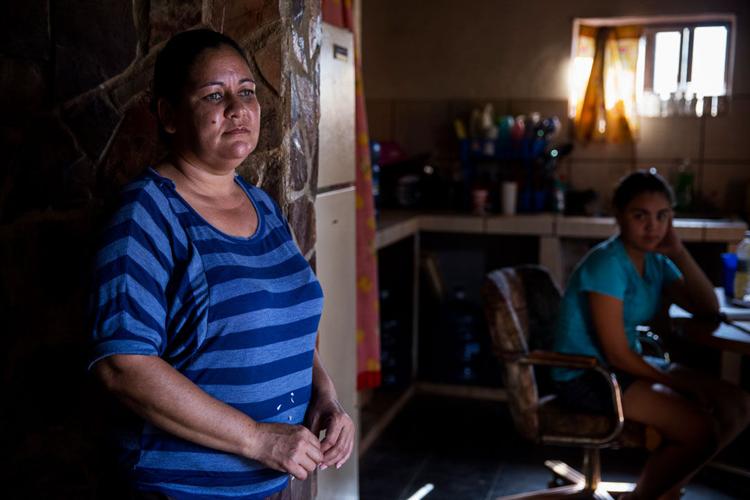
At one point Cosillos was in so much pain that he wanted to start shopping for coffins, said his mother, Blanca Ruiz, 38. He didn’t think he was going to make it.
The results never came.
“I’m still wondering why (the government) didn’t give me those first test results,” Ruiz said. “Maybe he tested positive for other heavy metals and they didn’t want to tell me.”
Ruiz said she filed a complaint with the Sonora Human Rights Commission, which was forwarded to federal officials because the tests were handled by COFEPRIS, Mexico’s health agency.
“After the spill, many people went to their health center and it wasn’t possible to detect them,” said Joel Lopez Villagomez, the director of a temporary treatment center that opened in March 2015.
The center, known as UVEAS, operates out of a home that was converted into a small treatment facility. It’s a temporary location because the Mexican government has plans to construct a permanent structure later this year.
It was here where Cosillos finally got the answers he was looking for. It had been nine months since he first became ill.
His blood analysis showed that he had levels of manganese above acceptable standards.
Manganese is a heavy metal that can have serious impacts on the nervous system if a person is exposed over prolonged periods of time, according to Hector Duarte Tagles, an environmental health specialist at the University of Sonora.
“There’s a high risk if people begin their treatment late. The longer some contaminants are in the organism, the more difficult it is to get rid of them,” Duarte Tagles said.
Adolfo García Morales, then a Sonora delegate to the Mexican Ministry of the Interior, said officials actively searched for patients throughout the Sonora River Basin.
To date, the government says it’s screened more than 10,000 residents.
“We’ve put a lot of emphasis on providing immediate care,” García Morales said.
“And I know for sure that we’ve given immediate care when people agreed to receive treatment.”
García Morales said there wasn’t a single person who had tests conducted that didn’t receive the results.
“The epidemiology unit opened recently, but that doesn’t mean that we haven’t been providing care to the population,” he said.
The new treatment center, UVEAS, will continue testing its patients every three months, for up to 15 years.
But according to Cosillos’ mother, Blanca Ruiz, the nine months it took for her son to get tested and begin treatment was unacceptable.
“If the government knew what was happening, why didn’t they take actions right away — right away,” Ruiz said.
Editor’s note: This report is part of an AZCIR collaboration with KPBS’ Fronteras Project, a regional news collaborative that produces reports on the changing culture and demographics of the American West and Southwest. The reporting was funded in part by a grant from the Corporation for Public Broadcasting.


