

JEFFERSON CITY • Missouri lawmakers head back to the Capitol this week for a veto session that could have them weighing legislation on guns, taxes and unions, among other issues.
But despite a number of high-profile pushes to override Gov. Jay Nixon’s vetoes, lawmakers don’t expect to be in Jefferson City much more than a day.
House Speaker Tim Jones, R-Eureka, and Senate Floor Leader Ron Richard, R-Joplin, both expect to finish efforts at overriding at least some of the Democratic governor’s 29 vetoes by the end of their first day, Wednesday, or by Thursday at the latest.
The biggest question they face is whether the Legislature can muster enough votes to override Nixon’s veto of a contentious bill that would cut state income taxes for the first time in nearly a century.
But with several Republicans in the House announcing that they will vote against the override, the chances appear slim.
People are also reading…
“I just don’t think they can get that thing done in the House,” Richard said. “I hope I’m surprised, but I don’t think the votes are there.”
Still, Jones said legislators have an opportunity to “make history” by overriding a record number of vetoes. To get there, they will have to override at least three bills — the record that was set in 2003, when Bob Holden, a Democrat, was governor.
The Legislature’s veto sessions have typically wrapped up in a matter of hours. In most years, lawmakers have attempted no overrides or honed in on one key piece of legislation. There have been just five successful override attempts in the past decade.
But with a near-record number of vetoes from Nixon this year, some have been bracing for a bigger showdown.
Republicans hold at least two-thirds of the seats in both the House and Senate, enough to override the governor’s vetoes if they all stick together. But the margins are tight, particularly in the House, where Republicans hold 109 seats — the exact number of votes needed for an override.
Nixon has spent much of the summer highlighting his opposition to the tax cut legislation, which would lower the state’s personal income and corporate tax rates. Nixon says the bill is sloppily drafted and would lead to unintended consequences, including an increase in prescription drug prices and a hit to the state budget that would hurt education funding.
“Although Missourians expect to have low and predictable taxes, they also want good jobs, quality schools and safe and healthy communities, and they are not willing to gamble these priorities on unproven experiments,” Nixon said in his veto message — a point he has made during dozens of appearances across the state.
Supporters of the legislation have said they want a chance to address some of Nixon’s concerns. Last week, Rep. T.J. Berry, a Republican from Kearney who sponsored the bill, sent a letter to the governor asking him to call a special session so the legislation can be corrected.
“I truly believe Missourians want to see us reach some sort of compromise on this important issue and that we should do all we can to find the common ground necessary to make a tax cut for working Missourians a reality,” he wrote.
But Nixon rebuffed his call and seized on Berry’s “acknowledgement of the serious flaws” in the legislation.
“Trying to throw something together at the last minute is not the responsible approach to an issue as complex and important as tax policy,” Nixon spokesman Scott Holste said in a statement.
GUN LAWS
Another vetoed bill that has drawn intense interest is one that seeks to nullify some federal gun laws.
While the gun bill had bipartisan support, it has come under fire from law enforcement and the state attorney general.
Under the legislation, Missouri would not recognize federal laws that “infringe on the people’s right to keep and bear arms.” It also would make it a misdemeanor for federal officials to try to enforce those measures.
In a letter to Jones, Attorney General Chris Koster, a Democrat endorsed by the National Rifle Association during his campaign last year, said the legislation would create “an obvious risk to public safety.”
“No other state has taken the step of criminalizing the enforcement of federal gun laws,” he wrote.
The legislation also bars the publishing of the “name, address or other identifying information of any individual who owns a firearm,” which has drawn criticism from the Missouri Press Association.
“Any time a name of someone who is a gun owner is published anywhere, online or in print, the publisher could be guilty of a misdemeanor and fined up to $1,000,” MPA president Mark Maassen said. “Local prosecutors, who work hard to protect their communities, are going to prosecute people who had no idea that a person whose name they publish was a gun owner.”
The bill’s sponsor, Rep. Doug Funderburk, R- St. Peters, remains optimistic that lawmakers will override Nixon’s veto.
“Things are still on track,” he said. “This is a political fight. It’s not about the substance of the bill.”
In Funderburk’s opinion, the legislation gives Missouri the ability to defend gun owners if they are unfairly targeted by the federal government or subjected to illegal confiscations.
“Missouri government is owned by Missourians, so I think that’s an appropriate role,” he said. “How could this be so devastating or troubling for people? We’re just trying to defend the Constitution.”
But Richard said he’s reconsidering his position on the gun bill because he believes some of the arguments Koster has made are valid.
“It’s up to the Legislature to pass good legislation that is drafted properly, and this argument that ‘even if it is unconstitutional, vote for it anyway,’ is the silliest argument I’ve ever heard,” Richard said.
Jones said he is still reviewing all of the legalities of the bill.
With the two most high-profile bills still up in the air, legislative leaders say other veto override votes are possible.
Richard said he thinks the Senate will have enough votes to override a veto of legislation that was dubbed the “paycheck protection” bill. It would require public employee labor unions to get annual written consent from employees before withholding dues and fees from their paychecks. That legislation faces a tougher battle in the House, where it originally passed with fewer votes than the 109 needed for an override.
Richard also plans to pursue an override on legislation dealing with public officials voting via conference calls.
Jones said he plans to meet with Republican members before the veto session starts to gauge the chances for each bill.
“As long as I feel and the rest of the caucus feels that there is at or near 109 votes, we intend to bring up as many bills as possible,” he said.
Editor's note: An earlier version of the this story used the wrong attribution for a comment from Senate Floor Leader Ron Richard, R-Joplin.
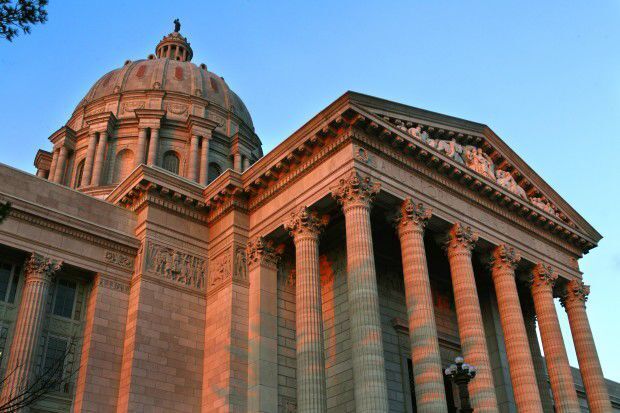
The Missouri State Capitol in Jefferson City on May 17, 2013. Photo by Robert Cohen, rcohen@post-dispatch.com
Elizabeth Crisp covers Missouri politics and state government for the Post-Dispatch. Follow her on Twitter at @elizabethcrisp.


