

The tricky process of sealing an offshore oil well with cement - suspected as a major contributor to the Gulf of Mexico disaster - has failed dozens of times, according to an Associated Press investigation.
Yet federal regulators give drillers a free hand in this crucial safety step - another example of lax regulation of events leading up to the April 20 explosion on the Deepwater Horizon oil rig.
Federal regulators don't regulate what type of cement is used, leaving it up to oil and gas companies. The drillers are urged to simply follow guidelines of the American Petroleum Institute, an industry trade group.
Far more stringent federal and state standards and controls exist on cement work for roads, bridges and buildings.
While the chain of failures on Deepwater Horizon is under investigation, rig owner Transocean has singled out cement work as one likely fundamental cause of the blowout.
People are also reading…
Even before Transocean pointed to cementing, independent experts suspected it partly because faulty cement work - either badly mixed or poorly placed against well walls - is so prevalent at offshore wells.
An AP review of federal accident and incident reports on offshore wells shows that the cementing process has been implicated at least 34 times since 1978. Many of the reports, available from the U.S. Minerals Management Service, which regulates offshore wells, identify the cause simply as "poor cement job."
• In a November 2005 accident where the Deepwater Horizon was positioned above another well in the Gulf, faulty cement work allowed wall-supporting steel casing to come apart. Nearly 15,000 gallons of drilling fluid spilled into the Gulf.
• Just a week later in a nearby well at another platform, cement improperly seeped through drilling fluid. As a result of an additive meant to quicken setting time, the cement then failed to block a gas influx into the well. When crew members finally replaced heavy drilling fluid with lighter seawater, as they also did last month before the blowout at Deepwater Horizon, the well flowed out of control and much of the crew had to be evacuated.
• Cementing was identified by federal investigators as a glaring cause of an August 2007 blowout, also off Louisiana. They said, "The cement quality is very poor, showing what looks like large areas of no cement."
Reports by MMS, a branch of the Interior Department, also provide evidence of the role bad cement work has played in accidents. One study named cementing as a factor in 18 of 39 well blowouts at Gulf rigs from 1992 to 2006. Another attributed five of nine out-of-control wells in the year 2000 to cementing problems.
Cement made to order
Cementing in the oil rig business is a sensitive, involved process.
Deepwater wells pose special challenges: severe pressures and temperatures, as well as the need for specialized equipment and lots of cement. The wellhead of the Deepwater Horizon operation sat on the ocean floor, nearly a mile from the surface. The drill hole itself went another 13,000 feet into rock.
All cement begins as a slurry with cement flakes and water. Contractors then add ingredients to make the cement set at the right time and to keep out gas and oil.
There are three major U.S. cementing companies: Halliburton, Schlumberger and BJ Services. Cementing is typically performed by such rig contractors as part of a broad range of drilling services that they supply.
Halliburton, which had the Deepwater Horizon job, mixes in nitrogen to make its slurry more elastic. The nitrogen also helps create a lightweight cement that resembles a gray foamy mousse and bonds better to the casing.
But the recipe also depends on the job, because cement must respond to varying pressures and temperatures. Cement contractors work closely with oil and gas companies on the formulas for individual wells. The oil and gas companies have the final say on what is used.
Once the consistency of the mix is decided on, it is pumped deep into the well, where it first sinks to the bottom and then oozes upward to fill the narrow spaces between the steel casing pipe and rock walls. When the cement sets, the casing and cement are supposed to form an impenetrable wall to keep gas or oil from pushing into the hole anywhere but the bottom, where its flow up the pipe can be controlled.
But if gas bubbles invade the setting cement, they can form a channel for pressurized gas and oil to surge uncontrollably up the well, usually around the casing. The cement must be strong enough to withstand up to 5,000 pounds of pressure per square inch, to keep the well walls from collapsing.
If cement was part of the cause of the Deepwater Horizon catastrophe, it also could be part of the remedy. Two relief wells are being drilled to intersect the leaking well and plug it with cement.
Halliburton did not respond to AP requests for comment.
Sunday's updates
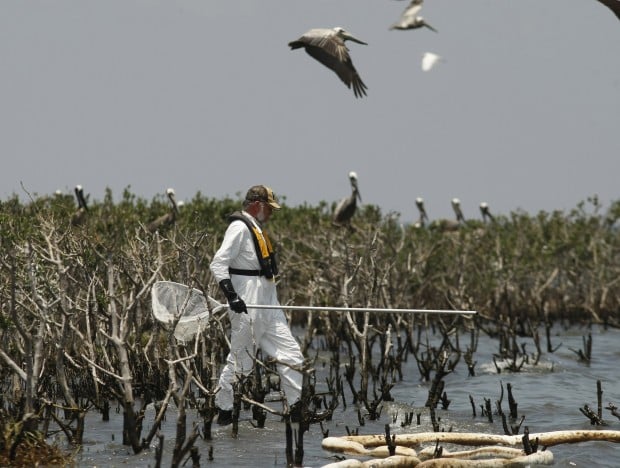
With oil pushing at least 12 miles into Louisiana's marshes and two major pelican rookeries now coated in crude, Gov. Bobby Jindal says the state is working on a chain of sand berms that would skirt Louisiana's coastline.
Jindal visited one of the affected nesting grounds Sunday. Jindal and officials from several coastal parishes say the berms would close the door on the oil still pouring from a deepwater gusher about 50 miles off the Louisiana coast.
The berms would be made with sandbags. The U.S. Army Corps of Engineers also is considering a broader plan that would use dredging to build sand berms across more of the barrier islands.


 Lake Mead's drops raise prospect of unaffordable Hoover Dam electricity


