

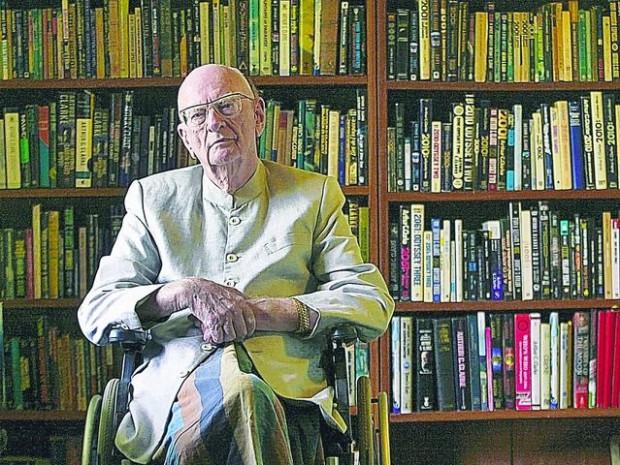
COLOMBO, Sri Lanka — Arthur C. Clarke, a visionary science-fiction writer who co-wrote "2001: A Space Odyssey" and won worldwide acclaim with more than 100 books on space, science and the future, died today, an aide said. He was 90.
Clarke, who had battled debilitating post-polio syndrome since the 1960s, died at 1:30 a.m. in his adopted home of Sri Lanka after suffering breathing problems, aide Rohan De Silva said.
Co-author with Stanley Kubrick of Kubrick's film "2001: A Space Odyssey," Clarke was regarded as far more than a science-fiction writer.
He was credited with the concept of communications satellites in 1945, decades before they became a reality. Geosynchronous orbits, which keep satellites in a fixed position relative to the ground, are called Clarke orbits.
He joined American broadcaster Walter Cronkite as commentator on the U.S. Apollo moonshots in the late 1960s.
People are also reading…
Clarke's non-fiction volumes on space travel and his explorations of the Great Barrier Reef and Indian Ocean earned him respect in the world of science, and in 1976 he became an honorary fellow of the American Institute of Aeronautics and Astronautics.
Regarded himself first as writer
But it was his writing that shot him to his greatest fame and that gave him the greatest fulfillment.
"Sometimes I am asked how I would like to be remembered," Clarke said recently. "I have had a diverse career as a writer, underwater explorer and space promoter. Of all these I would like to be remembered as a writer."
From 1950, he began a prolific output of both fiction and non-fiction, sometimes publishing three books in a year. He published his best-selling "3001: The Final Odyssey" when he was 79.
Some of his best-known books are "Childhood's End," 1953; "The City and the Stars," 1956, "The Nine Billion Names of God," 1967; "Rendezvous With Rama," 1973; "Imperial Earth," 1975; and "The Songs of Distant Earth," 1986.
When Clarke and Kubrick got together to develop a movie about space, they used as basic ideas several of Clarke's shorter pieces, including "The Sentinel," written in 1948, and "Encounter in the Dawn." As work progressed on the screenplay, Clarke also wrote a novel of the story. He followed it up with "2010," "2061," and "3001: The Final Odyssey."
In 1989, two decades after the Apollo 11 moon landings, Clarke wrote: "2001 was written in an age which now lies beyond one of the great divides in human history; we are sundered from it forever by the moment when Neil Armstrong and Buzz Aldrin stepped out on to the Sea of Tranquility. Now history and fiction have become inexorably intertwined."
Clarke won the Nebula Award of the Science Fiction Writers of America in 1972, 1974 and 1979; the Hugo Award of the World Science Fiction Convention in 1974 and 1980, and in 1986 became Grand Master of the Science Fiction Writers of America. He was awarded the CBE in 1989.
Born in Minehead, western England, on Dec. 16, 1917, the son of a farmer, Arthur Charles Clark became addicted to science fiction after buying his first copies of the pulp magazine Amazing Stories at Woolworth's. He read English writers H.G. Wells and Olaf Stapledon and began writing for his school magazine in his teens.
In April 1973, Arthur C. Clarke was one of the speakers at a University of Arizona science conference called "Janus: Colloquy on Technology and the Quality of Life." Speaking at a press conference, Clarke discussed the pending communications revolution. He predicted each businessperson would have his own computer terminal and viewing screen with which he could call up needed information or be hooked to a meeting anywhere in the world. Also addressing the multiday conference were Buckminster Fuller and Gene Roddenberry.
Arizona Daily Star


 As water lifeline evaporates, Arizona faces a cultural change over water use


