

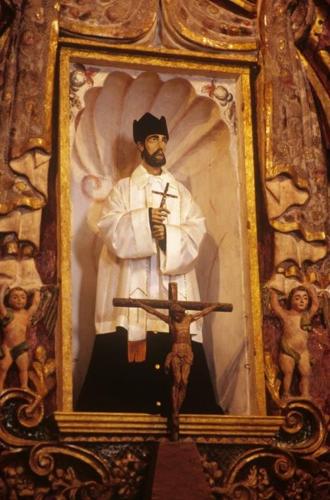
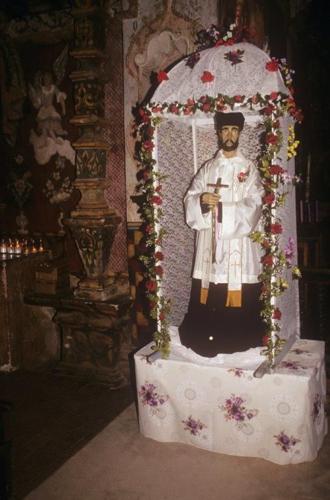
Wednesday, Dec. 3, is the feast day of St. Francis Xavier, the unofficial patron of our Pimería Alta. Readers of this blog will know that it’s a bit more complicated than that, as the saint as he exists in the hearts and minds of many Sonorans is actually a composite of Saints Francis Xavier and Francis of Assisi, with perhaps a little bit of Father Kino thrown in.
Here at mission San Xavier it is the standing statue of San Francisco Xavier over the high altar that is honored on Dec. 3, and the reclining statue of the same man in the west transept that is honored on Oct. 4, which is really Assisi’s day! And the wonderful, life-sized statue of Assisi that stands in the west transept simply stays where he is. Leaving all that aside, let’s take a look at the man whose day this is.
Francis Xavier (1506-1552) was a Basque nobleman who became an early follower of St. Ignatius Loyola and was one of the first Jesuits. He became a missionary to the East, working in Goa, south India, the Spice Islands, and Japan, before dying on an island off the cast of China while he was waiting to work in that vast country. His follower packed his body in lime and shipped it Goa, on India’s west coast, where it arrived fresh and unspoiled, and where it still remains. The patron saint of missionaries, he travelled thousands of miles and converted hundreds of thousands of people. He was also Father Kino’s personal patron saint.
People are also reading…
Many stories are told about him; this is one of my favorites: At some point, the Jesuits removed an arm from his corpse and carried it so Rome as a sacred relic. It is still there, on display in the Jesuit church of Il Gesu. When the Pope expressed doubts as to the authenticity of the relic, the arm grabbed a pen and wrote down “XAVIER.”
Here in the Pimería, his reclining statue, which represents his corpse, is the focal point of the huge annual October pilgrimage to Magdalena, Sonora. This week his standing statue will be taken from the main altar at San Xavier and carried in procession, complete with fireworks, around the plaza in front of the church on the eve of his feast. On the day itself, another procession will go from the church to the feast house, where the next year’s feast committee will be sworn in. The rest of the day will be given over to dancing and feasting. Then the saint will go back to his niche on the main retablo, and things will be quiet again for a while.


