
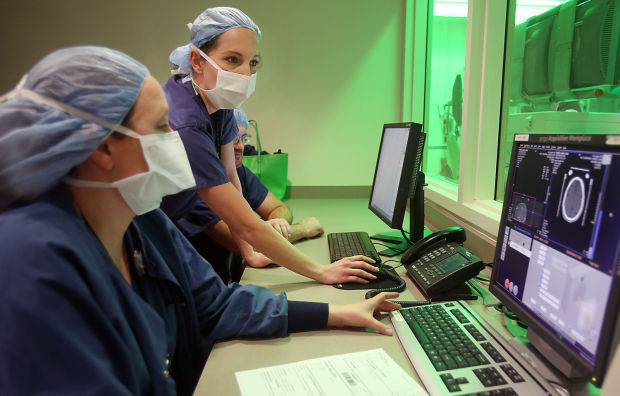
Jessie Heisey helps bridge the growing role of technology in the operating room and the doctors who perform surgical procedures.
Heisey, a clinical bioengineer, serves as on-site support for the equipment and software used in the high-tech operating room at Tucson’s Carondelet Neurological Institute.
As far as she knows, she is the only clinical bioengineer in Tucson.
After graduating from Arizona State University with a degree in bioengineering, she took a job with Brainlab, a German medical technology company. When she finished her training at Brainlab’s U.S. headquarters in Chicago, the company sent her back to Arizona.
Brainlab hired Heisey specifically for Carondelet, after the company purchased Brainlab equipment for the new facility. Her job as clinical bioengineer began with the installation of equipment and software in the operating rooms as they were being built.
People are also reading…
“Carondelet had a contract with Brainlab to have somebody on site for the first year of cases,” said Heisey, who is 30. “It wasn’t necessarily the norm, but because Carondelet has the technology on such a large scale, they had that agreement and they were the first of the kind in the country.”
Surgical scanner
Heisey says her main role is to serve as a link between the surgeons and the technology.
“That means day-to-day, I’m the one operating the systems. I also make suggestions on the best way to utilize the equipment for the specific patient’s procedure, as well as perform ongoing calibration and maintenance to ensure accuracy,” she said.
One of the Brainlab pieces she operates is the VectorVision integrative CT scanner. Although she has three sons of her own, Heisey refers to it as her baby.
CT, or computerized tomography, produces computer-processed X-ray images of small sections of specific areas of the body. With a traditional CT scanner, a patient is placed onto a table that slides under the scanner.
The VectorVision is different in that it moves over the patient while it’s taking the scan.
“The patient is anesthetized, hooked up to monitors and lines and draped for a sterile procedure,” Heisey said. “With this type of CT scanner, we no longer have to worry about what might happen while moving the patient.”
The scanner also allows for a patient to be scanned after any implants are placed and before the surgical field is closed. Traditionally, a patient will be closed and taken for a CT scan to verify placement. If it’s incorrect, the patient has to be taken back into surgery. Heisey said that this happens in about 5 percent of cases.
The VectorVision at Carondelet was the first in North America with the ability to slide in between two operating rooms. The operating suite it’s housed in has a wall that slides down, allowing the scanner to be shared between two rooms.
According to Heisey, there are now about 60 worldwide and 25 in the U.S., at locations such as Johns Hopkins Hospital, Duke University Hospital and Massachusetts General.
BRain stimulation
“Since we were the first, representatives from all of the other facilities have come here to see how we do it,” she said. “It’s been an amazing part of the job to be able to actually have these surgeons from all these very prestigious institutions come to see how we’re doing things in Tucson and be able to tell them this is what we’ve found is best.”
Integrative CT scanners and image-guided surgery have made it possible to decrease the invasiveness of many complicated procedures because of the quality of the image and the ability to guarantee accuracy of placement of probes and instruments.
“They’re applying the technology to different procedures than even Brainlab ever intended it to necessarily ever be used for,” Heisey said.
She discussed the use of deep brain stimulator treatments as an example of one of the newer uses of the intraoperative CT scanner.
“In some patients with Parkinson’s or other movement disorders, leads can be placed to stimulate the brain to help alleviate the symptoms of those diseases. Traditionally the patient is awake so the surgeon can verify they’re in the correct spot with the leads.
“Now we can take a CT scan before they ever leave the room and visually verify that those leads are in the right places. Those patients can now be asleep, which is much less traumatic for the patient.”
The technology is already commonly used in spinal surgery, tumor resection and aneurysm procedures, but Heisey said its even being used in some thoracic tumor cases because of the increased visibility.
Because technology is such a large part of the operating room at Carondelet, the surgeons that Heisey works with appreciate that they have an expert in tech support on hand.
“We’re working in a pretty high-tech environment and the work that we do can be pretty stressful,” said neurosurgeon Dr. Eric Sipos. “What having Jessie here does is allows us to focus on what we need to focus on, which is our patient, the job that needs to get done.”
Suggestions offered
With Heisey in the operating room, Sipos said that he doesn’t have to worry about any issues with the technology. She’s also familiar with the specific procedures and workflow in the operating room and knows how everything needs to work.
“You don’t want your aircraft pilot to have to worry about whether the engine’s going to turn off,” he said. “We have somebody who understands the inner working of all of this stuff and how it’s put together and how it’s supposed to work together. It’s a big deal.”
Even though the surgeons are familiar with the technology, Heisey still is able to make recommendations based on the procedure as far as how to use or place instruments.
“The surgeons are making the decisions but I’m helping with the Brainlab piece of the puzzle,” she said.
Every day is different
Another part of her job with Carondelet is to give feedback to Brainlab about what she and the surgeons would like to see going forward as far as products or technology, and vice versa.
“I get to see a different surgery every day. This surgery for this patient is a huge part of their life and it’s different than any surgery we’ve ever done before,” Heisey said.
“By being a part of these procedures and knowing that these cases are going better because I’m here, I can be proud of that and be excited to be here.”
Caitlin Schmidt is a NASA Space Grant intern at the University of Arizona and the Star. Contact her at cschmidt@tucson.com or 573-4191. On Twitter: @caitlincschmidt