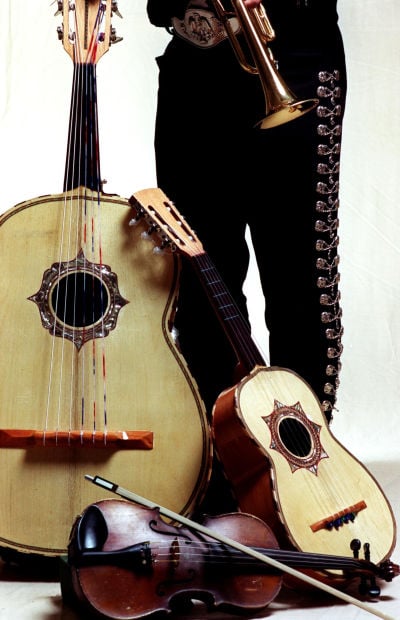
Clockwise from top, the trumpet, vihuela, violin and guitarrón are tools of the mariachi trade.Soaring voices not pictured.
We’re defining Tucson in 100 objects. The daily series began April 20. Follow along at: azstarnet.com/100objects
Once a year, for the Tucson International Mariachi Conference, the guitarrón count in the Old Pueblo skyrockets.
The six-stringed bass with the bulbous body and the resonant sound is the backbone of a mariachi ensemble and, along with the vihuela, one of two instruments that are distinct to it.
The overall effect, with trumpets, violins and soaring vocals added in, is the sound many visitors equate with our town.
It’s long been a tradition that, when friends arrive from elsewhere, you take them to one of Tucson’s many Mexican restaurants.
People are also reading…
Then, when the strolling mariachis come by your table, you demonstrate your mastery of the culture by asking them to play one of three Spanish songs you can remember.
That would be “Volver,” “De Colores” and “Bésame mucho.”
Many Tucson schools have mariachi bands and the music infuses indie-rock bands in the Southwest, notably in the performances of Tucson-based Calexico.
The origin of mariachi music is usually traced to the Mexican state of Jalisco, but its reach is worldwide.
Since 1983, Tucson has hosted the International Mariachi Conference, where the greats of the genre mingle with young aspirants in workshops and performances that have included Linda Ronstadt, Lola Beltrán and Vikki Carr.