

The Democratic majority of the Erie County Legislature stands poised to approve County Executive Mark Poloncarz's $123.7 million spending plan Thursday, which would take one of the biggest windfalls in decades and use it to boost a variety of infrastructure and community improvement projects, as well as county payroll.
But the Republican-supported minority caucus is gearing up to wage a battle on the Legislature floor. They will push to sidetrack the county executive's spending plan and replace it with a different plan that they say offers more public input.
That plan appears doomed to fail, due to a lack of votes, but the minority caucus intends to try and embarrass the county administration and the Democratic legislators who support it by arguing that the projects proposed lack both vision and community participation.
Minority Leader Joseph Lorigo set the stage Wednesday by grilling Deputy Budget Director Benjamin Swanekamp at a committee meeting about specifics to various proposed projects, many of which ranged in cost from hundreds of thousands of dollars to millions.
People are also reading…
Swanekamp did not have specific details to many of the projects, which were added at the request of Democratic majority members.
"We're now close to $15 million in expenditures the administration proposed, and you're not sure what we're doing," he told Swanekamp.
He cut off Democratic legislators who attempted to explain the nature of the projects.

"We're investing millions of dollars into parks and roads in the City of Buffalo, when the City of Buffalo is getting $330 million of their own American Rescue Plan," said Minority Leader Joseph Lorigo, C-West Seneca. "Why are we doing these things? These things deserve a conversation."
Discussion devolved into debate about whether money for ballfield improvements, streetscape projects and Christmas markets counts as transformational projects, with Lorigo and Democrat legislators ultimately arguing over who has been more of a bully in the spending plan discussions.
Republican-supported legislators contend that the county has until 2024 to decide exactly how they will allocate this huge sum of money, and the County Legislature shouldn't rush to approve a spending plan based on the administration's internal priorities and Democratic legislators' personal district requests.
The Democratic majority argued that if the minority caucus thought there were better ways to spend the $123.7 million in federal stimulus money and state funds, or ways to earmark more of the money to their own district needs, then they should have proactively reached out to the county executive.
Legislature Chairwoman April Baskin said that's what she did.
"I, personally, never got a call from the administration," she said. "I really want us to correct the narrative here."
Lorigo said he hasn't called Poloncarz because Poloncarz bluntly told him a month or two ago that he isn't interested in their support.
"The last conversation I had with the county executive, he laughed and told us that he didn't need us," Lorigo said.
Poloncarz rolled out his RENEW Plan – Reinvest in Erie's Neighborhoods and Employ our Workforce – at a news conference three weeks ago, flanked by the Democratic legislators.
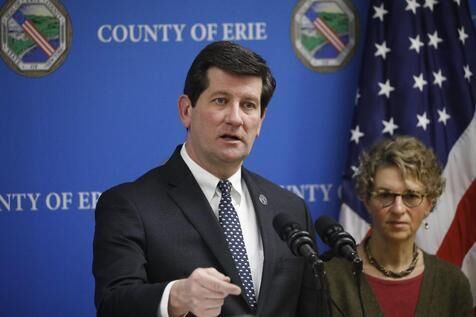
The largest influx in government funding Erie County has ever seen would transform the county, from its parks to county buildings to the sewer system, under Erie County Executive Mark C. Poloncarz's plan for spending federal pandemic aid.
Lorigo again faulted the Democratic Legislature leadership, which holds a 7-4 majority, for making no effort to include the Republican-supported minority in any conversations about spending needs and stated the Legislature should be a more independent and deliberative body.
Majority Leader Timothy Meyers said it didn't matter what projects Poloncarz and the Democratic majority supported. The minority caucus would have opposed it.
He and other Democratic legislators appeared visibly aggravated, but unsurprised, by the tone of Wednesday's committee discussions.
"It's along party lines. We're not going to agree," Meyers said. "Let's go into tomorrow. Everybody get ready for the cameras, and let's do this all over again. And then take your vote, and let's move on."
The Republican-supported minority intends to protest the RENEW Plan vote by putting forth their own process for deciding how money should be allocated. They called for a 30-day public comment period and outlined 10 agenda items worth serious discussion.
"This is a once-in-a-lifetime opportunity where we have a windfall of money that can truly make changes to our community for generations to come," Lorigo said. "Nothing in our amendments kills anything the county executive has proposed. Instead, it puts the entire plan on hold in favor of having a discussion on how to spend the money in a transformational way."

"I had some people ask me, when they heard I was doing this plan, they're like, 'Oh, you're going to put this money toward a football stadium?' And the answer was, 'Hell no, that would be a waste of this money,' " Poloncarz said.
Transportation and tourism projects include:
• New port of call: Working with the Niagara Frontier Transportation Authority to open up a Port of Buffalo for Great Lakes cruise ships. The minority caucus pointed out that Viking River Cruises has announced plans to launch a series of Great Lakes cruises, but Buffalo was left out as a port of call.
• High-speed rail: Working with Niagara and Cattaraugus counties to invest in a high-speed rail line that would expand the travel and tourism network connecting Buffalo to Niagara Falls and Ellicottville. The goal would be to encourage Buffalo to serve as a home base for tourists.
• Regional airline: Working with the NFTA to attract a regional airline that could use the Buffalo-Niagara International Airport as a hub for operations.
In terms of transportation and tourism, the county administration's RENEW program would spend millions in roads, convention center improvements, the Buffalo & Erie County Botanical Gardens expansion and county parks improvements.
Other parts of the minority caucus plan include speeding up the county administration's already existing plans to expand high-speed internet service through ErieNet, and investing more in private sector companies to expand the reliability of cellphone service.
The county has a company working on the design for ErieNet, which will be finished next year. Poloncarz has expressed his intention for funding the construction of the countywide broadband network with next year's American Rescue Plan funds.
Several proposals offered by the minority caucus revolved around community grants. They include:
• Providing a pot of grant funding to assist restaurants, nonprofit and cultural organizations.
• Implementing a property tax matching grant program that would reward local municipalities that make lasting cuts and operational changes to lower residents' taxpayer bills.
Finally, the caucus suggests reserving money to expand sewer system access and help transform SUNY Erie. The community college has seen a steady decline in enrollment and is facing financial hardships.


