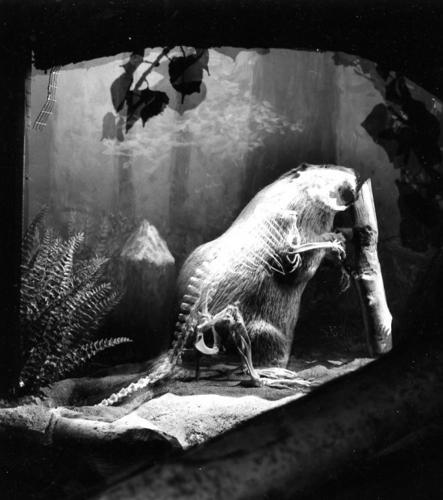
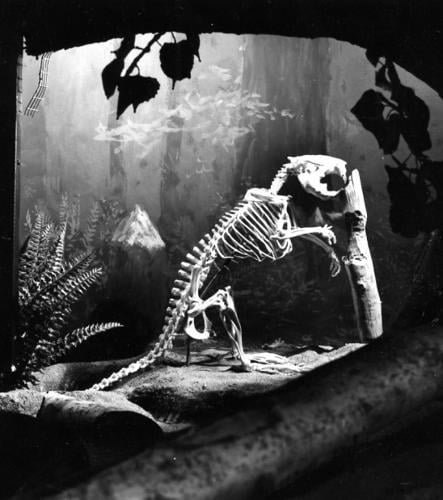
Today's "tail" is referring to a magic trick involving a beaver.
--Tucson Citizen, August 14, 1969
“Lookit! It’s a small bear!!”
“Naw, it ain’t. It’s a big rat.”
Two small boys maneuvered for positions to peer into the small, temporary opening to a new exhibit at the Arizona-Sonora Desert Museum.
Through the small window the boys were gazing at a preview of an unfinished group which will feature the beaver, an animal that once—many years ago—flourished in the Santa Cruz River. The complete exhibit will depict the importance of the beaver to the U.S. and Canada.
A historian reports the Santa Cruz “was all of 10 feet deep in the early days when Father Kino was establishing the San Xavier Mission. And during days of drought, deep holes in the river provided enough water to prevent the beavers’ extinction.”
People are also reading…
The museum’s beaver exhibit was designed and made by Lew Walker, associate director. It shows, though use of a mirror and lights, a transition form a beaver to its skeleton ad back again.
The fascinating “dissolving habitat display” fills an important need in the field of educational museum exhibits, Walker said.
Explanation of the dissolving beaver diorama at the museum is “fairly simple,” according to Walker. The principle “is based on the old disappearing act used by stage magicians through the use of mirrors and lighting.”
The transition begins with a life-size beaver depicted as chewing on the stump of a sapling. Then the beaver’s outer, furry covering gradually disappears and the viewer sees only the skeletal bones of the animal. Finally, in the space of a few seconds, the skeleton fades out of sight and once again the natural, life-sized beaver is seen.
The dissolving effect, according to Walker, is achieved by the use of a sheet of black glass, mounted at an angle to the window of the display. The beaver, reproduced in its natural from, is placed in a compartment directly behind the glass. It is lit from above and viewed directly through the glass, which is transparent under these lighting conditions.
The skeleton, designed by a natural history supply house, conforms to the exact size and shape of the beaver. The taxidermy work on the beaver was done by Walker.
“The skeleton is placed at an angle and to the right of the black glass and is lit by its own special group of lights. As the lights fade on, the black glass becomes opaque, transforming it into a mirror,” he said.
“The skeletal display therefore appears in perfect coincidence, in minute detain with the furry beaver which has just faded out. The second setting, of course, must be exact duplicate of the first setting.”
Walker and Cletus Hogan, a museum employe, worked out a mechanical device for dimming and brightening the lights in the display. A ready-made motor-operated rheostat, to control the delicate fade-out and fade-on lighting, would have cost about $1,400, Walker said.
So they built their own rheostat at a cost of about $100 and invented a system of sliding stainless steel plates into water to change the lights from bright to dim. The water, in a glass container, is charged with electricity.
Then the plates are eased in and out of the water. As the plates enter the water, they pick up a small amount of current, which is increased as the plates are more deeply immersed. The homemade rheostat allows one set of bulbs to remain lighted for 10 second. Then there is a five-second dissolve, and the cycle begins all over again.