

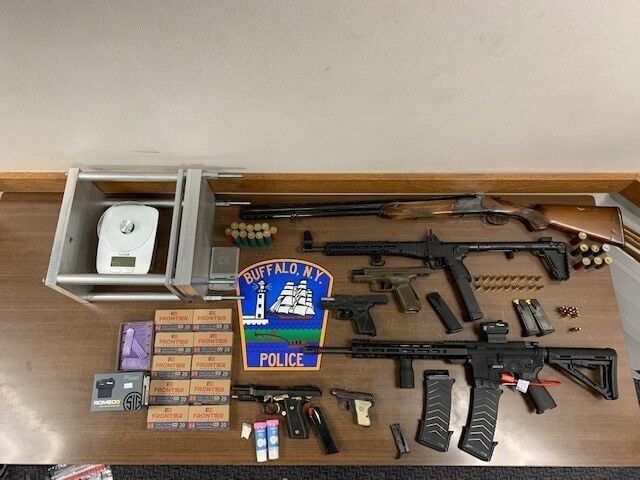
When the group Most Valuable Parents and its coalition partners march against gun violence on Saturday, they will do so against a backdrop of skyrocketing gunfire in Buffalo this year, with the number of people shot up 54% compared to the annual average over the past decade.
In marching from East Ferry Street and Fillmore Avenue to Martin Luther King Jr. Park at 2 p.m., they also will do so in a heavily African American neighborhood. The locale highlights the fact that Blacks in Buffalo are the vast majority of those who both pull the triggers and get hit by the bullets – despite having no gun factories anywhere around.
That’s why the march’s focus is the federal Tiahrt Amendments, named for the former Kansas congressman who sponsored them. Though somewhat loosened over time, those provisions still prohibit the federal Bureau of Alcohol, Tobacco, Firearms and Explosives from giving the public – including cities, states, researchers and litigants – access to the gun trace data it collects.
People are also reading…
In the words of one bill that would repeal the amendments, the provisions “hamstring law enforcement’s ability to solve and prosecute gun crimes, stop illegal gun trafficking and hold negligent gun dealers and owners accountable.”
Erie County District Attorney John Flynn shares the statistics on the rising number of shootings and homicides in the past two years.
While the amendments are federal, not local provisions, march organizers say they already have been talking with Rep. Brian Higgins, D-Buffalo, who has been receptive. They also say that local activism can help build national momentum to eliminate the restrictions on sharing data so that more Americans know what’s going on.
“The thing we can do is just keep bringing awareness to the public” so that constituents elsewhere can press their own members of Congress to get behind the effort, said Mia Ayers-Goss, MVP executive director.
Ayers-Goss, who’s had two children wounded by gunfire, predicted the impact of repealing the amendments would be “huge” because it would provide policymakers with information they lack now, such as where illegal guns are coming from. That’s the first step in figuring out how to stop guns from getting into the hands of people those on all sides of the gun debate agree should not have them.
Notably – and before I could even ask her – Ayers-Goss emphasized that the group is “absolutely not” anti-gun.
“We’re not against guns in general. If you are an upstanding citizen, that’s your right,” she said, noting that the majority of legal gun owners are not the ones committing crimes. “We are OK with people having guns that are legal.”
That’s significant, because the carnage from illegal firearms in Black neighborhoods today is at odds with the long – but little known – legacy of African American gun ownership. In fact, one of the ironies of today’s debate over firearms is that throughout U.S. history, the gun often has been among Blacks’ best friends.
In his exhaustively researched 2014 book “Negroes and the Gun: The Black Tradition of Arms,” Fordham University law professor Nicholas Johnson documents incidents of escaped slaves using guns to fend off would-be captors.
Similarly, Blacks who helped the Union Army kept their guns – as well as the Southern land some of them had worked while enslaved. When one former landowner tried to hire them back as paid laborers, they had other ideas, which he quickly acceded to. The former slave holder’s change of attitude was attributed less to a change of heart than to the fact that, as one newly freed Black man put it, “ ’cause I had so much ammunition on me.”
Johnson notes that passage of the 14th Amendment in 1868 giving full citizenship and equal protection of the law to anyone born here – including the formerly enslaved – was an important bulwark against Southern states’ efforts to deny Blacks their Second Amendment rights.
In examples some might view wistfully in light of attacks on voting rights today, Johnson writes that armed Blacks in Texas surrounded election sites in 1875 fearing Democrats – the racist party of that era – would steal ballots or stuff the ballot box.
A few decades later, the scholar W.E.B. Du Bois kept a double-barreled shotgun for protection against white mobs, making the distinction – as did Martin Luther King Jr. – between arming for political violence and arming for self-defense.
King himself applied for a concealed carry permit but was turned down because he could not show “good cause,” Johnson notes, prompting other armed men to protect his home. And the Deacons for Defense and Justice, a group of armed Black men, regularly guarded King’s marches from the periphery while not actually participating so that the events could still be dubbed “nonviolent.”
This tradition of armed self-defense continues today, as the number of Black gun owners spiked by 58% last year, more than in any other racial group, the National Shooting Sports Foundation told CNN.
Much of that increase can be attributed to growing racial tensions. But in a Pew Research Center survey earlier this year, 82% of Blacks cited gun violence as a “very big problem,” far more than any other racial group did. Residents in urban areas – like Buffalo – also were more likely to see it that way. And groups like MVP are fed up.
But gun violence doesn’t affect just the city.
“What’s important is that we work together … it’s not just an inner-city problem, it’s a Buffalo problem,” Ayers-Goss said, noting that it affects the entire region because kids from the suburbs come into the city and can get caught up in the violence as well.
And while mass shootings draw most of the attention, it’s those day-by-day shootings that take the greatest toll and which more access to the ATF data could help cities like Buffalo combat.
The sad reality is that Black criminals preying on their own neighbors have joined white racists as major threats to African American life. And while dealing with the socioeconomic conditions that push some kids into crime is certainly necessary, that has to be accompanied by efforts to keep out illegal guns in the first place.
Yes, as gun rights proponents like to point out, a gun is just a tool, and can be used for good or evil. But you can’t nail if you don’t have a hammer. Sure, you can try to use the flat side of the pliers or the head of the screwdriver, but you won’t be nearly as effective.
Stem the flow of illegal guns, and criminals won’t be as effective, either.
And while gun rights advocates are suspicious of anything that hints of more restrictions – and rightly so, given ludicrous laws like New York’s SAFE Act – they also don’t want guns in the hands of those who should not have them.
But if we mean it when we say that, and want to have more credibility than gun control extremists who claim to want only “common sense” restrictions but never met a law they didn’t like, we can’t become their mirror images. Gun rights advocates can’t find a reason to oppose every new initiative, especially those that gather data to help stem the flow of illegal guns, which no law-abiding gun owner can be in favor of. This is a movement everyone should get behind.
In addition to focusing attention on the handcuffs imposed by the Tiahrt Amendments, Saturday’s march also is a tribute to Neal Dobbins, the MVP founder who died earlier this year and who lost a son to gun violence. In addition to his many other community efforts, Dobbins was a vocal advocate of doing away with the amendments.
It’s no coincidence that the event honoring him and targeting those amendments is being held on Sept. 25.
That is National Day of Remembrance for Murder Victims.


